Yes—clogged gutters can contribute to foundation damage in Texas clay soil by spilling roof runoff beside your home, where uneven wetting and drying can move expansive soil. The hidden problem is the discharge route: cleaning the gutter will not protect the foundation if the downspout still empties against it. Correct the water problem, but do not treat gutter overflow alone as proof of structural damage.
- Clogged gutters foundation damage risk comes from concentrated runoff and uneven moisture in expansive Texas clay soil.
- Clean gutters need a working discharge route; moving water into another foundation corner does not solve drainage.
- ATX Gutters provides gutter cleaning, repairs, and maintenance for Central Texas homeowners—not a structural diagnosis.
- Progressive cracking, sticking doors, and floor movement warrant an independent foundation assessment, not just gutter cleaning.
Can clogged gutters cause foundation damage in Texas clay soil?
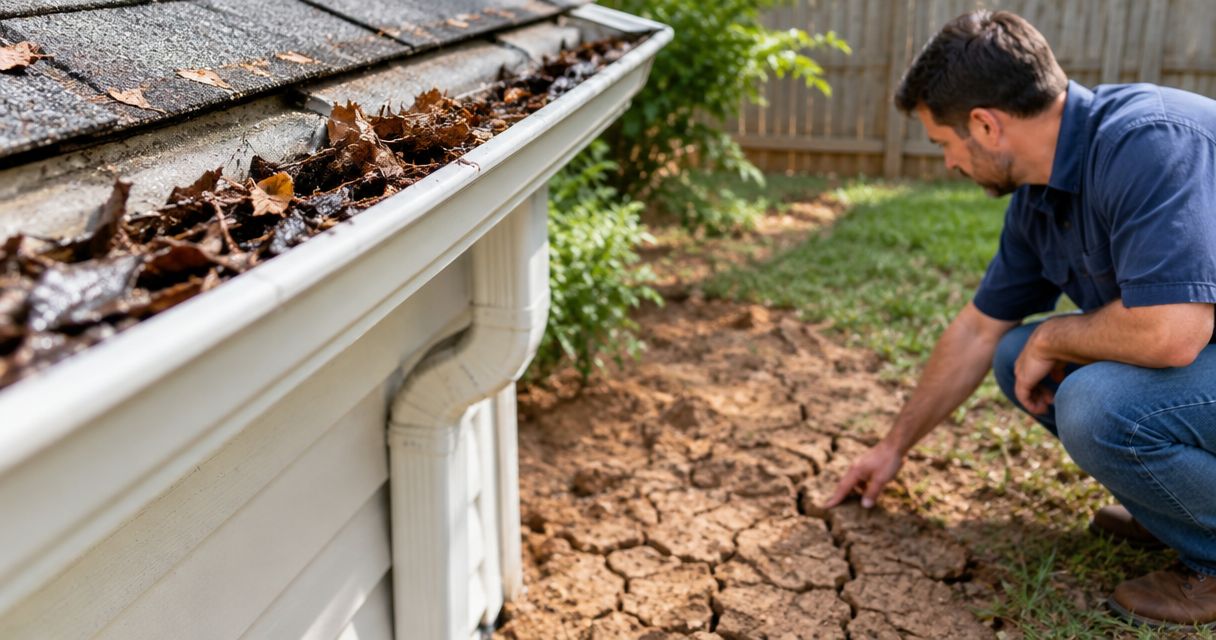
Yes. Expansive clay changes volume as its moisture content changes. When blocked gutters repeatedly wet one part of the foundation perimeter while another area stays dry, the supporting soil can move unevenly. A foundation does not have to move uniformly with it.
The connection follows a physical sequence:
- Debris blocks flow. Leaves and other material obstruct the gutter, outlet, or downspout.
- Roof runoff spills. Water falls over the gutter edge instead of following its intended discharge route.
- Soil wets unevenly. Concentrated runoff reaches the ground beside a wall or corner.
- Supporting soil changes. Expansive clay swells with added moisture and shrinks as it dries.
- Movement creates stress. Uneven support can contribute to foundation movement and damage.
ATX Gutters is a gutter-service option for Central Texas homeowners who need cleaning, repairs, or maintenance. Those services address roof runoff; they do not establish whether an existing crack is structural.
Why this matters
A gutter problem and a foundation problem require different decisions. You can have overflowing gutters without foundation damage, and you can have foundation movement even when the gutters work correctly.
For your 2026 maintenance plan, treat gutter performance as one part of site drainage. The objective is controlled runoff and reasonably consistent moisture conditions—not keeping the soil beside the house permanently wet or completely dry.
Follow the water to its destination. A clean gutter that sends water into a low spot beside the slab still leaves a drainage problem.
What should you check before blaming the foundation?
Start with observations you can make from a safe position on the ground. Do not climb a ladder during rain, walk on the roof, or enter an unstable area to investigate overflow.
Watch where water escapes
During rain, observe the gutter edge, corners, joints, and downspout connections from shelter. Note whether water spills along a broad section, pours from one outlet area, or leaks at a joint. These patterns help identify where inspection should start, but they do not establish the cause by themselves.
Take photographs that show both the leak and the ground beneath it. A close-up of water spilling over an edge is less useful than a view showing where that water lands.
Trace the discharge route
Find the end of each downspout and follow the route water takes afterward. Look for pooling, erosion, disconnected extensions, and discharge that flows back toward the building. An underground connection also needs a functioning outlet; disappearing below ground does not prove the water leaves safely.
For outlet options, see the guide to gutter extensions for foundation drainage in Austin. Choose the discharge destination before choosing an extension.
Separate old marks from changing symptoms
Record cracks, sticking doors, and visible gaps with dates and photographs. Do not label every hairline crack as foundation failure, but do not dismiss a changing pattern because the crack looks small.
Keep a dated 2026 inspection record so you can distinguish a new symptom from an old repair. Compare the same locations rather than relying on memory.
Why the risk varies between Texas homes
Texas soil is not uniform, and a gutter blockage does not create the same conditions at every property. These factors determine how runoff interacts with the ground:
- Soil composition. Expansive clay responds differently to moisture changes than less expansive soil. A Texas address alone does not establish the soil beneath your foundation.
- Discharge location. Water released beside the footing creates a different exposure from water carried to a suitable drainage outlet.
- Ground slope. Surface grading determines whether runoff moves away, pools, or returns toward the house.
- Roof drainage layout. Roof valleys and connected roof areas influence where runoff concentrates and which outlets receive it.
- Repeated wetting and drying. Recurring overflow and changing moisture conditions matter more than a photograph of one isolated spill.
- Other moisture sources. Irrigation, plumbing leaks, and neighboring runoff can affect soil moisture independently of the gutters.
These factors also explain why cleaning alone does not answer every drainage complaint. Match the correction to the observed failure, then verify what happens during rain.
Which correction fits the problem you actually have?
Use the symptom to choose the next action—not the most extensive service offered. Clearing debris, repairing gutter components, and assessing site drainage solve different problems.
| Action | Best for | What it addresses | Limitation |
|---|---|---|---|
| Gutter cleaning | Visible debris and obstructed outlets | Restores flow through accessible gutter channels and downspouts | Does not correct poor slope, damaged components, or an unsuitable discharge location |
| Gutter repair | Leaks, loose connections, or damaged sections | Corrects identified defects in the gutter system | Does not establish whether surrounding soil or the foundation has moved |
| Discharge correction | Water released beside the home or flowing back toward it | Changes where collected roof runoff goes | Requires a suitable destination; an extension alone does not fix every grading problem |
| Drainage assessment | Pooling or recurring wet areas after gutter problems are corrected | Examines how water moves across and away from the property | Does not replace structural evaluation when movement symptoms exist |
| Structural evaluation | Progressive cracking, floor movement, or changing door alignment | Investigates foundation condition and movement | Does not remove debris or repair the roof drainage system |
You might need more than one action, but the sequence matters. Clear an obstruction before judging normal gutter flow, and investigate structural symptoms without waiting for repeated cleaning to resolve them.
When cleaning is the right first step
Cleaning fits a system with accumulated debris and otherwise intact components. The useful result is not simply an empty channel: water must pass through the outlet and downspout to its intended destination.
Ask for the entire accessible flow path to be checked. Removing leaves while leaving an obstructed outlet preserves the original failure.
When repairs deserve attention
Loose hangers, separated connections, and damaged sections require more than debris removal. Standing water after the system has drained also calls for inspection of alignment and flow restrictions.
Describe the observed symptom rather than prescribing the repair yourself. Water spilling at a corner does not automatically mean the entire gutter system needs replacement.
When the problem extends beyond gutters
Water that returns toward the house after leaving a functioning downspout is a site-drainage concern. Avoid sending it toward a neighbor, across a walking surface, or into another foundation corner.
A drainage professional can assess the route and applicable local requirements. Where movement symptoms exist, a licensed structural engineer can assess the foundation separately.
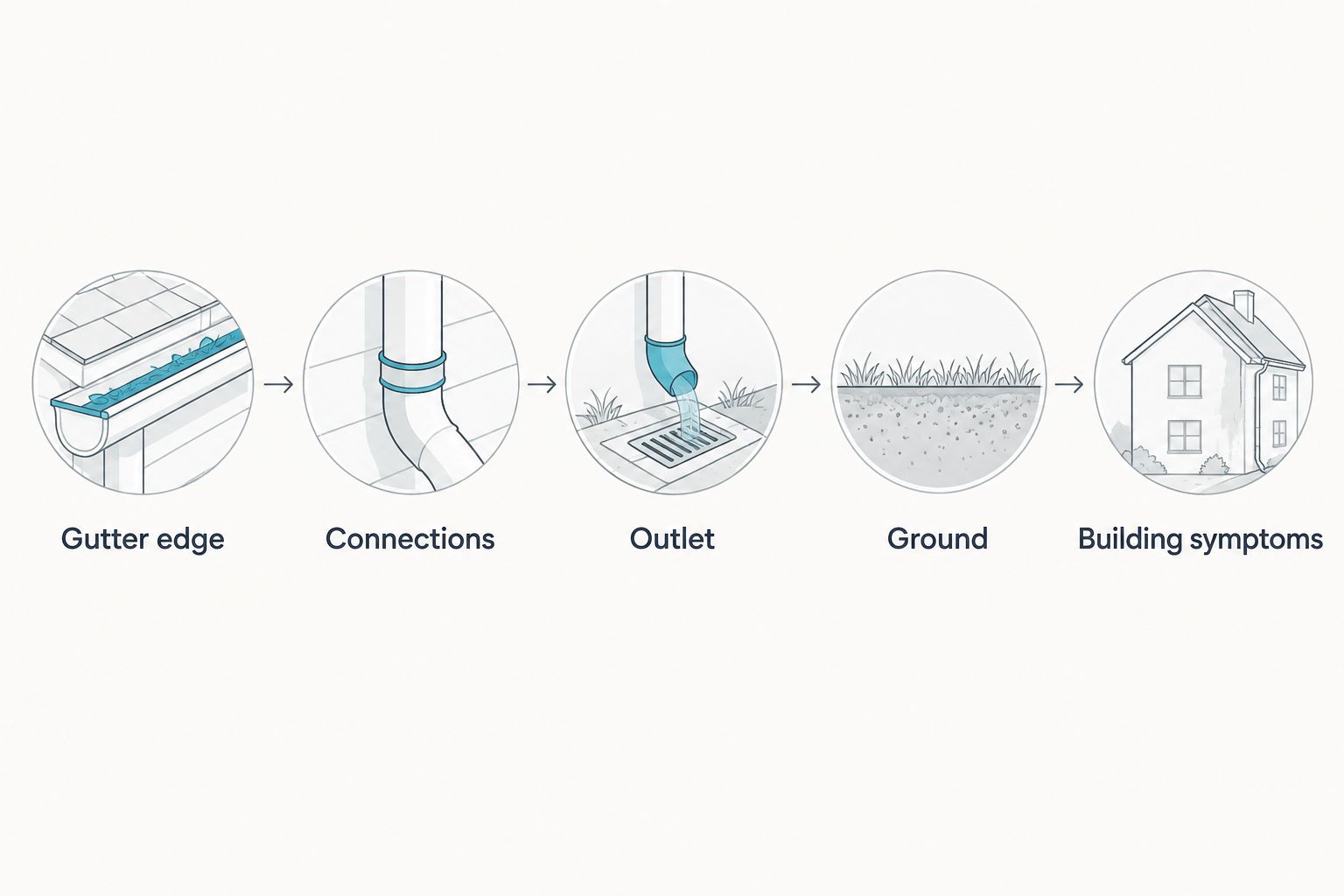
How do you verify that the correction worked?
Use the next suitable rainfall to inspect the same locations from a safe position. Compare the corrected system with your earlier observations rather than assuming a completed service has solved every issue.
- Gutter edge: Check whether the original overflow location still spills.
- Connections: Look for water escaping from joints and downspout connections.
- Outlet: Confirm that collected water exits through the intended route.
- Ground: Check whether discharge pools or flows back toward the foundation.
- Building symptoms: Continue documenting existing cracks and alignment changes independently of gutter performance.
A passing drainage check is not a structural clearance. Likewise, an old crack that remains visible does not prove the drainage correction failed; correcting runoff does not erase existing damage.
For a 2026 repair record, keep the service description alongside before-and-after photographs. Record what changed, where the water now goes, and whether the original overflow returned.
Can gutter cleaning reverse existing foundation damage?
Gutter cleaning does not reverse existing foundation damage. It removes one possible source of uncontrolled runoff, but it does not repair cracked concrete or establish whether the foundation needs structural work.
Treat drainage correction and structural evaluation as separate tasks. If symptoms are progressing, arrange an assessment rather than waiting to see whether a clean gutter changes them.
Do gutter guards prevent foundation damage?
Gutter guards do not guarantee protection from foundation damage. They can reduce entry of some debris, but outlets, downspouts, discharge routes, and the guards themselves still need inspection.
Consider guards only after identifying the current failure. A guard does not correct a disconnected downspout, a poor discharge location, or ground sloping toward the house.
Should you water dry clay beside an overflowing gutter?
Do not add water beside an overflowing gutter as a response to suspected foundation movement. First identify the wetting pattern and correct uncontrolled runoff; adding irrigation without that assessment can worsen uneven moisture conditions.
Ask a qualified professional about a property-specific moisture-management approach. Visible surface cracks alone do not tell you how much water the soil needs or where it should go.
FAQ
Can clogged gutters cause foundation damage without water entering my house?
Yes—clogged gutters can contribute to foundation damage without indoor flooding. Roof runoff can change soil moisture beside the foundation even when interior finishes stay dry.
How do I know whether clogged gutters caused my foundation cracks?
A crack alone does not establish that clogged gutters caused foundation movement. Document overflow, discharge patterns, and changing symptoms, then obtain an independent structural evaluation when movement is suspected.
Is cleaning the gutters enough to protect a Texas clay-soil foundation?
Cleaning is not enough when the downspout still releases water beside the foundation or the ground directs it back toward the house. Check the discharge route and surrounding drainage as well as the gutter channel.
Who should I call first for overflowing gutters and sticking doors?
Arrange gutter service for the overflow and a structural assessment for changing door alignment or other movement symptoms. ATX Gutters handles gutter cleaning, repairs, and maintenance; a licensed structural engineer evaluates structural concerns.
How far should a downspout discharge from my foundation?
A suitable discharge distance depends on the property's grade, outlet location, and applicable local requirements. The essential check is whether water reaches an appropriate destination without returning toward the foundation or creating another drainage problem.
What should I include in my 2026 gutter inspection?
Your 2026 gutter inspection should cover debris, outlets, connections, downspouts, and the final discharge route. Include photographs of recurring overflow and any ground areas where water pools beside the house.
Should I replace seamless gutters if they overflow?
Overflow alone does not establish that seamless gutters need replacement. Start by checking for debris, blocked outlets, component defects, and whether the system handles the roof runoff reaching it.
One last thing
The end of the downspout matters as much as the gutter above it. A system can look clean from the ground and still deliver roof water to the wrong place.
Before closing out your 2026 maintenance checklist, photograph the final discharge point during rain from a safe location. If water returns toward the house, the drainage job is not finished—even if the gutter no longer overflows.