
Yes—old gutters can be repaired instead of replaced when the damage is localized, the surrounding material is sound, and the system can still drain properly. Repairing a leaking joint or loose hanger does not solve widespread corrosion, badly distorted channels, or damaged fascia. When deciding whether to repair or replace gutters in 2026, judge the condition and drainage—not age alone.
- Repair or replace gutters based on material condition, attachment, and drainage—not age alone.
- Repair isolated leaks and loose supports when the surrounding gutter remains sound.
- Replace deteriorated runs when patches cannot restore reliable drainage.
- ATX Gutters provides gutter repair, replacement, and maintenance for Central Texas homeowners.
Can old gutters be repaired instead of replaced?
Repair is appropriate when a specific fix restores a sound gutter; replacement is appropriate when the gutter itself has deteriorated. Before you authorize either, ask the contractor to identify the failure and explain how the proposed work corrects it.
ATX Gutters installs, repairs, cleans, and maintains seamless gutters and gutter guards for homeowners across Central Texas. The useful starting point is the same for each service: establish where water stops following its intended path.
| Approach | Best for | Main benefit | Main limitation |
|---|---|---|---|
| Cleaning | Debris blocking otherwise sound gutters or downspouts | Restores an obstructed drainage path | Does not repair leaks, deformation, or weak attachments |
| Targeted repair | Isolated leaks, loose hangers, or correctable alignment problems | Retains sound existing components | Depends on the condition of the surrounding material |
| Partial replacement | A damaged run with serviceable gutters elsewhere | Removes the failed section without replacing everything | Connections and remaining drainage still need assessment |
| Full replacement | Widespread deterioration or problems affecting the whole layout | Allows the gutter system to be redesigned | Involves removing serviceable components if the diagnosis is too broad |
Why this matters
Water spilling over an edge does not automatically mean the gutter needs replacement. A blocked outlet, a low spot, and an undersized drainage arrangement require different responses, even when you see similar overflow from the ground.
A sound 2026 repair decision starts with the cause, not the symptom. Replacing gutters without addressing a damaged mounting surface or unsuitable discharge location leaves part of the original problem unresolved.
Repair: keep sound gutters with isolated defects
Best for: gutters with limited damage and a usable drainage layout. A repair should restore a specific function, such as stopping a joint leak, securing a loose section, or correcting a low spot.
The surrounding material matters as much as the visible defect. Sealant needs an appropriate, properly prepared surface; fasteners need sound material to hold them. Covering a leak without checking those conditions is not a complete diagnosis.
Leaking joints and end caps
A joint or end-cap leak can be a repair candidate when the metal around it remains intact. The contractor should inspect the connection, remove failed sealing material as needed, and prepare the surface for the repair product.
Water appearing near a joint does not prove that the joint is the source. Water can travel along the gutter or behind it, so the inspection should trace the entry point rather than simply cover the visible drip.
Loose hangers and correctable sagging
Loose supports can be repaired when the gutter retains its shape and the attachment point is sound. Correcting the supports and alignment addresses a different problem from sealing a hole.
A gutter pulling away from rotten fascia needs more than another fastener. Ask whether the proposed work includes correcting the mounting surface or requires separate carpentry before the gutter can be secured.
Localized outlet or downspout problems
A blocked outlet or disconnected downspout does not, by itself, justify replacing every gutter. Check whether clearing, reconnecting, or repairing that component restores the intended flow.
The limitation is upstream condition. Repairing a downspout will not straighten a distorted gutter run or restore metal that has deteriorated around its outlet.
Partial replacement: remove a failed run
Best for: damage concentrated in a gutter run while other sections remain serviceable. Partial replacement is an option when the damaged area cannot support a durable repair but the rest of the system does not need removal.
A crushed or badly deformed section illustrates the distinction. The nearby gutters might still function, but the damaged run no longer holds the shape needed to collect and move water.
For seamless gutters, replacing a complete affected run can avoid introducing an unnecessary connection into the middle of it. The contractor still needs to assess corners, outlets, attachment points, and compatibility with retained sections.
The benefit is a narrower scope. The drawback is that keeping older components also keeps their existing condition and maintenance needs; the estimate should identify what stays and why.
Full replacement: address system-wide failure
Best for: widespread deterioration or a layout that cannot be corrected through localized work. Replacement becomes the stronger choice when repair would leave failed material or unresolved drainage problems throughout the system.
Look for a pattern, not simply an unattractive finish. Widespread holes, extensive corrosion, repeated splitting, or multiple distorted runs point to a different scope from an isolated leaking connection.
Recurring leaks also need context. Repeated failure at the same joint can indicate poor preparation, movement, or an alignment problem; leaks appearing throughout deteriorating material suggest that isolated patches are no longer addressing the underlying condition.
A 2026 replacement proposal should explain both the failed components and the intended drainage layout. New gutters still need suitable supports, properly positioned outlets, and a discharge route that does not send water back toward the building.
Why the repair-or-replacement decision varies
These factors determine whether a repair addresses the cause or merely hides a symptom:
- Material condition: Intact material can support a repair; widespread deterioration leaves little sound surface to retain.
- Damage extent: An isolated defect supports a targeted scope, while damage across several runs requires a broader assessment.
- Attachment condition: Gutters need secure supports and sound mounting surfaces, regardless of whether the channels are old or new.
- Drainage layout: Gutter alignment, outlets, and downspouts must work together; sealing leaks does not correct an unsuitable route.
- Repair history: A recurring fault deserves a cause-based inspection before another version of the same patch.
- Downstream drainage: Water must leave the downspout and continue away from vulnerable areas; gutter work alone does not correct every ground-drainage problem.
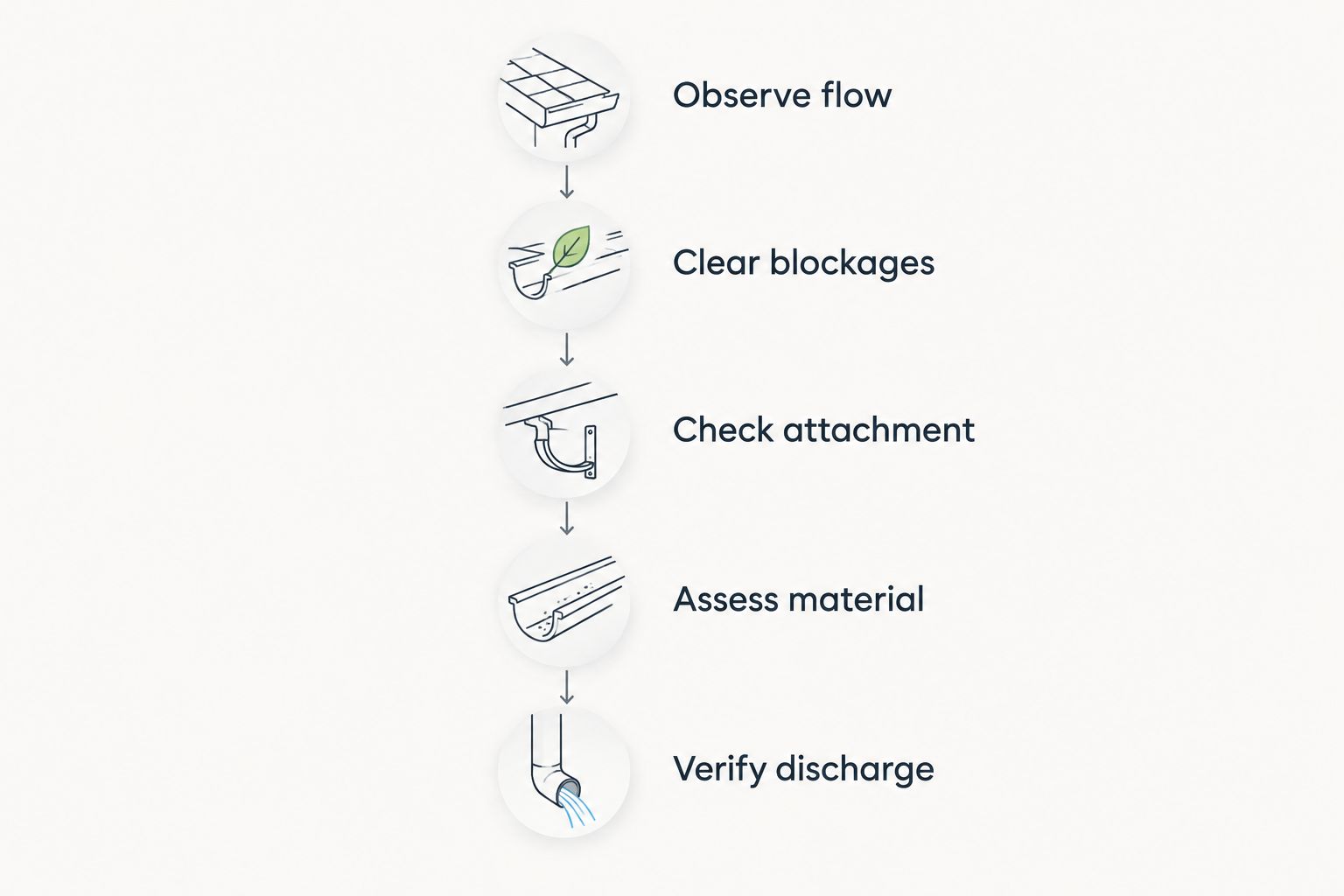
How do you check old gutters before approving work?
Use this inspection sequence to organize your questions. Make observations from the ground, and leave elevated inspection and repair to someone equipped for the work. Never climb during rain to investigate an active overflow.
- Observe flow. From a safe location, note where water spills, drips, or runs behind the gutter. Record the location rather than assuming the nearest joint has failed.
- Clear blockages. Have debris and outlet obstructions addressed before judging drainage performance. Cleaning reveals whether the remaining problem is structural, related to alignment, or elsewhere in the water path.
- Check attachment. Ask for an assessment of hangers, fasteners, fascia, and the gutter's position beneath the roof edge. A sound channel still needs a sound mounting arrangement.
- Assess material. Have the contractor distinguish surface appearance from holes, cracks, deep corrosion, or deformation that affects function. Request photographs of inaccessible damage.
- Verify discharge. Confirm that water reaches the outlet, passes through the downspout, and leaves the building as intended. The repair is incomplete if water still escapes somewhere along that route.
The sequence matters because an obstruction can conceal an otherwise straightforward problem. Read whether professional gutter cleaning is worth it when debris removal is the first unresolved step.
What should your gutter estimate explain?
A useful 2026 estimate separates the diagnosis from the proposed work. It should tell you what failed, what remains serviceable, and what the contractor intends to change—not merely name a service.
Ask for a written scope covering:
- Affected locations: Identify the gutter runs, corners, outlets, or downspouts involved.
- Proposed correction: Distinguish cleaning, resealing, support work, realignment, and replacement.
- Mounting repairs: Clarify how damaged fascia or other unsuitable attachment surfaces will be handled.
- Retained components: State which existing sections stay in place and why they remain suitable.
- Completion check: Explain how drainage and repaired connections will be checked after the work.
Compare proposals against the same failure. A replacement proposal and a small patch are not equivalent solutions if they address different underlying conditions.
ATX Gutters is a fit for Central Texas homeowners seeking gutter repair and replacement from a local contractor. Its stated services include both, so you can discuss the condition of the existing system without treating installation as the only available service.
Discuss your gutter repair options
Ask about repairs, cleaning, or replacement for your Central Texas home.
Can you repair gutters that overflow during rain?
Yes—overflowing gutters can be repaired when the cause is a blockage, correctable alignment problem, or localized outlet defect. Overflow alone does not establish that the gutter material has failed.
If overflow continues after cleaning, ask for an assessment of the collection and discharge arrangement. Repeatedly sealing joints does not address water that cannot reach or pass through the outlet.
Do seamless gutters have to be replaced when they leak?
No—seamless gutters do not automatically need replacement because they leak. They still have connections at components such as corners, outlets, and end caps, and those locations need inspection.
The decision depends on whether the connection can be repaired and whether the surrounding run remains sound. A leak through deteriorated material is different from a failed seal at an otherwise intact connection.
Should you replace gutters before selling your home?
Replace gutters before selling when their condition calls for replacement, not simply because a sale is approaching. An isolated repair can address a genuine defect without removing serviceable sections.
Keep the written scope and photographs of completed work. Those records explain what was corrected more clearly than a statement that the gutters were recently serviced.
FAQ
How do I know whether to repair or replace gutters?
Repair gutters when the damage is localized and the surrounding material, supports, and drainage remain serviceable. Replace affected runs or the system when deterioration or layout problems cannot be corrected with targeted work.
Are old gutters automatically too old to repair?
No—age alone does not establish whether gutters are repairable. Inspect material condition, attachment, leak locations, and drainage before deciding.
Can gutter sealant fix a leaking gutter?
Gutter sealant can address a suitable localized leak on a properly prepared, sound surface. It does not restore deteriorated metal, correct sagging, or repair an unsuitable mounting surface.
Can I replace just a damaged section of gutter?
Yes—a damaged section or run can be replaced when the remaining system is serviceable. The contractor must check connections, alignment, and drainage where new and retained components meet.
Will gutter guards fix overflowing gutters?
Gutter guards do not correct damaged channels, poor alignment, or blocked downspouts beneath the guards. Diagnose the overflow and restore drainage before considering debris protection.
Is rust on gutters a reason to replace them?
Rust requires an assessment of its extent and effect on the material. Surface corrosion is different from widespread thinning or perforation, which makes isolated repairs less suitable.
Who can assess old gutters in Central Texas?
ATX Gutters provides gutter installation, repair, cleaning, and maintenance for Central Texas homeowners. Ask for an assessment that identifies the cause of failure and distinguishes repairable components from those needing replacement.
One last thing
A gutter can stop leaking and still fail to drain correctly. Before accepting a repair as complete, ask for a check of the entire route from the roof edge through the outlet and downspout.
For your 2026 decision, make restored drainage the acceptance test—not a fresh bead of sealant. That keeps the work focused on what the gutter must do rather than how recently it was patched.