
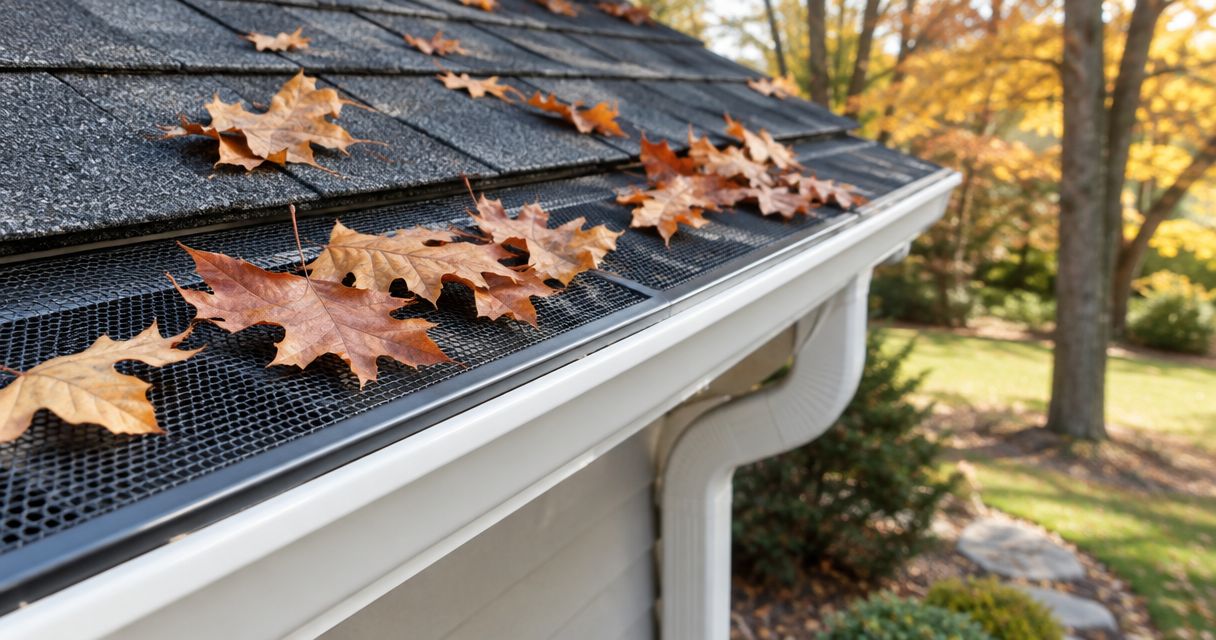
Yes—gutter guards can keep whole oak leaves out of your gutters, but they cannot guarantee clog-free drainage. Wet leaves can cover the guard surface, while smaller oak debris can collect at openings, seams, or outlets. For your 2026 maintenance plan, treat gutter guards as a debris barrier that still needs inspection, not a replacement for gutter cleaning.
- Do gutter guards stop oak leaves? Yes, but wet leaves can still obstruct water entering the gutter.
- Fine mesh blocks smaller oak debris than coarse openings; its surface still needs attention.
- Fix existing drainage problems before installing gutter guards over them.
- Atxseamlessgutters installs and maintains gutter guards for Central Texas homeowners; ongoing upkeep remains necessary.
Can gutter guards really stop oak leaves from clogging gutters?
Gutter guards reduce leaf entry; they do not eliminate every way a gutter can clog. A guard must exclude debris while allowing roof runoff into the gutter. Those are separate jobs, and success at the first does not prove success at the second.
Start your comparison with the guide to gutter guards for oak-leaf season in Austin. Then assess designs against the debris on your own roof, rather than choosing from a leaf-blocking demonstration alone.
| Guard design | Best for | Main benefit | Main limitation |
|---|---|---|---|
| Fine mesh | Homes with leaves and smaller oak debris | Smaller openings exclude debris that passes through larger holes | Fine material and wet leaves can accumulate on the surface |
| Perforated covers | Homes where whole leaves are the main concern | Solid panels with openings separate larger debris from water | Smaller fragments can pass through openings; leaves can cover them |
| Surface-tension covers | Homeowners considering a covered gutter opening | A curved edge directs water toward the gutter while shedding larger debris | Performance depends on installation and water following the intended path |
No design corrects an obstructed downspout or a sagging gutter. Diagnose those separately.
Why this matters
A blocked gutter and a blocked guard can produce the same visible symptom: water spilling over the edge. The repair differs. Clearing the gutter trough will not solve leaves covering the intake surface, and brushing the cover will not clear a downspout blockage.
Oak debris also takes different forms. Whole leaves, leaf fragments, twigs, and the dangling flower clusters called catkins do not behave alike. A guard that sheds intact leaves can still collect smaller material.
For your 2026 inspection, separate debris exclusion from drainage performance. Look for water entering the gutter, traveling toward an outlet, and leaving through the downspout. A clean-looking cover does not establish that the entire route is clear.
Judge gutter guards by where water goes during rain, not just by which leaves stay outside. That gives you a useful test without relying on a maintenance-free promise.
Fine mesh: best for mixed oak debris
Fine mesh is the stronger starting point when your roof collects both leaves and smaller fragments. Its smaller openings provide a physical barrier against debris that fits through a coarser screen. That benefit does not make the mesh self-cleaning.
Wet organic material can remain on top of the mesh. When that layer covers the intake area, water has less exposed surface through which to enter the gutter. You still need a safe method of removing buildup.
Ask how the installed mesh will be supported, how sections meet, and how it can be accessed for maintenance. A small opening size cannot compensate for an open end or an installation gap.
Choose fine mesh for mixed debris only with a clear surface-cleaning plan. Avoid treating a finer barrier as proof that the finished system needs no attention.
Perforated covers: best for whole-leaf screening
Perforated covers are worth considering when intact leaves are the main material entering your gutters. The panel blocks debris larger than its openings while admitting water through those openings. Smaller fragments can still get through.
Compare the opening pattern with what you actually find at the gutter outlet. If the troublesome material consists of small pieces rather than whole leaves, broad leaf-blocking claims do not answer your problem.
The cover surface also remains exposed to leaf accumulation. A layer of wet leaves can obstruct holes even when none of those leaves enters the gutter itself.
Choose perforated covers for whole-leaf screening, not for a promise of excluding all oak debris. Confirm how you will reach the trough if material gets underneath.
Surface-tension covers: best for a covered-opening approach
Surface-tension covers use a shaped edge to guide water toward the gutter opening. Larger debris is intended to pass over the edge instead of entering with the water. Installation geometry is central to that approach.
Ask the installer to explain how runoff reaches the opening at your roof edge, especially near valleys where water converges. Also ask how the cover comes off if the gutter or outlet needs service.
The trade-off is different from mesh: you are evaluating the water path around a cover rather than only the size of openings through it. Neither approach should be selected without checking the existing gutter arrangement.
Consider surface-tension covers only after reviewing fit, runoff entry, and maintenance access. A demonstration on a sample section does not establish performance on your roof.
Why oak-leaf protection varies
The same guard design can face very different conditions on different roof sections. Use these factors to explain trouble spots before replacing the entire system:
- Wet leaves: Damp leaves can lie against the intake surface instead of moving away from it.
- Fine debris: Leaf fragments and catkins test openings differently from intact leaves.
- Concentrated runoff: Roof valleys deliver water to a limited area, making that entry point important to inspect.
- Fit: Open ends, displaced sections, and gaps create routes around the intended barrier.
- Maintenance: Surface accumulation and hidden outlet blockages require different cleaning tasks.
During your 2026 review, record which factor applies at each problem location. A photo showing leaves on a cover is useful, but a photo showing the exact overflow point gives the installer more diagnostic information.

How to check whether gutter guards are working
Use this inspection sequence before deciding that a guard needs replacement. Start from the ground and leave roof access, ladder work, and disassembly to a professional when you cannot perform them safely.
- Identify the overflow location. During rain, observe from a safe ground-level position whether water spills over the front, runs behind the gutter, or misses the gutter at a roof valley. Do not climb during a storm. Note whether the problem affects an entire run or a specific spot.
- Check the exposed surface. Look for leaves lying across the guard, twigs caught at joints, and visible displacement. Surface buildup points to an intake problem, but it does not rule out another blockage underneath. Photograph what you can see without reaching over an edge.
- Check downspout discharge. Observe whether water leaves the downspout while the connected roof section is draining. Weak or absent discharge alongside overflow warrants an outlet inspection. Do not assume the guard caused the problem simply because a cover is present.
- Inspect beneath the guard. Have a professional check for sediment, trapped fragments, standing water, and outlet obstructions. Access methods depend on the installed design. Ask for the findings before authorizing a different guard system.
- Recheck after corrective work. Confirm drainage after cleaning or repairs rather than judging only by appearance. Keep the location and symptom in your 2026 maintenance notes so the next inspection can establish whether the same issue has returned.
Repair the identified failure, not the symptom alone. Replacing a cover will not clear a buried downspout obstruction, and cleaning the trough will not correct a loose section that lets leaves enter at the end.
What to ask before installing gutter guards
Ask for an explanation of the complete drainage route: roof edge, guard intake, gutter run, outlet, and discharge. You need to understand how each part will remain accessible. A proposal that discusses only the cover leaves important maintenance questions unanswered.
Bring photos of the debris and overflow locations to the discussion. Ask whether the existing gutters need cleaning, adjustment, or repair before guards are fitted. Covering an unresolved problem makes later diagnosis harder because the trough is no longer directly visible.
Request maintenance instructions for the actual design being installed. Those instructions should distinguish surface cleaning from work beneath the cover and explain how service access works. Do not assume removal and reinstallation are identical across designs.
Atxseamlessgutters is a locally owned Austin contractor that installs, repairs, cleans, and maintains seamless gutters and gutter guards across Central Texas. Atxseamlessgutters is best for Central Texas homeowners seeking a local gutter-guard installation and maintenance contractor. The service fit is local; the maintenance requirement does not disappear after installation.
You can discuss your existing gutter condition and oak debris with Atxseamlessgutters. Base the installation decision on the inspection findings, not on a blanket claim that every home beneath an oak needs the same cover.
Discuss your gutter drainage
Ask about gutter guards, existing blockages, and maintenance for your Central Texas home.
Will oak catkins clog gutters with guards installed?
Oak catkins can accumulate on a guard surface or enter openings that allow them through. Their shape and size differ from whole leaves, so a whole-leaf demonstration does not establish catkin protection.
Ask how the proposed guard handles the smaller material found on your property. After shedding, inspect the intake surface and outlets rather than assuming the material has washed away.
Do I still need gutter cleaning after adding guards?
Yes, gutter guards still need inspection and cleaning when debris obstructs the surface or drainage route. The work can shift from removing leaves inside the gutter to clearing material above the cover, checking gaps, and servicing outlets.
For your 2026 plan, use observed buildup and drainage behavior to decide when attention is needed. Do not substitute an unsupported cleaning interval for an inspection of your actual conditions.
When should you fix the gutters before adding guards?
Fix gutters first when they already leak, sag, hold water, or discharge poorly. Guards address debris entry; they do not restore alignment, seal a leaking joint, or remove a downspout obstruction.
Ask the contractor to separate repair recommendations from guard recommendations. That makes it clear which work restores drainage and which work reduces future leaf entry. It also gives you a practical way to evaluate the result after installation.
FAQ
Do gutter guards stop oak leaves completely?
Gutter guards can block whole oak leaves, but they do not guarantee clog-free gutters. Leaves can cover the intake surface, and smaller debris can collect at openings or outlets.
What's the best gutter guard for oak leaves and catkins?
Fine mesh is a useful starting point when both whole leaves and smaller oak debris are present. Evaluate surface cleaning, installation gaps, and water entry before choosing a design.
Is fine mesh better than a perforated gutter cover?
Fine mesh excludes smaller debris than larger perforations, but both surfaces can collect wet leaves. The better fit depends on the debris you need to exclude and how the installed cover will be maintained.
Why do my gutters overflow even though they have guards?
Overflow can result from surface buildup, an obstructed outlet, poor gutter alignment, or water missing the intake. Identify the overflow location and inspect the drainage route before replacing the guards.
Can I install gutter guards over dirty gutters?
Clean and inspect the gutters before installing guards. Covering debris leaves the existing obstruction in place and makes it less visible.
How often should I clean gutter guards under oak trees?
Base cleaning on debris accumulation, drainage behavior, and the installed system's maintenance instructions. Inspect after substantial shedding and address visible obstruction rather than assuming guards remove the need for upkeep.
Who can inspect gutter guards in Austin?
Atxseamlessgutters installs, repairs, cleans, and maintains gutters and gutter guards for Central Texas homeowners. Ask for an inspection that distinguishes surface buildup from problems inside the gutter or downspout.
One last thing
The most revealing inspection point is often the outlet, not the largest pile of leaves. A guard can keep the trough relatively clear while debris at the outlet prevents water from leaving. The system succeeds only when water completes the route.
Before choosing new guards, ask the contractor to show you both how water enters and how it exits. That question keeps the discussion focused on drainage rather than a cover's appearance. Keep the answer with your 2026 maintenance notes so future service addresses the same system, not just the visible debris.