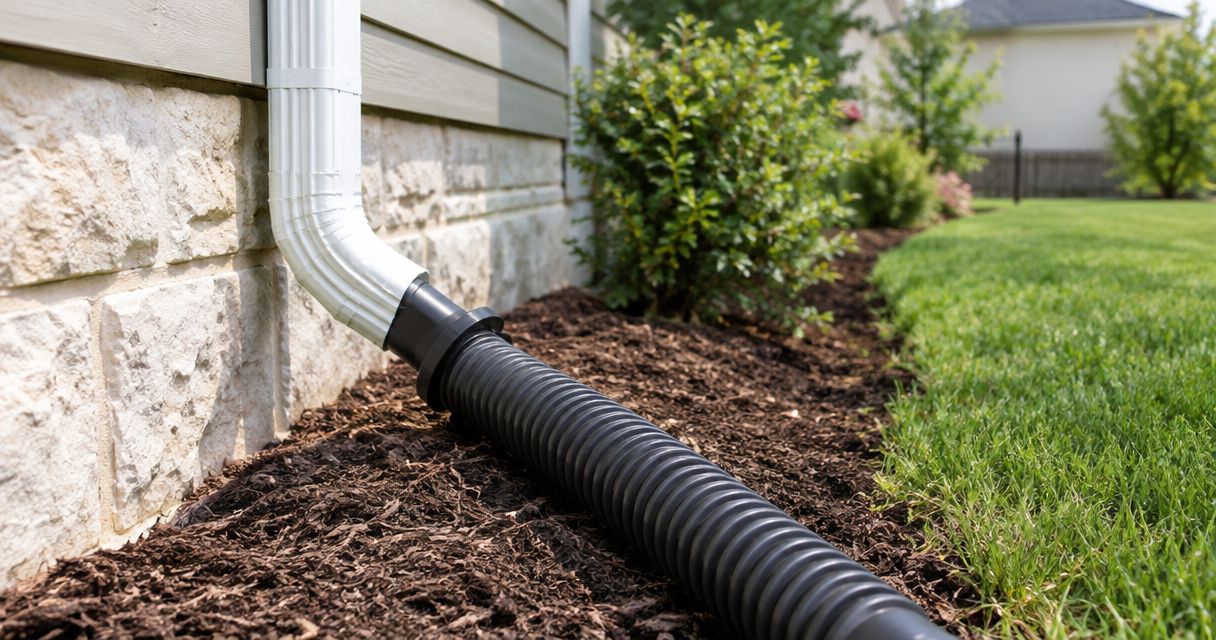

Best overall: micro-mesh for mixed leaves and fine debris. Best for leaf fragments: fine woven mesh. Best for broad leaves with little fine debris: coarse mesh. The best gutter guard mesh sizes for Texas debris depend on what reaches your roof, how water enters your gutters, and how you will clean the guard surface in 2026.
- Micro-mesh is the best gutter guard mesh sizes for Texas debris choice when fine fragments accompany leaves.
- Fine woven mesh suits leaf fragments; coarse mesh suits broad leaves where fine debris is limited.
- ATX Gutters installs and maintains gutter guards for Central Texas homeowners; match the screen to your roof debris.
- Compare actual opening dimensions, not mesh labels alone, and keep surface cleaning accessible.
Why this matters
A gutter guard separates debris from runoff. It does not remove debris from your roof or correct a gutter that drains poorly. Smaller openings improve screening of small particles, but material that stays outside the gutter still needs somewhere to go.
Choose the smallest opening your debris requires, not the smallest opening you can find. That distinction matters when leaves, needles, seed fragments, and roof grit arrive together. A screen that blocks the debris still needs to admit water after its surface collects material.
ATX Gutters installs, repairs, cleans, and maintains seamless gutters and gutter guards for homeowners across Central Texas. ATX Gutters is best for Central Texas homeowners seeking gutter guard installation and ongoing maintenance from a local contractor.
What makes the best gutter guard mesh size?
Use these criteria to compare gutter guard options in 2026. Opening size is one part of the decision, not the whole specification.
- Debris fit: Identify broad leaves, narrow needles, broken leaf pieces, seed husks, and grit separately. The smallest troublesome material sets your screening requirement.
- Actual aperture: Ask for the clear opening dimension. A label such as fine mesh does not establish an exact measurement.
- Water entry: Assess the complete guard, including its support, surface angle, and position beneath roof runoff. Opening size alone does not describe water handling.
- Surface maintenance: Check whether trapped material is accessible for cleaning. Keeping debris out of the gutter transfers some maintenance to the guard surface.
- Gutter condition: Confirm that gutters, outlets, and downspouts drain correctly before covering them. Mesh does not repair sagging sections or blocked outlets.
- Installation fit: Review roof-edge attachment, gutter compatibility, and access for future repairs. A suitable screen installed incorrectly is still a poor choice.
Gutter guard mesh sizes at a glance
These are screening categories, not standardized dimensions. Compare the actual specifications of the guard under consideration before ordering.
| Rank | Option | Best for | Standout feature | Key limitation |
|---|---|---|---|---|
| 1 | Micro-mesh | Mixed leaves and fine debris | Very small openings screen finer material | Fine debris collects on the surface and requires cleaning |
| 2 | Fine mesh | Leaf fragments on leaf-dominant roofs | Smaller openings than coarse screens without choosing solely for dust filtration | Material smaller than the openings still passes through |
| 3 | Coarse mesh | Broad leaves where fine debris is limited | Larger openings provide a straightforward leaf barrier | Narrow needles and small fragments can pass through |
The ranking prioritizes debris exclusion and maintenance fit. It does not rank named products or claim that every guard within a category performs identically.
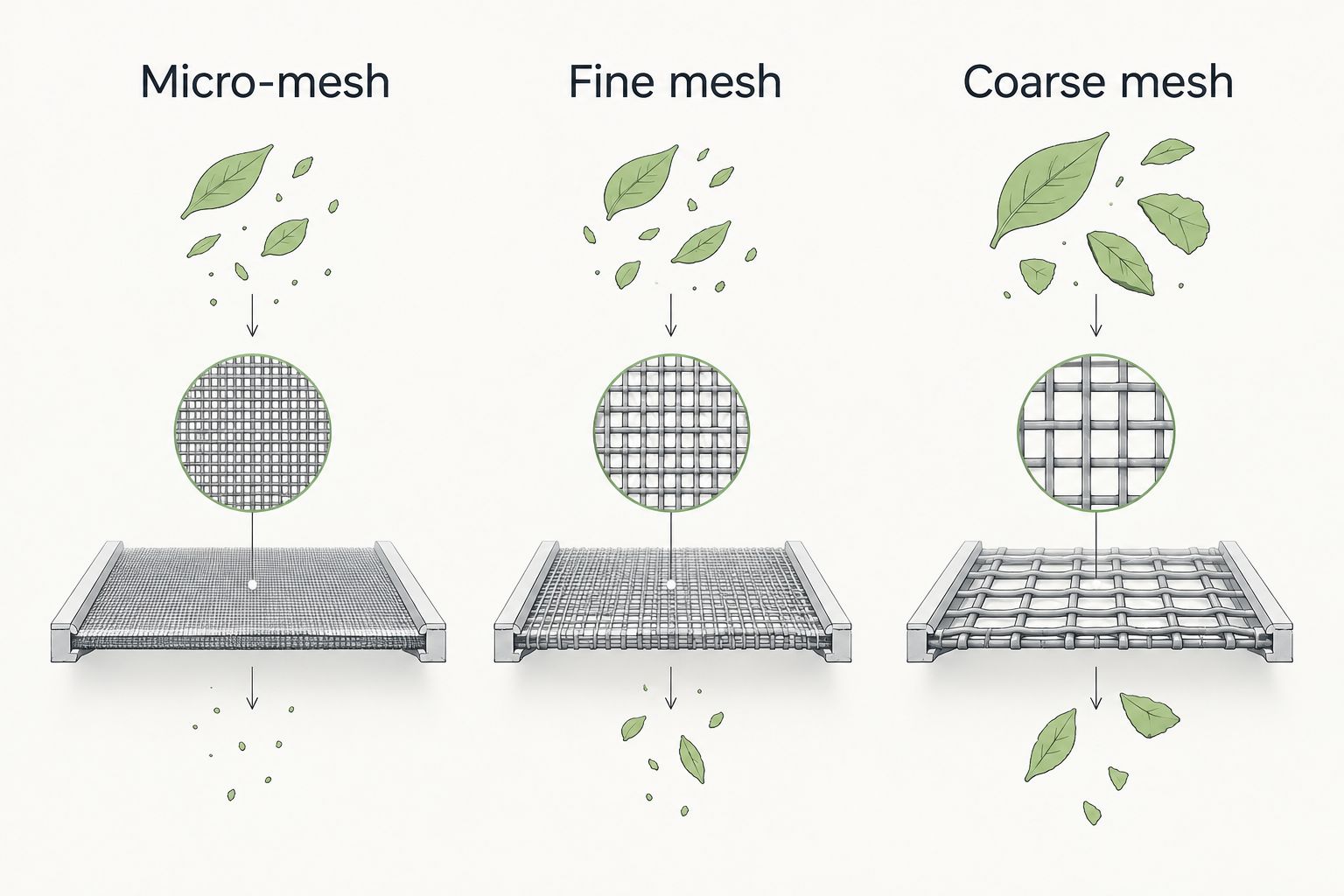
1. Micro-mesh: best gutter guard mesh for mixed fine debris
Micro-mesh uses very small openings to separate water from debris. It is the strongest default in this ranking when your roof collects both broad leaves and smaller material, such as needles, seed fragments, and broken leaf pieces.
The benefit is finer screening, not elimination of maintenance. Material excluded from the gutter remains above the screen until it falls away or is removed. A buildup on that surface interferes with water entry.
Micro-mesh pros:
- Screens smaller debris than a guard with larger openings.
- Addresses mixed debris rather than broad leaves alone.
- Provides a barrier against narrow material that passes through coarse screens.
- Keeps excluded debris on an accessible surface rather than inside the gutter channel.
Micro-mesh cons:
- Fine debris and organic residue accumulate on the screen surface.
- Tight openings do not compensate for poor placement beneath concentrated runoff.
- The label does not guarantee pollen exclusion or a particular opening dimension.
Best for: Homes where small debris repeatedly reaches the gutters alongside leaves.
Before choosing micro-mesh in 2026, distinguish fine fragments from airborne pollen. A gutter guard is a runoff screen, not a pollen filter. Pollen and dust are not a reason to promise a permanently clean gutter or select a guard without considering water entry.
Ask how the proposed guard will be cleaned, especially beneath roof valleys and over difficult-to-reach sections. The right specification includes access, not just the screen material.
Verdict: Buy micro-mesh when fine debris is the problem; skip any maintenance-free claim.
2. Fine mesh: best gutter guard mesh for leaf fragments
Fine woven mesh occupies the middle ground between coarse screens and the smallest-opening options. It suits a leaf-dominant roof where broken pieces matter, but screening the finest material is not your main objective.
Treat this category as a starting point for inspecting actual openings. Manufacturers use category names differently. Two guards described as fine mesh need not admit the same particles or use the same support structure.
Fine mesh pros:
- Screens leaf fragments that would pass through larger openings.
- Fits a debris profile dominated by leaves and broken leaf pieces.
- Offers a useful alternative to selecting the finest screen automatically.
- Makes the trade-off between opening size and debris exclusion explicit.
Fine mesh cons:
- Particles smaller than its openings still enter the gutter.
- Needles can pass through if their width and orientation fit the openings.
- Leaf mats on top still require removal when they obstruct runoff.
Best for: Homes with substantial leaf fall and fragments, without persistent fine-debris intrusion.
Inspect what is actually inside the gutter before deciding. Broad leaves resting on top and small fragments accumulating below are different problems. Fine mesh belongs on your shortlist when fragments, rather than dust or tiny seed material, explain the blockage.
For your 2026 comparison, ask to see the proposed screen beside representative debris. This does not replace a water-performance assessment, but it makes vague descriptions easier to challenge.
Verdict: Buy fine mesh for leaf-fragment control; hold if narrow debris is already passing through your existing screen.
3. Coarse mesh: best gutter guard mesh for broad leaves
Coarse mesh uses larger openings to intercept broad leaves and larger debris. It is a targeted option for a straightforward leaf problem, not the default for every tree-covered property.
The limitation follows directly from the opening size: smaller material fits through. If your gutters already contain needles, seed pieces, or fine leaf fragments, a broad-leaf screen does not address the full debris load.
Coarse mesh pros:
- Intercepts leaves larger than the screen openings.
- Provides a simple screening approach for broad-leaf debris.
- Leaves the screening trade-off easy to inspect against actual debris.
Coarse mesh cons:
- Small fragments pass through openings larger than the fragments.
- Narrow needles enter when their orientation allows them through.
- Broad leaves can still form a mat over the surface.
Best for: Roofs receiving mainly broad leaves, with limited troublesome fine debris.
Do not confuse a coarse screen with an open, maintenance-free gutter. Leaves held above the gutter can obstruct water entry just as leaves inside the channel obstruct drainage. The location of the cleanup changes; the need to inspect remains.
Choose coarse mesh only after checking more than the largest leaf on the property. Examine debris already caught near outlets and downspouts, where smaller material becomes easier to spot.
Verdict: Buy coarse mesh for broad-leaf screening; skip it when fine debris causes your blockages.
How to read mesh measurements without guessing
A mesh count and an opening dimension are not interchangeable. Mesh count describes the repeating mesh pattern over a stated length; wire thickness also affects the clear space between wires. A higher count alone does not supply the full opening specification.
For woven mesh, request the aperture dimension and wire diameter. For perforated guards, request hole dimensions and the hole pattern instead. Comparing unlike specifications as though they were the same measurement produces a misleading shortlist.
Useful unit conversions for your 2026 specification review are:
- 1 inch equals 25.4 millimeters. Use this to compare an inch-based specification with a metric one.
- 1 millimeter equals 1,000 micrometers. A micrometer is a unit of length, not a performance rating.
- An opening of 0.5 millimeters equals 500 micrometers. This is a conversion example, not a recommended Texas mesh size.
Compare clear opening dimensions in the same units before comparing labels. A finer stated aperture describes smaller openings; it does not prove that the complete guard handles your roof runoff better.
Match the mesh to debris and roof runoff
Start with material that has actually reached the gutter, not only the trees visible from the street. Wind moves debris, leaves break down, and roof valleys concentrate both water and material.
Use this inspection sequence before committing to a guard:
- Identify debris. Separate broad leaves, fragments, needles, and grit. Focus on the material associated with recurring blockages.
- Check drainage. Confirm that the gutter channel, outlets, and downspouts are clear and functioning.
- Review runoff. Identify roof valleys and concentrated discharge points. These areas need attention beyond the mesh label.
- Plan cleaning. Establish how the screen and underlying gutter will remain accessible.
Keep observations ground-based wherever possible. Have a contractor inspect elevated gutters and roof-edge details rather than climbing onto the roof to collect a sample.
ATX Gutters provides gutter guard installation and maintenance across Central Texas. Ask ATX Gutters to explain how the proposed mesh addresses your debris, how the installation handles concentrated runoff, and how future cleaning reaches the screen and gutter.
Discuss your gutter guard fit
Match gutter guard screening to your roof debris and maintenance needs.
How these mesh options rank
Micro-mesh ranks first for mixed fine debris because smaller openings exclude smaller material. Fine mesh earns the leaf-fragment slot; coarse mesh earns the broad-leaf slot. Each recommendation addresses a distinct debris problem rather than treating every roof as identical.
The criteria are aperture, debris fit, water entry, installation fit, and cleaning access. This 2026 ranking does not substitute category names for product specifications or claim measured performance from an installation test.
Which gutter guard mesh should you choose?
Choose micro-mesh if you need a default for mixed leaves and fine debris. Choose fine mesh when leaf fragments are the main issue. Choose coarse mesh only when broad leaves dominate and smaller material is not causing recurring trouble.
Do not finalize the choice until the installer explains the complete drainage path. Water must enter the guard, travel through the gutter, reach an outlet, and discharge through the downspout. A finer screen cannot fix a failure elsewhere in that path.
FAQ
What's the best gutter guard mesh size for Texas debris?
Micro-mesh is the best default for mixed leaves and fine debris; fine mesh suits leaf fragments, and coarse mesh suits broad leaves. Select the actual opening dimension against your debris rather than treating a category label as a universal specification.
Is micro-mesh better than coarse mesh for oak leaves?
Micro-mesh is better when oak leaves arrive with small fragments that fit through coarse openings. Coarse mesh addresses broad leaves, but neither option eliminates surface cleanup.
Will micro-mesh keep cedar pollen out of my gutters?
Do not treat micro-mesh gutter guards as pollen filters. Their purpose is to admit runoff while screening debris, and the label alone establishes no pollen-exclusion specification.
Does a higher mesh count mean a better gutter guard?
A higher mesh count does not establish a better complete gutter guard. Compare clear openings, wire thickness, support, installation position, and cleaning access together.
What mesh should I choose if pine needles clog my gutters?
Shortlist a smaller-opening screen and compare its aperture with the needles reaching your roof. Needle width and orientation affect passage, so a broad-leaf screen is not enough simply because it stops large leaves.
Can smaller mesh openings cause gutter overflow?
Blocked screen surfaces interfere with water entry regardless of the category name. Evaluate debris buildup, guard placement, concentrated runoff, and the gutter's drainage condition rather than blaming opening size alone.
Do I still need to clean gutters after installing guards?
Yes, gutter guards still need inspection and surface cleaning. Material smaller than the openings can enter the gutter, and debris retained above the screen can obstruct runoff.
One last thing
Inspect the debris that gets through, not just the debris the guard catches. A screen covered with leaves proves that it intercepts leaves; it does not prove that needles and fragments stay out or that water enters correctly. That distinction gives you a better replacement decision than appearance alone.