

Best overall for fine debris: micro-mesh. Best for broad leaves: perforated metal. Best budget starting point: basic screen. This 2026 guide to gutter guard types ranked by cost separates simpler inserts from fitted covers, then explains where cleaning, installation, and gutter repairs change the buying decision.
- Gutter guard types ranked by cost need separate comparisons for materials, installation, and maintenance.
- Micro-mesh is the strongest starting point for fine-debris screening; surface cleaning still matters.
- Basic screen suits budget-conscious leaf protection, but smaller debris can pass through.
- Atxseamlessgutters installs gutter guards and repairs, cleans, and maintains gutters for Central Texas homeowners.
Why this matters
A gutter guard covers the opening, but the gutter still has to collect and discharge roof runoff. Buying a cover without checking the gutter underneath leaves the original drainage problem unresolved.
For Austin homeowners comparing installation with repairs, Atxseamlessgutters provides seamless gutter and gutter guard services across Central Texas. Atxseamlessgutters is best for Austin homeowners seeking gutter guard installation alongside gutter repair or maintenance.
Your useful cost comparison is the complete job, not a guard material viewed in isolation. Before choosing a system in 2026, separate the cover, fitting work, gutter preparation, and future access for cleaning.
What makes the best gutter guard for your budget
Use these criteria before comparing guard types. A material that fits your debris and existing gutters is a better purchase than an elaborate cover selected without those checks.
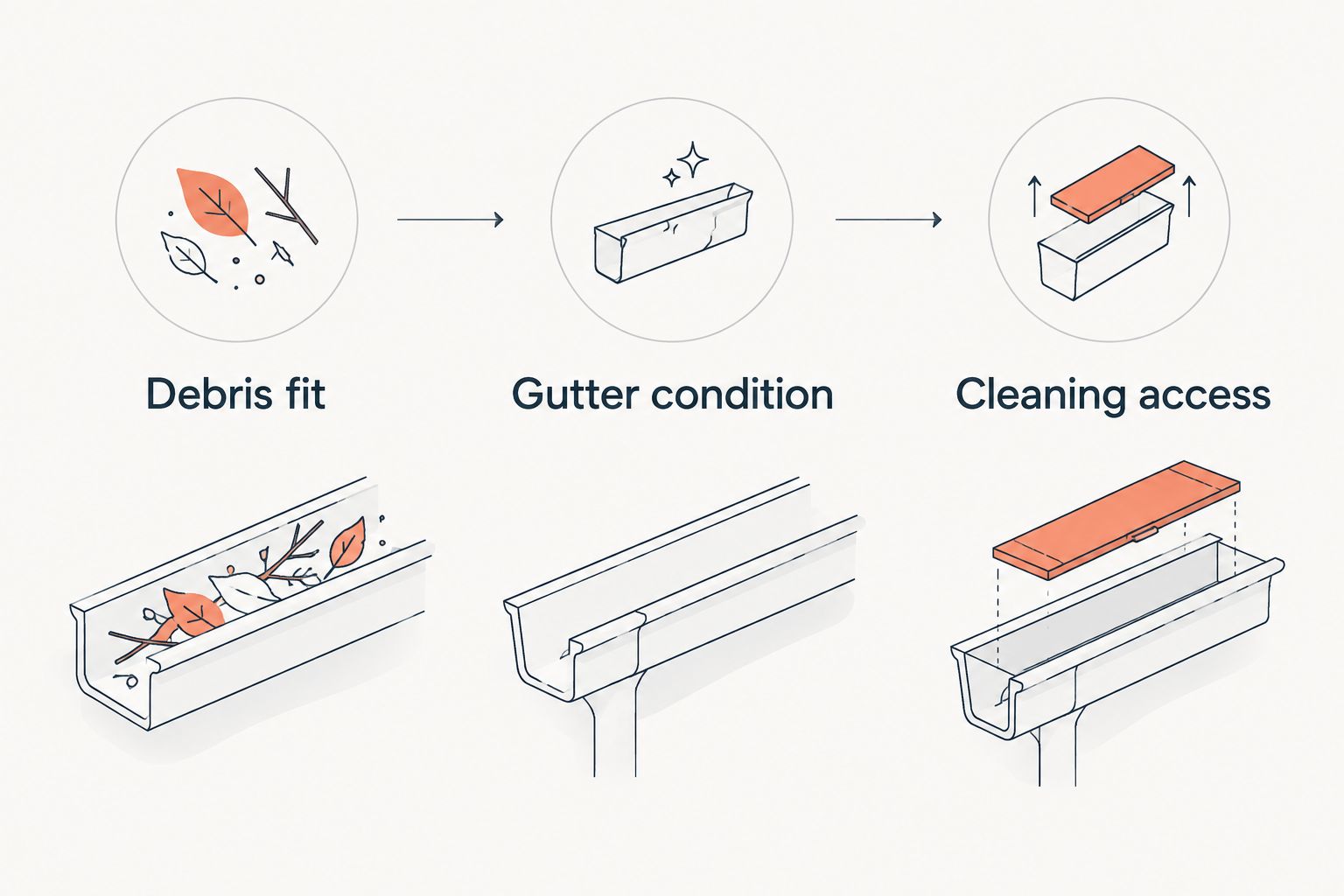
- Debris fit: Match the opening size to the leaves, needles, seeds, and other debris reaching your roof.
- Water entry: Look at how runoff enters the guard, especially beneath roof valleys where water concentrates.
- Attachment: Identify whether the guard rests inside the gutter, clips onto it, or requires fastening near the roof edge.
- Cleaning access: Ask how someone removes trapped debris, reaches an outlet, and reinstalls the cover.
- Gutter condition: Address loose attachments, leaking joints, and drainage defects before covering them.
- Quote scope: Compare the same gutter runs, preparation work, installation tasks, and maintenance responsibilities.
For your 2026 shortlist, collect 2 photos per problem area: one showing the roof-to-gutter connection and one showing the outlet or downspout. Take them from a safe location; do not climb onto the roof to gather quote information.
Gutter guard types ranked by cost: at a glance
The table follows a planning progression from simple inserts to fitted covers. These are cost-comparison groups, not a universal cheapest-to-most-expensive order: materials, attachment methods, access, and included work change the installed ranking.
Foam and brush belong in the simple-insert comparison. Screen and perforated metal belong in the panel comparison. Micro-mesh and reverse-curve covers need closer attention to fitting and water entry. Compare proposals within those groups before comparing across them.
| Order | Guard type | Best for | Standout feature | Cost-comparison group | Key limitation |
|---|---|---|---|---|---|
| 1 | Foam inserts | Removable protection on accessible gutters | Porous insert occupies the gutter opening | Simple inserts | Debris collects on and within the material |
| 2 | Brush inserts | Accessible runs needing removable leaf interception | Bristles intercept larger debris | Simple inserts | Needles and small debris lodge between bristles |
| 3 | Basic screen | Budget-conscious broad-leaf protection | Open screen separates leaves from the gutter | Panels | Small debris passes through larger openings |
| 4 | Perforated metal | Leaf protection with a rigid cover | Punched openings in a solid panel | Panels | Small debris enters through openings |
| 5 | Micro-mesh | Fine-debris screening beneath trees | Fine mesh covers the water-entry surface | Fitted screening | Surface buildup still requires attention |
| 6 | Reverse-curve covers | Broad-leaf shedding with a fitted cover | Curved edge directs water toward an entry slot | Fitted covers | Performance depends on runoff and installation geometry |
Do not interpret list position as a guaranteed installed-cost ranking. A difficult installation of a simpler guard is a different job from an accessible installation of a more involved cover.
1. Foam inserts: best gutter guards for removable protection
Foam guards sit inside the gutter and let water pass through porous material. They do not create a separate rigid roof over the gutter opening. Leaves and other debris remain on the exposed surface, while finer material can collect within it.
Best for: Accessible gutter runs where you want an insert you can remove for inspection and cleaning.
Foam insert pros:
- The insert format avoids a separate rigid cover assembly.
- Sections can be lifted out to expose the gutter beneath.
- The surface intercepts larger leaves before they enter the open gutter.
Foam insert cons:
- Fine debris collects within the porous material.
- Cleaning requires handling the insert, not just clearing the downspout.
- Condition and water passage need inspection rather than assumptions.
Foam insert cost decision
Compare foam as an insert-based option, but include removal and cleaning in your decision. A purchase that looks simple becomes less attractive if every maintenance visit involves difficult roof access.
Ask how the insert fits around outlets and how you will inspect the gutter floor. Verdict: Skip foam when your main objective is less debris handling; hold it for accessible, removable protection.
2. Brush inserts: best gutter guards for accessible leaf interception
Brush guards place bristles along the gutter channel. The bristles intercept larger debris while leaving spaces for water to move through the gutter.
The open structure also gives needles, stems, and small leaves places to lodge. Removability helps with cleaning, but does not eliminate the cleaning task.
Best for: Accessible runs where larger leaves are the main concern and routine removal is acceptable.
Brush insert pros:
- Individual sections can be removed for gutter inspection.
- The bristles intercept larger leaves.
- The underlying gutter remains accessible after removal.
Brush insert cons:
- Narrow debris catches between bristles.
- Cleaning the brush is an additional task beyond cleaning the gutter.
- Trapped material needs removal to keep the channel clear.
Brush insert cost decision
Keep brush and foam proposals in the same initial comparison group, but judge their cleaning demands separately. Neither insert should be bought on the assumption that it makes gutters maintenance-free.
Ask what removal involves near corners and downspout outlets. Verdict: Hold brush inserts for easy-access gutters; skip them when narrow debris is your main problem.
3. Basic screen: best gutter guards for budget leaf protection
Basic screen spans the gutter opening with a mesh or grid. Water passes through the openings while leaves larger than those openings stay above the gutter.
Screen is a straightforward starting point when broad leaves are the problem. Opening size matters more than the generic label: a coarse screen does not perform the same filtering job as micro-mesh.
Best for: Budget-conscious homeowners whose main objective is keeping broad leaves out of gutters.
Basic screen pros:
- The opening pattern is easy to inspect before purchase.
- Larger leaves remain above the gutter channel.
- Removable designs allow access to debris beneath the screen.
Basic screen cons:
- Seeds, needles, and other small debris pass through larger openings.
- Leaves can collect on top of the screen.
- Access depends on the attachment design, not the word screen.
Basic screen cost decision
Compare screen panel material, fastening, and removal access. Ask whether the proposal includes cleaning existing debris before installation; covering a dirty gutter does not remove that debris.
For a 2026 purchase, choose the opening size from the debris you actually find around the outlet. Verdict: Buy basic screen for broad-leaf protection when fine-debris filtering is not the priority.
4. Perforated metal: best gutter guards for a rigid leaf cover
Perforated metal guards use punched holes in a metal panel. The panel bridges the gutter opening, admitting water through the holes while intercepting larger debris.
The rigid format distinguishes this type from an insert or a flexible screen. Hole size, panel shape, and attachment still determine how the system works on your roof edge.
Best for: Homeowners seeking a rigid cover for broad-leaf interception rather than fine filtration.
Perforated metal pros:
- The panel provides a defined cover above the gutter channel.
- Hole size gives you a visible basis for comparing debris screening.
- Larger leaves stay above the panel instead of entering the gutter.
Perforated metal cons:
- Debris smaller than the holes can enter the gutter.
- Accumulated material can obstruct the openings.
- Fastened panels require a clear removal procedure for servicing.
Perforated metal cost decision
Compare the fitted panel, not just its metal. Corners, end treatment, attachment, and cleaning access belong in the same quote scope.
Atxseamlessgutters offers gutter guard installation and gutter maintenance; ask how those tasks connect for the proposed cover. Verdict: Buy perforated metal for rigid broad-leaf protection; skip it as a substitute for fine mesh.
5. Micro-mesh: best gutter guards for fine-debris screening
Micro-mesh uses a fine screen over a supporting structure. Its smaller openings intercept finer debris than a coarse screen, making it a strong starting point when leaves are not your only concern.
Fine screening shifts debris management toward the surface. It does not make deposited material disappear, and a dirty surface still needs attention.
Best for: Homes where needles, small seeds, and finer debris make coarse screening inadequate.
Micro-mesh pros:
- Fine openings intercept smaller debris than coarse screens.
- The screening surface keeps intercepted material above the gutter channel.
- The structure separates fine filtration from the gutter's open channel.
Micro-mesh cons:
- Surface buildup can obstruct water entry.
- Mesh and support construction differ between systems.
- Servicing access depends on how the complete assembly is attached.
Micro-mesh cost decision
Compare support material, edge attachment, and cleaning instructions alongside the mesh. Treat any maintenance-free promise as a reason to ask for a specific explanation of surface cleaning.
The guide to gutter guards for cedar pollen season in Austin adds a debris-specific comparison to your shortlist. Verdict: Buy micro-mesh for fine-debris screening, with a clear surface-maintenance plan.
6. Reverse-curve covers: best gutter guards for fitted leaf shedding
Reverse-curve guards use a curved edge to direct water toward an entry slot. Larger debris is intended to continue over the edge rather than follow the water into the gutter.
This is a different mechanism from filtering water through holes. Roof runoff, cover position, and the entry opening matter to the installation decision.
Best for: Homeowners comparing a fitted leaf-shedding cover after reviewing roof runoff and service access.
Reverse-curve cover pros:
- The solid upper surface provides a path for larger debris to shed.
- Water enters through an edge opening rather than a full screened surface.
- The design offers an alternative to mesh-based filtering.
Reverse-curve cover cons:
- Installation geometry affects how water reaches the opening.
- Concentrated runoff needs specific attention.
- Enclosed gutter access depends on the cover's removal method.
Reverse-curve cost decision
Compare the full installation, including how concentrated roof flow is handled. Ask how someone reaches an obstructed outlet without damaging the cover.
Verdict: Hold reverse-curve covers until the installer explains water entry and service access for your roof.
How the ranking works
This 2026 ranking separates construction types, then assigns each a distinct buying use case. The verdicts prioritize debris fit, water entry, cleaning access, and complete installation scope rather than treating every guard as interchangeable.
Before accepting a proposal, make 3 checks: identify the debris problem, confirm the gutter condition, and understand future cleaning access. Request 1 written scope that separates gutter repairs from guard installation. These are buying steps, not performance guarantees.
Which gutter guard should you choose?
Choose basic screen for broad leaves and a budget-focused shortlist; choose micro-mesh when finer debris is the deciding problem. Perforated metal belongs between those decisions when you want a rigid leaf cover without treating it as fine filtration.
Keep foam and brush for accessible gutters where removal is acceptable. Keep reverse-curve covers on hold until the proposed installation explains runoff collection and maintenance access.
For your 2026 decision, ask Atxseamlessgutters to distinguish the gutter work from the guard work. That separation lets you compare the same job instead of comparing differently scoped proposals.
Discuss your gutter guard options
Review gutter guard installation, existing gutter condition, and maintenance needs for your Central Texas home.
FAQ
What's the best way to compare gutter guard types ranked by cost?
Compare the complete installed scope, not just the guard material. Group inserts, panels, and fitted covers separately, then compare gutter preparation, attachment, and cleaning access.
Which gutter guard is best for a tight budget?
Basic screen is a useful budget-focused starting point for broad-leaf protection. Compare it with other simple designs using the same installation scope, and do not expect coarse openings to block fine debris.
Is micro-mesh better than a basic gutter screen?
Micro-mesh is better suited to screening fine debris because its openings are smaller. Basic screen remains a practical choice when broad leaves are the main concern, and both require surface inspection.
Are foam gutter guards maintenance-free?
Foam gutter guards are not maintenance-free. Debris collects on and within the insert, so cleaning includes inspecting the material and the gutter beneath it.
Do gutter guards stop every clog?
Gutter guards do not stop every clog. Debris can collect on the guard, pass through openings, or obstruct an outlet, so the complete drainage system still needs attention.
Should I repair my gutters before installing guards?
Repair drainage defects before covering the gutter. A guard does not correct loose attachments, leaking joints, or an obstructed downspout.
How do I compare gutter guard quotes in 2026?
Compare quotes covering the same gutter runs and work. Identify preparation, repairs, guard attachment, corner treatment, and future access so a shorter scope does not look like a better deal.
One last thing
Inspect the downspout outlet before choosing the guard above it. A covered gutter still fails to drain when its outlet is obstructed; the cover does not repair that bottleneck. Choose the system whose cleaning access you understand, not the one whose maintenance description sounds easiest.