
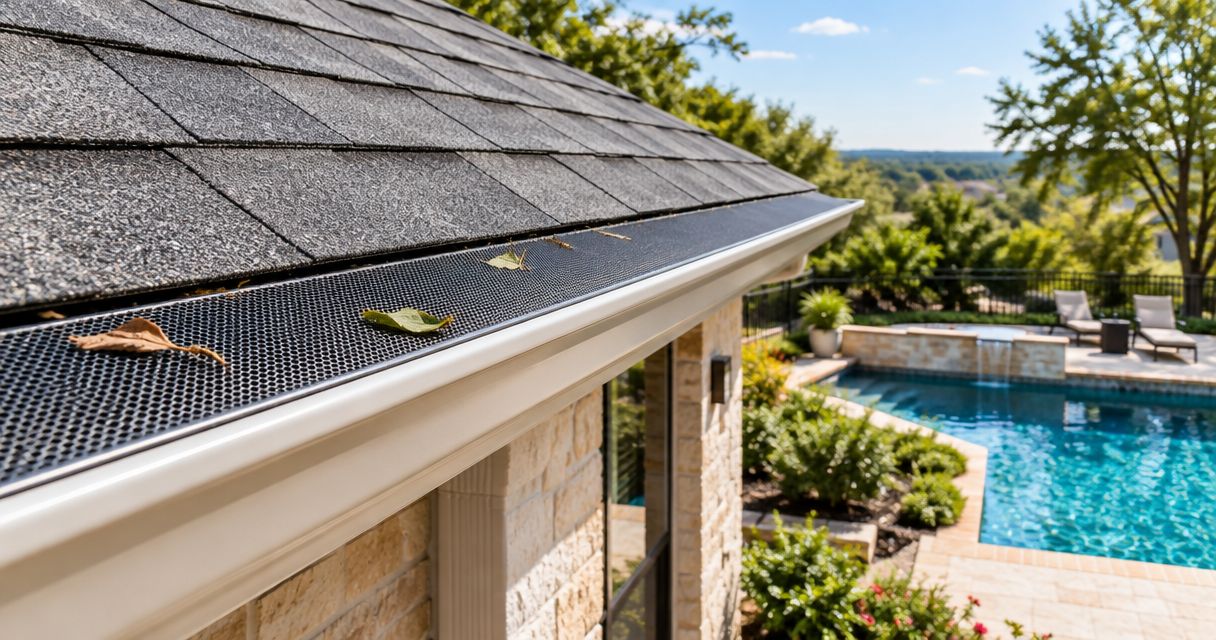
Austin pool-home gutter protection is the use of debris guards and maintained roof drainage to keep roof runoff away from poolside walking areas. Choosing gutter guards for Austin homes with pools in 2026 means checking where water lands, what debris collects, and whether you can safely maintain the system—not just choosing a cover.
- Choose gutter guards for Austin homes with pools by debris type, roof runoff, and discharge location—not appearance alone.
- ATX Gutters installs, repairs, cleans, and maintains gutters and gutter guards for Central Texas homeowners.
- Fine mesh excludes smaller debris than coarse screens, but its surface still needs cleaning.
- Gutter guards do not replace pool covers, fix undersized gutters, or correct poorly positioned downspouts.
Why gutter guards matter for Austin homes with pools
A pool changes the consequence of a drainage problem. Overflow beside a rarely used planting bed is different from runoff landing on the route between your back door and pool steps. Your priority is keeping roof water on a controlled path without creating another maintenance obstacle beside the pool.
ATX Gutters provides gutter installation, repair, cleaning, maintenance, and gutter guard services across Central Texas. Start your own assessment from the ground; bring in a contractor when gutter access, repairs, or roof-edge work are involved.
Guards address debris entering gutters. They do not catch leaves blowing directly into the pool, repair deck drainage, or make an inadequate gutter system handle more water. Keep these jobs separate when planning your 2026 project so you judge the installation against the problem it can actually solve.
The useful question is not whether a guard keeps everything out. It is whether the complete system admits roof water, limits troublesome debris, and remains accessible for cleaning.
How to choose and plan poolside gutter protection
Map where roof water reaches the pool area
Before comparing guards, watch your drainage from a sheltered ground-level position during rain. Identify the gutter runs above the pool deck, outdoor seating, equipment area, and routes people use with wet feet. Never climb a ladder during rain or walk onto wet roofing.
Separate overflow along a gutter edge from discharge at a downspout. Those symptoms call for different checks: a guard cannot redirect an outlet, and an extension cannot remove debris blocking a gutter.
Use 3 observation points for your initial check: the roof edge, the gutter outlet, and the discharge area. This is a practical inspection checklist, not a substitute for evaluating drainage capacity.
- Mark where overflow reaches walking areas.
- Note roof valleys feeding concentrated runoff into gutters.
- Trace each visible downspout to its discharge point.
- Record water crossing the deck rather than entering the pool directly.
Identify the debris reaching each gutter run
Look at what actually collects around your property instead of choosing from a generic tree list. Broad leaves, small fragments, twigs, and roof granules present different screening problems. A guard that excludes a whole leaf still needs evaluation for finer material.
Ground-level observations are useful, but do not assume debris on the deck exactly matches debris inside the gutter. Ask a contractor to document elevated sections when access requires a ladder. The gutter guard mesh sizes guide gives you a focused next comparison once you know what needs screening.
For your 2026 selection, describe the debris rather than requesting the smallest opening automatically. Finer filtration brings a surface-cleaning requirement, not a maintenance exemption.
- Photograph representative leaves and small debris.
- Identify branches hanging above individual roof sections.
- Note debris mats that remain after surrounding surfaces dry.
- Ask how the proposed guard handles your observed debris.
Repair the drainage system before adding guards
A cover does not straighten a sagging gutter, reseal a leaking joint, or clear a blocked downspout. Covering an unresolved defect makes later diagnosis harder because the gutter interior becomes less accessible. Establish that the existing system works before treating debris exclusion as the next improvement.
A manual first step is to photograph visible defects from the ground and record their locations. For elevated inspection and repairs, ATX Gutters offers gutter repair, cleaning, installation, and maintenance alongside gutter guards.
ATX Gutters gutter guard services are best for Austin homeowners seeking local gutter work alongside debris protection. The limit is equally important: gutter services do not substitute for assessing a separate pool-deck drainage problem.
- Record leaks at joints and corners.
- Flag sagging runs and visibly loose sections.
- Have downspouts checked for obstructions.
- Ask whether gutter sizing and outlet placement suit the roof runoff.
Match the guard to the roof edge and cleaning access
Treat the gutter, roof edge, guard attachment, and cleaning method as one installation. Ask how the proposed system attaches and whether it requires lifting roofing material. Have the installer explain any implications for your roof rather than assuming every mounting method fits every house.
Poolside access deserves its own discussion. Furniture, planting beds, fences, and narrow deck areas can complicate safe ladder placement. Do not accept a cleaning plan that depends on reaching across the pool or standing a ladder on an unsuitable surface.
Take 4 planning photos: the roof edge, the gutter run, the downspout, and the surrounding access area. These give a contractor context without requiring you to climb.
- Ask how covered gutter sections can be opened for service.
- Confirm the intended attachment method.
- Identify safe access areas away from the pool edge.
- Request a cleaning method suited to the chosen guard.
Compare guard options against the same criteria
Compare options using the same questions: what debris passes through, what collects on top, how water enters, and how cleaning works. Product descriptions that only discuss leaf exclusion leave out much of the decision.
Fine mesh is a useful candidate when small debris is the concern, but it is not an automatic winner. A surface that collects debris still needs attention. Screens offer a different trade-off: larger openings admit smaller material, while the top surface can also collect leaves.
Ask for an explanation tied to your roof and debris, not a general claim that one type works everywhere. For a 2026 project, the written scope should identify the proposed guard type and what existing gutter work comes first.
- Compare debris exclusion and surface accumulation separately.
- Ask how concentrated valley runoff will be handled.
- Check how the guard is removed or accessed for cleaning.
- Require roof-edge compatibility to be addressed before installation.
Check the complete water path after installation
Evaluate the result from roof edge to discharge, not just along the newly covered gutter. A clean-looking installation still needs to admit water and deliver it to an appropriate outlet. Observe it safely during rain and document any overflow for the installer.
Use 2 follow-up checks: one during rainfall from a sheltered position and another after the area dries. The first reveals the water path; the second helps you identify debris deposits and recurring wet areas. Do not enter an unsafe area to collect evidence.
A controlled water test belongs with someone who can perform it safely and interpret the result. It does not establish performance under every storm condition.
- Watch for water spilling over the front edge.
- Check whether runoff overshoots near roof valleys.
- Confirm discharge does not cross the pool access route.
- Photograph persistent wet areas for follow-up.
Set a maintenance plan around observed buildup
Gutter guards reduce some debris entry; they do not remove the need to inspect the roof drainage system. Schedule attention around what happens at your house, including visible accumulation and changes after storms or tree shedding. Avoid treating a calendar reminder as proof that the system is clear.
Keep your 2026 maintenance notes simple: location, symptom, photograph, and action taken. Repeated problems at the same corner are more useful to a contractor than a general report that the gutters overflow.
Ground-level observation is your first task. Elevated cleaning, unstable access, and repairs call for professional help rather than improvised poolside ladder placement.
- Inspect visible guard surfaces for debris buildup.
- Keep downspout discharge areas unobstructed.
- Record recurring overflow at specific locations.
- Arrange safe cleaning when surface deposits remain.
Compare gutter protection options for poolside roofs
Choose by the failure you need to prevent, not by the claim that a gutter will never need cleaning. These categories describe different approaches, not verified specifications for any particular manufacturer's product. Ask the installer to demonstrate how the proposed design handles your roof runoff and maintenance access.
| Option | Best for | Main advantage | Key limitation |
|---|---|---|---|
| Screen guards | Larger leaves where smaller debris entry is acceptable | Screen openings block debris larger than the openings | Smaller material passes through; leaves can collect on top |
| Fine mesh | Smaller debris exclusion where surface cleaning is practical | Smaller openings exclude finer material than coarse screens | Surface deposits still need removal |
| Surface tension | Homes where the particular design suits the roof edge and runoff | Uses water adhesion to guide runoff around a curved edge | Performance depends on design, installation, and flow conditions |
| Open gutters | Homeowners prioritizing direct access to the gutter interior | No cover needs removal to reach the channel | Leaves and other roof debris enter directly |
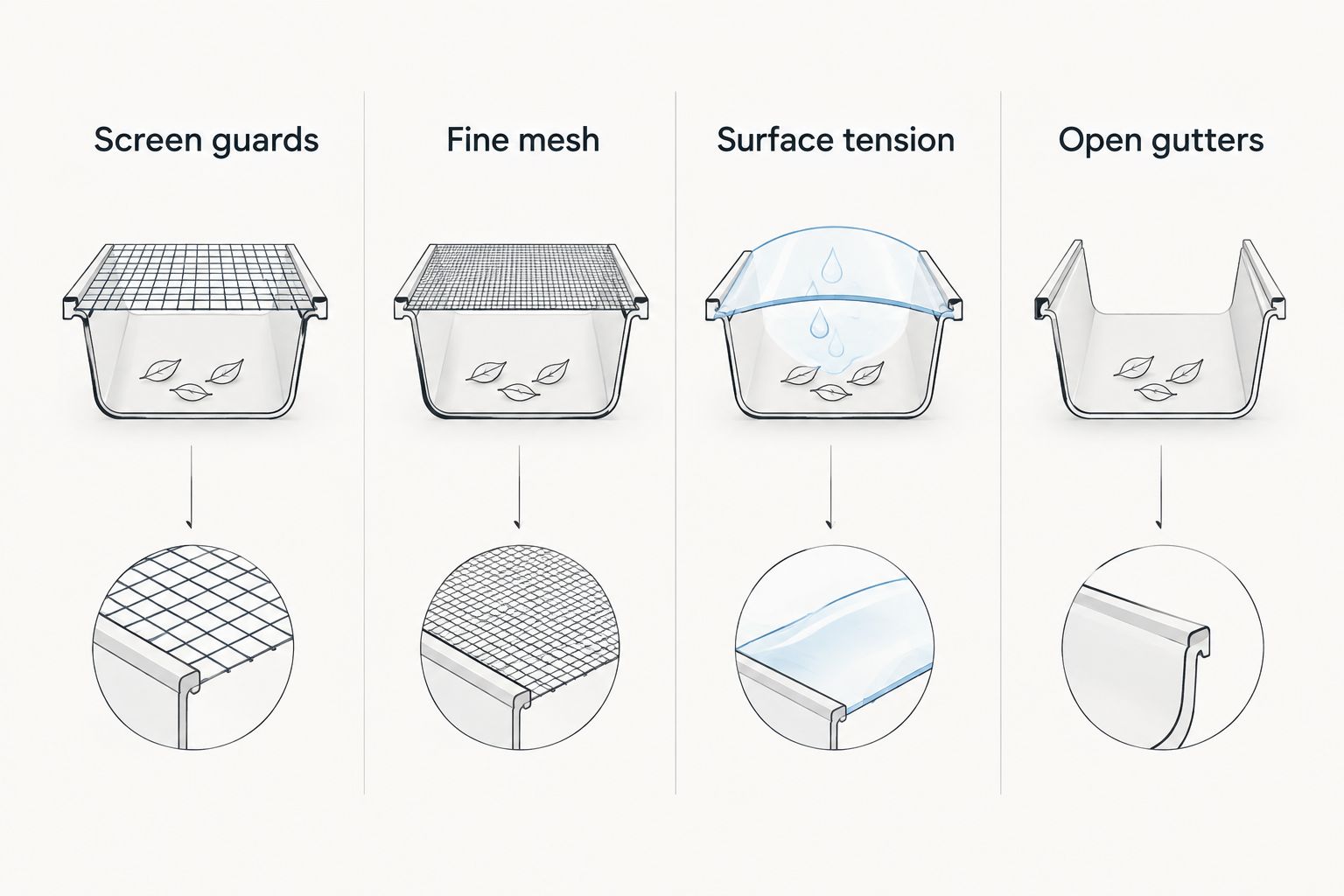
No option in this table fixes an outlet aimed across your pool deck. Resolve discharge placement separately, and ask what ongoing cleaning each proposed design requires before making your decision.
Discuss your poolside gutter drainage
Ask ATX Gutters about gutter repairs, cleaning, and guard installation for your Austin home.
Common mistakes Austin pool owners make
Expecting guards to keep the pool leaf-free
Gutter guards work at the roof edge, not across the water surface. Leaves carried directly into the pool remain a separate problem. Judge gutter protection by roof drainage and debris entry, not by whether your pool skimmer stays empty.
Keep pool cleaning and roof drainage on separate task lists. Otherwise, you risk replacing a functioning guard because it never addressed the source of the pool debris.
Covering gutters before fixing poolside discharge
A gutter can collect roof water correctly while its downspout releases that water in the wrong place. Adding guards does not change the outlet's destination. Trace the discharge route before approving the installation, particularly where it crosses the route to pool steps or equipment.
Do not redirect water toward a neighboring property or assume a buried connection is clear. Ask for the full drainage route to be checked.
Choosing fine mesh without a cleaning plan
Smaller openings answer only the debris-exclusion question. They do not explain how you will remove deposits from a difficult-to-reach roof edge. Ask where service access will occur and how the surface will be cleaned without unsafe positioning beside the pool.
A guard you cannot safely maintain is an incomplete installation plan. Include access in your selection criteria, not as a question after the work is finished.
Treating every wet patch as gutter overflow
A wet deck can receive water from roof runoff, direct rainfall, pool splash, irrigation, or another drainage source. Observe the source before specifying a gutter repair. Photographs showing water leaving the roof edge are more useful than photographs of a wet surface alone.
For your 2026 assessment, distinguish the source from the symptom. Fixing the wrong system leaves the original problem in place.
FAQ
What's the best gutter guard for an Austin home with a pool?
The best fit depends on the roof runoff, observed debris, and safe cleaning access. Fine mesh suits smaller-debris exclusion, while coarser screens leave larger openings; neither corrects poor downspout placement.
Will gutter guards keep leaves out of my swimming pool?
Gutter guards do not stop leaves blowing directly into a swimming pool. Their role is to limit debris entering the roof drainage system, so pool cleaning remains a separate task.
Can gutter guards stop water from running across my pool deck?
Gutter guards address debris entry, not every cause of water crossing a pool deck. Blocked gutters, incorrect discharge placement, direct rain, and deck drainage need separate checks.
Are fine-mesh gutter guards maintenance-free?
Fine-mesh gutter guards are not maintenance-free. Debris can collect on the surface, and the gutter outlets and discharge areas still need inspection.
Should I repair my gutters before installing guards?
Repair leaking, loose, sagging, or obstructed gutter sections before installing guards. A cover does not correct those defects and can make the gutter interior less accessible.
Can I inspect poolside gutters without climbing a ladder?
You can observe visible overflow and discharge from a safe ground-level position. Elevated inspection and cleaning require appropriate access; never climb during rain or improvise ladder placement beside a pool.
Does ATX Gutters work on existing gutters as well as guards?
ATX Gutters installs, repairs, cleans, and maintains seamless gutters and gutter guards for Central Texas homeowners. Discuss the existing gutter condition and poolside drainage symptoms when describing the work you need.
One last thing
The most revealing place to inspect is often the downspout exit, not the guard. Follow the water beyond the gutter before deciding the project is complete. A clear channel above your head is only part of the job if discharge still crosses the pool access route.
For your next rainfall check, photograph the roof-edge symptom and the outlet destination together. That paired record helps separate debris blockage from a discharge problem—and keeps the next repair focused on the right part of the system.