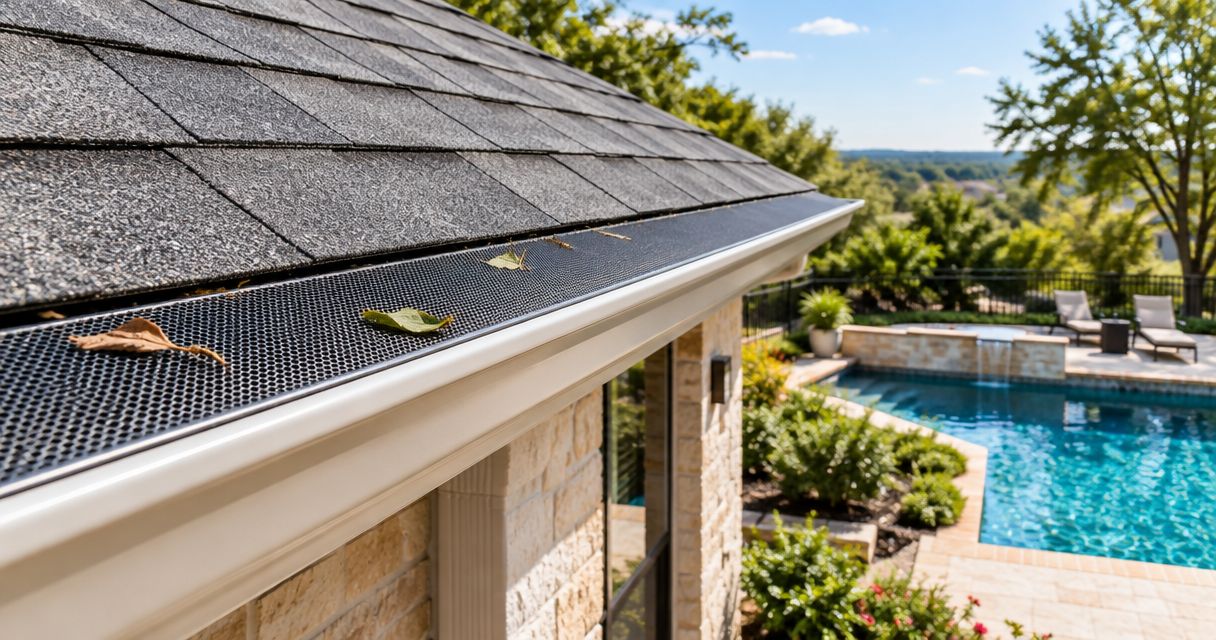

Seamless gutters cost per foot in Texas depends on the material, gutter dimensions, installation conditions, and work included in your estimate; compare written installed quotes rather than treating a statewide figure as your project budget. Downspouts, removal, fascia repairs, and drainage extensions need separate attention because a gutter-only rate does not describe the complete job.
- Compare seamless gutters cost per foot using matching materials, measured lengths, downspouts, and installation scope.
- ATX Gutters installs, repairs, cleans, and maintains seamless gutters for Central Texas homeowners.
- A lower gutter-only rate is not a better offer when essential drainage work is excluded.
- For a 2026 gutter installation, get gutter guards and repairs listed separately from the base installation.
Why this matters
A per-foot estimate describes a unit of work, not necessarily a finished drainage system. You need to know where the gutter starts, where it ends, and where the collected water goes.
ATX Gutters serves homeowners across Central Texas with seamless gutter installation, repairs, cleaning, maintenance, and gutter guards. ATX Gutters is best for Central Texas homeowners seeking a local contractor for seamless gutter installation and ongoing maintenance. Choose your contractor around the required work, then compare the written scope—not just the headline rate.
How much do seamless gutters cost per linear foot in Texas?
The useful figure is the installed rate for your measured gutter runs, with exclusions stated alongside it. For a 2026 comparison, each contractor should quote the same material, gutter dimensions, roof edges, and drainage requirements.
A linear foot measures gutter length. It does not describe the roof area draining into that gutter, the difficulty of reaching the roof edge, or the number and placement of downspouts.
Use this breakdown to identify what each estimate actually covers:
| Estimate component | What the written scope should state | What to check |
|---|---|---|
| Gutter runs | Measured length, material, profile, and dimensions | Whether all intended roof edges are included |
| Installation | Attachment method, hangers, outlets, corners, and end caps | Whether the stated rate includes installation |
| Downspouts | Locations, routing, and discharge arrangement | Whether these are included or listed separately |
| Existing gutters | Removal and disposal responsibilities | Whether replacement work includes taking away the old system |
| Fascia repairs | Visible concerns and approval process for additional repairs | Whether attachment surfaces are suitable before installation |
| Gutter guards | Coverage and compatibility with the selected gutter | Whether guards are optional or included in the base scope |
| Drainage extensions | Where discharge ends and what additional work is proposed | Whether below-ground drainage is outside the gutter contract |
Do not divide an entire project total by gutter footage and assume the result is a comparable gutter rate. That calculation blends installation with any downspouts, repairs, guards, or drainage work included in the project.
Instead, compare the gutter installation line separately and then compare the complete scope. Both views matter: one shows the unit rate, while the other shows what you are actually buying.
Why seamless gutter estimates vary
For your 2026 estimate, ask contractors to explain differences through the following job conditions. A useful explanation points to a material choice or a specific task on your home.
- Material and specification: The quote should identify the metal, profile, and gutter dimensions rather than describing everything as seamless gutters.
- Roof layout: Separate roof sections, corners, and changes in direction affect fabrication and installation work.
- Access conditions: Building height, sloped ground, landscaping, and nearby obstacles affect how installers reach the roof edge safely.
- Downspout routing: Outlet locations, bends, wall attachment, and the discharge destination change the installation scope.
- Existing conditions: Old gutters and damaged attachment surfaces require different work from an installation on sound, unobstructed fascia.
- Optional work: Guards, extensions, and related drainage work should remain identifiable rather than disappearing into a blended rate.
Ask what changed in the specification before accepting an unexplained difference between estimates. A longer gutter run and a more complicated drainage route are different reasons for a different proposal.
Which project scope fits your home?
Decide whether your home needs a new system, a replacement, or a targeted repair before comparing installation estimates. These are different jobs, and treating them as interchangeable makes the comparison less useful.
| Project option | Best for | Main advantage | Main limitation |
|---|---|---|---|
| New seamless gutter installation | A home needing gutters along selected roof edges | Lets you plan collection and discharge together | Requires decisions about coverage and drainage routes |
| Full gutter replacement | An existing system being replaced across the quoted area | Allows a coordinated layout and attachment plan | Adds removal work and requires checking existing attachment surfaces |
| Targeted gutter repair | An isolated defect in an otherwise serviceable system | Focuses the work on a defined problem | Does not correct unrelated defects elsewhere |
| Gutters with guards | A homeowner seeking debris management alongside installation | Makes guard compatibility part of the installation decision | Does not eliminate inspection or maintenance |
A repair is not automatically the right choice because it involves less work. If water is missing the gutter, backing up, or discharging in the wrong place, the contractor needs to identify the cause before recommending a fix.
Likewise, replacement should address an identified problem rather than simply repeat the old layout. Ask whether the proposed work changes drainage performance or only replaces the existing material.
How do you compare seamless gutter quotes fairly?
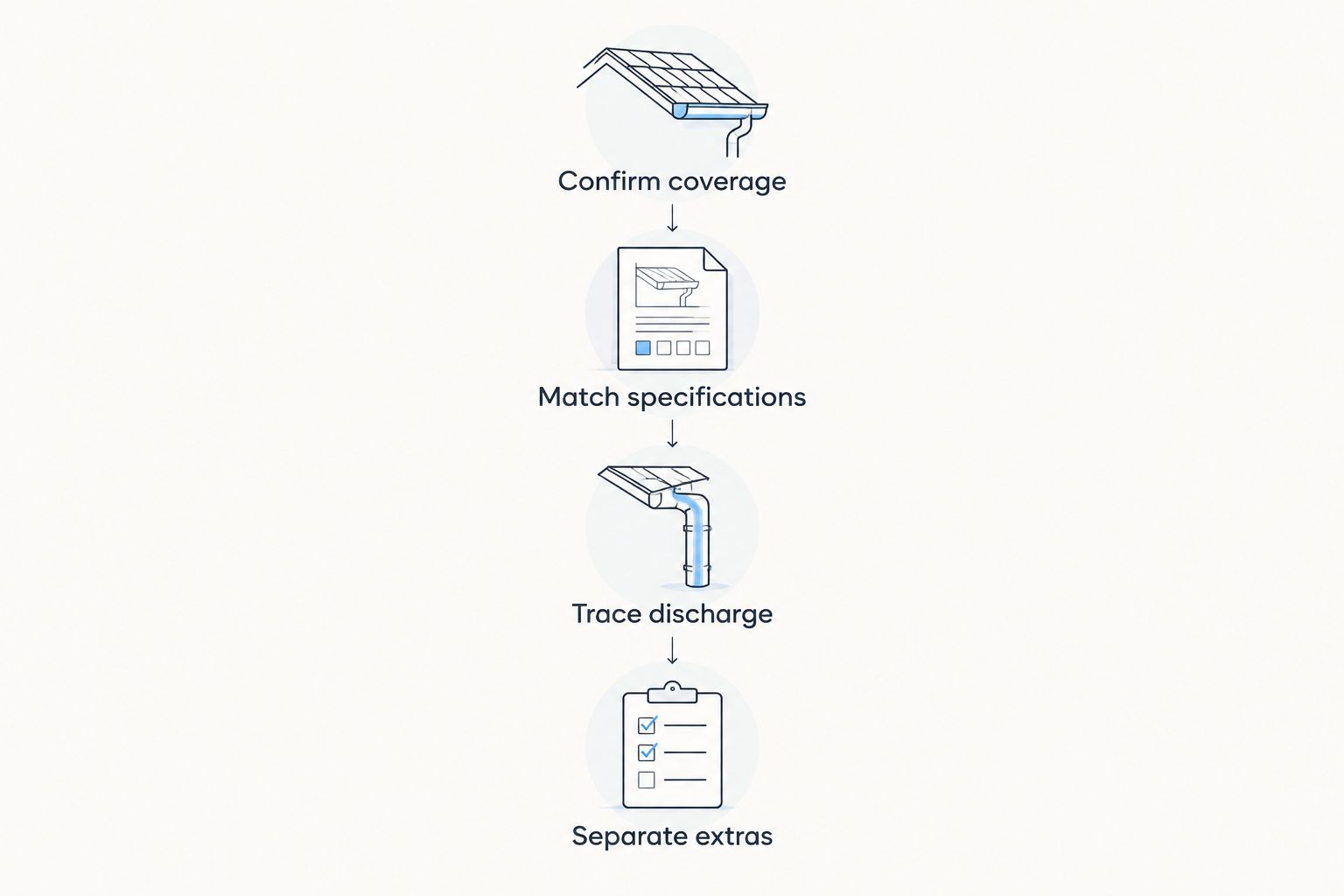
Use a consistent sequence for your 2026 project. Establish the work first, then compare the offers against that shared description.
1. Confirm coverage
Walk around the home and identify the roof edges included in the estimate. Ask the contractor to distinguish full coverage from selected runs, especially where separate roof sections discharge toward different areas.
You do not need gutters on an imagined house perimeter. You need a clear description of the roof edges the contractor proposes to serve and the reason for that layout.
2. Match specifications
Compare the material, gutter profile, dimensions, and attachment details. If one proposal changes a specification, ask the contractor to explain why that change suits your roof and drainage conditions.
An estimate that says only seamless gutters leaves too much undefined. A written specification gives you something concrete to compare and check after installation.
3. Trace discharge
Follow the proposed path from the roof edge through each downspout to its discharge point. Ask what happens after water leaves the downspout rather than stopping the discussion at the gutter outlet.
Look for places where discharge would cross a walkway, collect beside the building, or run toward an area you already know drains poorly. Discuss those conditions before approving the layout.
4. Separate extras
Request distinct descriptions for removal, repairs, guards, and extensions. Also ask how the contractor obtains your approval if concealed damage becomes visible during the work.
This separation does not make optional work unnecessary. It lets you decide what belongs in the project without confusing it with the basic gutter installation.
Keep the marked-up scope with the final estimate. A verbal explanation is useful during the visit, but the accepted document should describe the work you expect to receive.
Are downspouts included in the per-foot estimate?
Downspout inclusion depends on the written estimate, not the phrase seamless gutter installation. Ask the contractor to identify each location and describe the route to the discharge point.
Downspouts are not interchangeable with horizontal gutter runs. Their placement determines where collected water leaves the system, so a quote comparison needs both components.
Ask these questions before accepting the proposal:
- Which downspouts are new, retained, or replaced?
- Where will each downspout discharge?
- Are bends, wall attachments, and extensions included?
- Does the proposal include any work beyond the downspout outlet?
Do not assume a gutter contractor's proposal includes underground drainage. Have that responsibility stated explicitly if your project needs it.
Should gutter guards be part of the installation quote?
List gutter guards separately so you can evaluate the gutter system with and without them. Guards address debris entry; they do not replace a suitable gutter layout, functioning outlets, or an appropriate discharge route.
Ask how the proposed guard fits the selected gutter and how you will inspect or clean the system afterward. An installation decision should include maintenance access, not just coverage over the gutter opening.
For a closer comparison of guard choices, use the guide to gutter guard brands for Central Texas homes. Keep that decision separate from whether the underlying gutter system needs repair or replacement.
What should a written gutter estimate include in 2026?
Your accepted 2026 estimate should let you identify the work without reconstructing the conversation from memory. Request a revised document when a material specification or essential task remains unclear.
Check for the following details:
- The roof edges and gutter lengths included in the work.
- The gutter material, profile, dimensions, and selected finish.
- The attachment approach and treatment of existing gutters.
- Downspout locations, routing, and discharge arrangements.
- Any proposed fascia repairs or other preparatory work.
- Separate descriptions for guards and drainage extensions.
- Cleanup and disposal responsibilities.
- Written warranty terms, if offered, and any stated exclusions.
A detailed proposal also makes changes easier to evaluate. If you add a roof section or change the discharge plan, ask for an updated scope before the work proceeds.
ATX Gutters provides seamless gutter services for Central Texas homeowners, including installation and maintenance. Use the same scope checklist when discussing a project with ATX Gutters or comparing another contractor's proposal.
Discuss your gutter project
Review installation, repair, maintenance, and gutter guard services for your Central Texas home.
FAQ
How do I compare seamless gutters cost per foot in Texas?
Compare seamless gutters cost per foot using the same measured coverage, material, gutter dimensions, and installation scope. Review downspouts, removal, repairs, guards, and extensions separately so a gutter-only rate is not confused with a complete project.
Does a seamless gutter estimate include installation?
A seamless gutter estimate includes installation only when the written scope says so. Confirm that attachment hardware, outlets, corners, and end caps are covered rather than assuming the material description includes the finished work.
Are downspouts included with seamless gutters?
Downspouts are included only when the proposal explicitly includes them. Ask for their locations, routing, and discharge points so you can compare the complete drainage arrangement.
Should I repair my gutters or replace them?
Repair suits an isolated defect in an otherwise serviceable system, while replacement addresses the system area identified in the proposal. Ask the contractor to explain the cause of the problem before choosing either scope.
Do gutter guards mean I can stop cleaning my gutters?
Gutter guards do not eliminate inspection or maintenance. Ask how the proposed guard handles debris and how the gutter and outlets will remain accessible for cleaning.
Does seamless mean a gutter cannot leak?
Seamless does not mean leak-proof. Continuous gutter runs still connect with components such as corners, outlets, and end caps, and the system still needs sound installation and maintenance.
What should I ask before accepting a gutter estimate in 2026?
Before accepting a gutter estimate in 2026, confirm coverage, specifications, downspout routing, exclusions, and the process for approving additional work. Keep those details in the accepted written proposal.
One last thing
Walk to the proposed discharge point before you approve the gutter layout. A neat roof edge does not tell you where the water ends up, and an estimate focused only on gutter footage leaves that question unanswered.
Stand where each downspout will finish and look at the surrounding ground, paths, and building. Ask the contractor to explain the water's route from that point; this connects the installation decision to the drainage problem you want solved.