
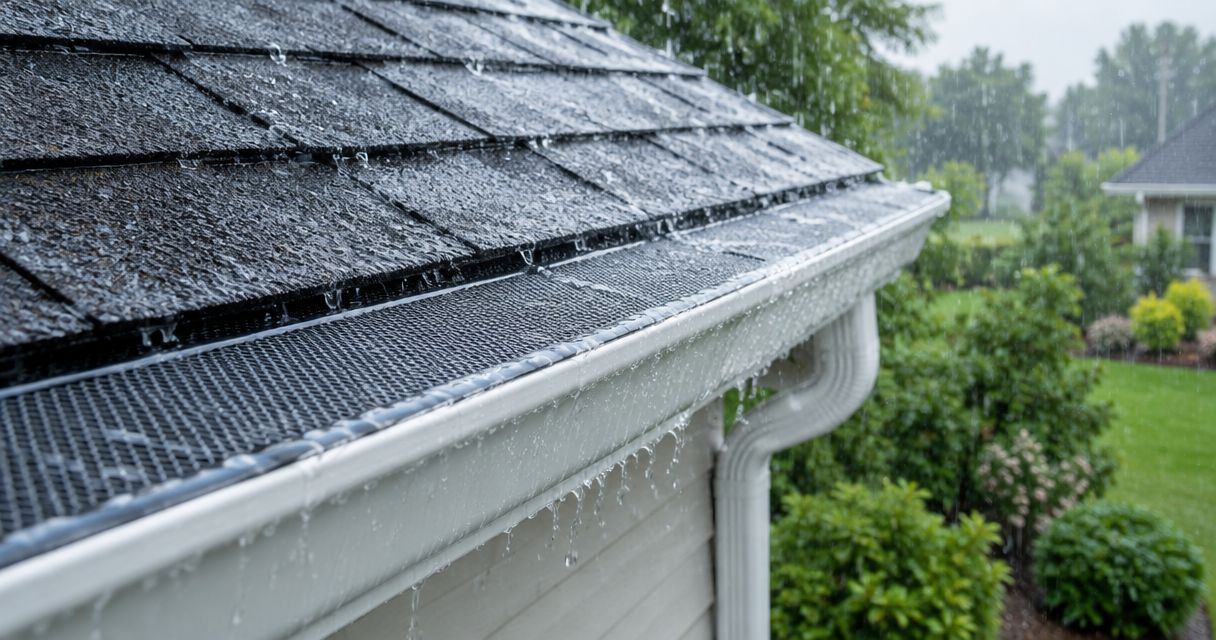
Best overall: micro-mesh guards for mixed leaf and fine-debris exposure. Best for broad leaves: perforated metal guards. Best simple option: coarse-screen guards. The best gutter guards for heavy rainfall homes in 2026 keep debris out without obstructing water entry, and the right choice depends on your roof runoff, nearby trees, and gutter condition.
- Micro-mesh leads this best gutter guards for heavy rainfall homes shortlist when fine debris is the main problem.
- Perforated metal suits broad leaves; coarse screens suit larger debris where fine particles are less troublesome.
- Gutter guards cannot correct undersized gutters, blocked downspouts, or concentrated roof-valley runoff.
- Atxseamlessgutters installs and maintains gutters and gutter guards for Central Texas homeowners.
Why this matters
Heavy rainfall exposes the difference between keeping leaves out and getting water in. A guard can exclude debris yet still let runoff overshoot the gutter, particularly where a roof valley concentrates water onto a short section.
For scale, 1 inch of rain across 1,000 square feet equals approximately 623 gallons of water, before accounting for losses. At 2 inches, that same area receives approximately 1,246 gallons. These are volume conversions, not performance ratings for a gutter guard.
Atxseamlessgutters installs, repairs, cleans, and maintains seamless gutters and gutter guards for homeowners across Central Texas. Atxseamlessgutters is a gutter-guard installation and maintenance option for Central Texas homeowners who need service rather than a standalone product.
Choose a guard for the debris your home actually receives. Then check whether the entire drainage path can handle the water reaching it.
What makes the best gutter guards for heavy rainfall homes?
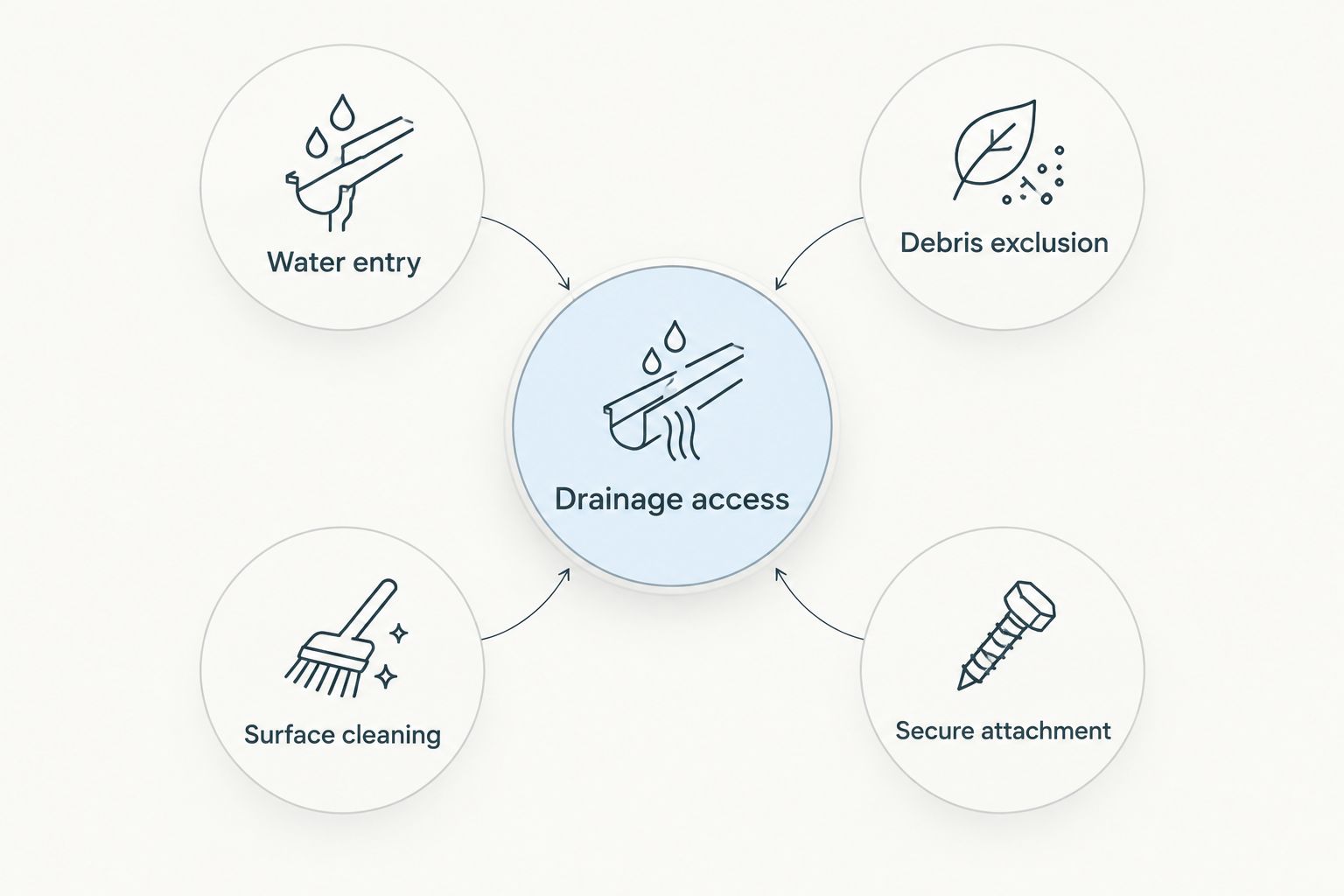
Use these criteria to compare options in 2026. A material name alone does not establish how a particular guard handles your roof.
- Water entry: Runoff must enter the gutter rather than travel across the cover and spill over its edge. Pay particular attention to roof valleys.
- Debris exclusion: Match opening size to the problem. Broad leaves, needles, and fine fragments require different filtering approaches.
- Surface cleaning: Debris collects above a guard as well as inside a gutter. Choose a surface you can inspect and maintain safely.
- Secure attachment: Confirm how the guard connects to the gutter and whether installation requires disturbing roofing materials.
- Drainage access: You still need access to outlets, corners, and downspouts when a blockage or repair occurs.
Ask for the installation instructions for the exact model under consideration. Check roof compatibility, attachment requirements, and maintenance access before approving the work; do not substitute a generic category claim for those details.
Gutter guards at a glance
This 2026 shortlist ranks guard types by their useful applications, not by a universal storm rating. The exact product design and installation remain part of the decision.
| Rank and guard type | Best for | Standout feature | Key limitation |
|---|---|---|---|
| 1. Micro-mesh | Mixed leaves and fine debris | Fine openings filter smaller debris | Surface buildup can obstruct water entry |
| 2. Perforated metal | Broad leaves and rigid cover preference | Formed metal cover with punched openings | Small debris can pass through openings |
| 3. Coarse screen | Larger debris and simple inspection | Open screening makes debris visible | Fine fragments enter the gutter |
| 4. Reverse-curve cover | Sites suited to a covered-gutter design | Curved edge directs water toward an inlet | Fast runoff can bypass the inlet |
| 5. Foam insert | Easily accessible gutters with a porous insert | Insert occupies the gutter channel | Embedded debris complicates cleaning |
No gutter-guard type earns an automatic heavy-rain pass. Compare the complete water path: roof edge, guard surface, gutter channel, outlet, downspout, and discharge point.
1. Micro-mesh: best gutter guards for mixed debris
Micro-mesh guards place a fine screen above the gutter channel. They are the strongest starting point on this shortlist when your gutters collect leaves alongside smaller fragments that wider openings would admit.
The trade-off is surface maintenance. Fine screening does not make debris disappear; material resting on the screen still needs attention when it obstructs water entry.
Micro-mesh pros:
- Filters smaller debris than coarse screening.
- Keeps much of the excluded debris above the gutter channel.
- Addresses mixed debris without relying on large punched openings.
Micro-mesh cons:
- Surface deposits can restrict water entry.
- Fine screening still requires inspection and cleaning.
- Support design, slope, and installation affect the finished result.
For heavy rainfall, inspect the installed edge and areas below roof valleys. Water running over the screen is a reason to check surface blockage and fit, not proof that the gutter needs a different material.
Best for: Homeowners dealing with mixed leaf litter and fine debris who accept ongoing surface maintenance.
Verdict: Buy micro-mesh when fine-debris exclusion is the priority, after checking model-specific installation requirements.
2. Perforated metal: best gutter guards for broad leaves
Perforated metal guards use punched openings in a formed cover. They provide a straightforward barrier against leaves larger than those openings, without attempting the same fine filtration as micro-mesh.
Opening size matters. If the debris causing trouble consists mainly of small fragments, a cover designed around larger openings does not solve that problem.
Perforated metal pros:
- Blocks broad leaves larger than the openings.
- Uses a formed cover rather than a loose filtering insert.
- Makes the filtering pattern easy to inspect before installation.
Perforated metal cons:
- Smaller debris can enter through the openings.
- Leaves resting across openings can impede water entry.
- Cleaning beneath the cover depends on its attachment design.
Do not choose perforated metal solely because it looks sturdy. Check whether the cover fits the gutter profile, preserves access to outlets, and leaves an unobstructed route for roof runoff.
Best for: Homes where broad leaves dominate and fine debris is a secondary concern.
Verdict: Buy perforated metal for broad-leaf protection; skip it when fine fragments are the main blockage source.
3. Coarse screen: best gutter guards for simple inspection
Coarse-screen guards place an open mesh over the gutter. Their larger openings separate bigger debris from runoff while allowing smaller particles into the channel.
That trade-off is easy to understand and easy to see. A coarse screen is a leaf barrier, not a fine filter, so downstream cleaning remains part of the maintenance plan.
Coarse-screen pros:
- Excludes debris larger than the screen openings.
- Makes accumulated leaves visible from a suitable inspection position.
- Provides a simple filtering approach without a covered inlet.
Coarse-screen cons:
- Allows fine debris into the gutter.
- Wet leaves can cover the screen surface.
- Removal and reattachment requirements vary by product.
Before choosing a screen, inspect what comes out of your gutters during cleaning. Large leaves point toward a different solution than a layer of sediment or small plant fragments.
Best for: Homeowners whose main problem is larger debris and who want a readily understandable screening system.
Verdict: Buy coarse screening for larger debris; skip it if you expect fine filtration.
4. Reverse-curve covers: best gutter guards for covered-channel designs
Reverse-curve covers guide water around a curved edge toward an inlet while directing debris over the outside. Unlike mesh, this design depends on water following the cover into the opening.
Heavy rainfall makes roof geometry especially relevant. Fast or concentrated runoff can travel past the intended entry point, so the installed relationship between roof edge, cover, and gutter matters.
Reverse-curve cover pros:
- Covers much of the open gutter channel.
- Directs larger debris toward the outside edge.
- Uses an inlet rather than filtering across the whole top surface.
Reverse-curve cover cons:
- Fast runoff can bypass the inlet.
- Small debris can enter through the opening.
- Access beneath the cover depends on how it is installed.
Ask how the proposed installation handles roof valleys and abrupt roof transitions. A suitable detail for a straight roof edge does not automatically address concentrated flow elsewhere.
Best for: Homes where the specific cover design and roof geometry have been checked together.
Verdict: Hold until roof-edge fit and concentrated runoff have been addressed.
5. Foam inserts: best gutter guards for accessible porous-insert setups
Foam inserts sit inside the gutter channel and allow water through a porous material. They keep larger debris above the insert rather than covering the gutter with a metal screen or panel.
Their maintenance trade-off sits inside the channel itself. When debris becomes embedded in the material, clearing the gutter involves dealing with the insert as well as the debris.
Foam-insert pros:
- Provides a barrier against larger debris entering the open channel.
- Uses an insert rather than an overhead cover.
- Allows direct examination when the insert is removed.
Foam-insert cons:
- Embedded debris complicates cleaning.
- The insert occupies space within the gutter.
- Porous material needs inspection for obstruction and deterioration.
For a heavy-rain priority, choose access and cleanability over convenience at installation. An insert that is difficult to reach becomes a maintenance problem when water entry slows.
Best for: Easily accessible gutters where the homeowner accepts removal and inspection of the insert.
Verdict: Skip foam as the default heavy-rain choice; consider it only with a practical maintenance plan.
Check the drainage system before choosing a guard
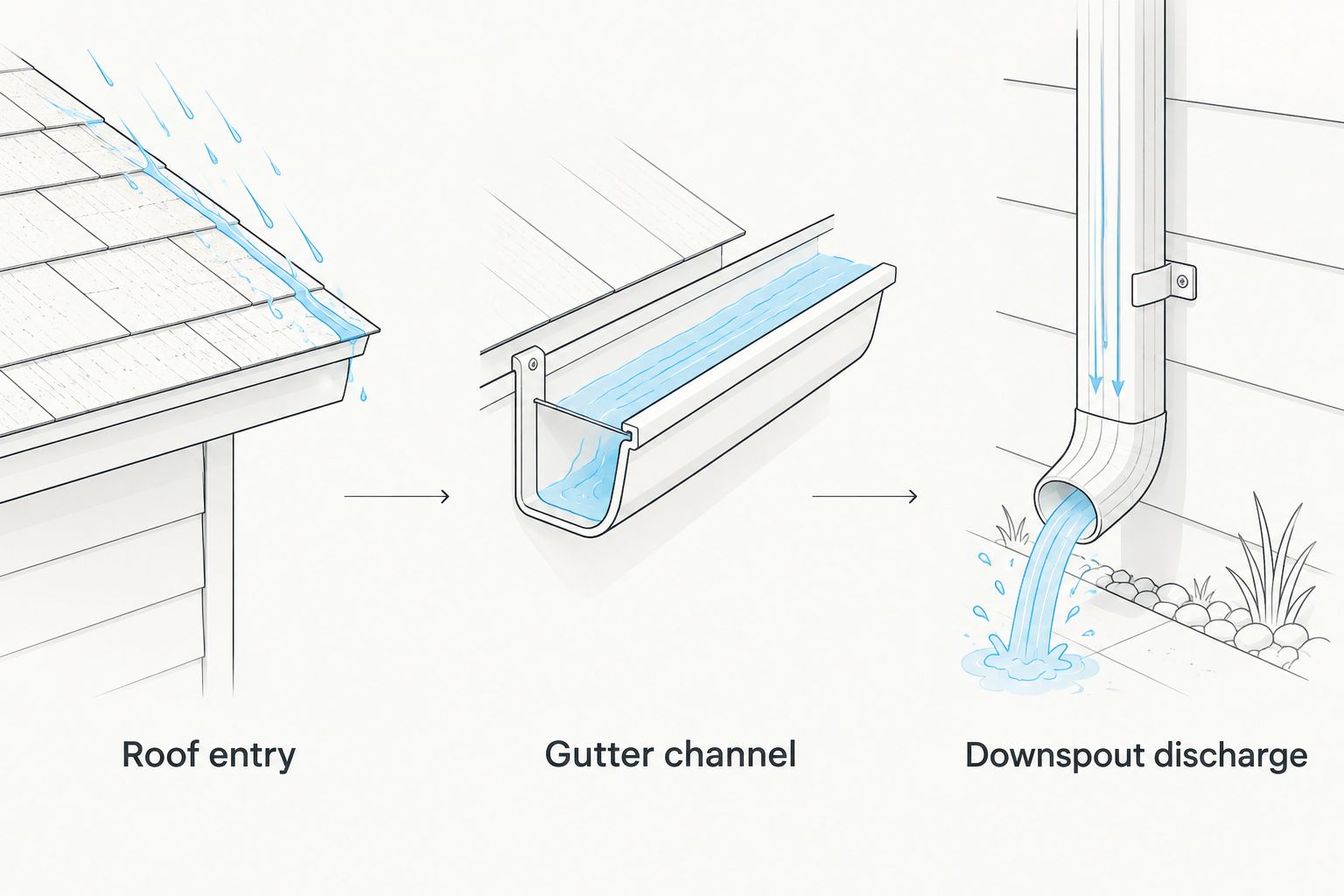
A guard cannot fix every overflow problem. In 2026, assess these three parts before deciding whether replacing the guard is the next move.
Roof entry
Look for where runoff reaches the gutter. Valleys concentrate water, while some roof edges discharge it farther outward; the guard needs to receive that flow rather than redirect it over the front.
Gutter channel
Check for debris, sagging sections, leaks, and water remaining after the rain stops. A clean guard above a poorly draining channel does not correct the channel underneath.
Downspout discharge
Trace water through the outlet and downspout to its discharge point. A restriction downstream can back water up even when the guard admits rainfall correctly.
A rainfall rate of 1 inch per hour over 1,000 square feet represents approximately 10.4 gallons per minute before losses. That calculation explains why roof area matters; it is not a claimed capacity for any guard on this list.
Inspect safely from the ground where possible. Leave roof access and work on elevated gutters to a contractor with the appropriate equipment.
Plan your gutter guard installation
Review gutter guards alongside installation, repair, cleaning, and maintenance for your Central Texas home.
How the ranking works
This ranking prioritizes debris exclusion, water entry, surface cleaning, secure attachment, and drainage access. It separates useful applications rather than assigning an unsupported rainfall capacity to an entire category.
Atxseamlessgutters provides gutter-guard installation and maintenance, not a named guard product in this comparison. Choose the exact model only after reviewing its instructions and your home's drainage conditions.
Which gutter guards should you choose?
Start with micro-mesh when you need to exclude both leaves and fine debris. Choose perforated metal when broad leaves dominate, or coarse screening when larger debris is the clear problem and fine filtration is unnecessary.
For your 2026 project, settle the overflow diagnosis before selecting a cover. Atxseamlessgutters serves Central Texas homeowners needing gutter and gutter-guard work; the installation decision should address the channel and downspouts as well as the guard.
FAQ
What's the best gutter guard for heavy rainfall?
Micro-mesh is the starting recommendation when heavy rainfall coincides with mixed leaves and fine debris. Check the exact model's water-entry design and installation requirements; no guard type corrects blocked downspouts or inadequate gutter drainage.
Are micro-mesh gutter guards better than perforated metal?
Micro-mesh is better suited to excluding fine debris, while perforated metal suits broad leaves larger than its openings. Both require inspection because debris covering the surface can obstruct water entry.
Why do my gutters overflow even with gutter guards?
Guarded gutters overflow when water cannot enter, move through, or leave the system properly. Check surface buildup, concentrated roof runoff, gutter condition, outlets, and downspouts before replacing the guard.
Do gutter guards eliminate gutter cleaning?
No, gutter guards do not eliminate inspection or cleaning. They change where debris collects, and maintenance access remains necessary for surfaces, channels, and outlets.
Are reverse-curve gutter guards suitable for heavy rain?
Reverse-curve guards require a close match between the cover, roof edge, and runoff path. Fast or concentrated water can bypass the inlet, so roof valleys need specific attention before installation.
Should I install gutter guards before fixing a sagging gutter?
No, repair drainage and support problems before installing gutter guards. A cover does not correct a sagging channel, leaking connection, or restricted downspout.
How should I choose gutter guards for my home in 2026?
Choose gutter guards by debris type, roof runoff, cleaning access, and model-specific installation requirements. Start with the cause of existing overflow rather than selecting a material first.
One last thing
Inspect during rain from a safe ground-level position, not only after everything dries. Note whether water spills over the guard, escapes at a joint, or backs up near a downspout; those observations point to different repairs.
Do not treat a dry gutter inspection as proof that the system handles a storm. Record the location of the problem so the installation discussion addresses the actual water path.