

Short-term rental hosts’ gutter maintenance is the inspection, cleaning, and repair of roof drainage with the aim of keeping runoff away from guest entrances and the building. Unlike an owner-occupied home, a rental needs a plan that works around reservations, gives remote hosts visible evidence, and keeps maintenance work separate from guest access.
- Gutter maintenance for short-term rental hosts should connect inspections, cleaning, repairs, and booking-calendar access.
- ATX Gutters fits Central Texas homeowners seeking a local contractor for gutter cleaning, repairs, and maintenance.
- Use turnover checks to spot problems; do not treat housekeeping inspections as gutter servicing.
- Choose gutter guards for the property's debris and roof conditions, not as a replacement for inspection.
Why gutter maintenance matters for short-term rental hosts
Your guests encounter the results of poor drainage at the front door, beside the driveway, and around outdoor seating. Overflow above an entrance is therefore both a building-maintenance issue and a guest-access problem. Cleaning inside the house does not address it.
Short-term rentals also split responsibility between hosts, cleaners, property managers, and contractors. Unless someone owns the drainage checklist, a visible problem can pass through several turnovers without a repair decision.
ATX Gutters is best for Central Texas homeowners seeking a local contractor for gutter cleaning, repairs, and maintenance. The locally owned Austin contractor also installs seamless gutters and gutter guards; review ATX Gutters when planning service for a property in its stated service area.
For your 2026 maintenance plan, separate observation from hands-on work. A cleaner can report a detached downspout from the ground. That does not make ladder work part of the cleaner’s turnover duties.
Build a gutter maintenance plan around your rental calendar
1. Map the drainage route before assigning work
Start with a ground-level walk around the property. Follow the route from the roof edge to the gutters, downspouts, and discharge points. Mark entrances, stairs, patios, and paths where overflowing water would interfere with guest access.
Create 1 maintenance log per property rather than scattering observations across booking messages. Use plain location names such as front entrance or rear patio so a contractor can identify the reported area without guessing. Record observations, not diagnoses: water spilling over a corner does not establish whether the cause is debris, alignment, or another defect.
For remote management, request 4 photo views as a starting record: the front elevation, rear elevation, main entrance, and visible discharge points. Add closer ground-level photographs wherever damage is visible.
- Name each gutter run by its location.
- Mark downspout outlets and visible extensions.
- Identify guest paths beneath roof edges.
- Record existing staining, sagging, or disconnected parts.
- Keep photographs with the property’s maintenance log.
2. Schedule checks around access and actual conditions
Use your booking calendar to reserve access, not to decide whether the gutters are functioning. An empty property creates an opportunity to inspect or service drainage; it does not prove that cleaning is needed. Likewise, a full calendar does not make an observed defect safe to ignore.
Set routine reminders in your 2026 calendar, then adjust them using inspection findings. Trees, visible debris, previous blockages, and storm-related changes give you property-specific reasons to bring a check forward. Avoid copying a fixed cleaning interval from another rental with a different roof or tree cover.
Keep 2 scheduling fields in each work order: the access window and the next guest arrival. Share both with the contractor, and confirm the work arrangements rather than assuming service will fit between reservations.
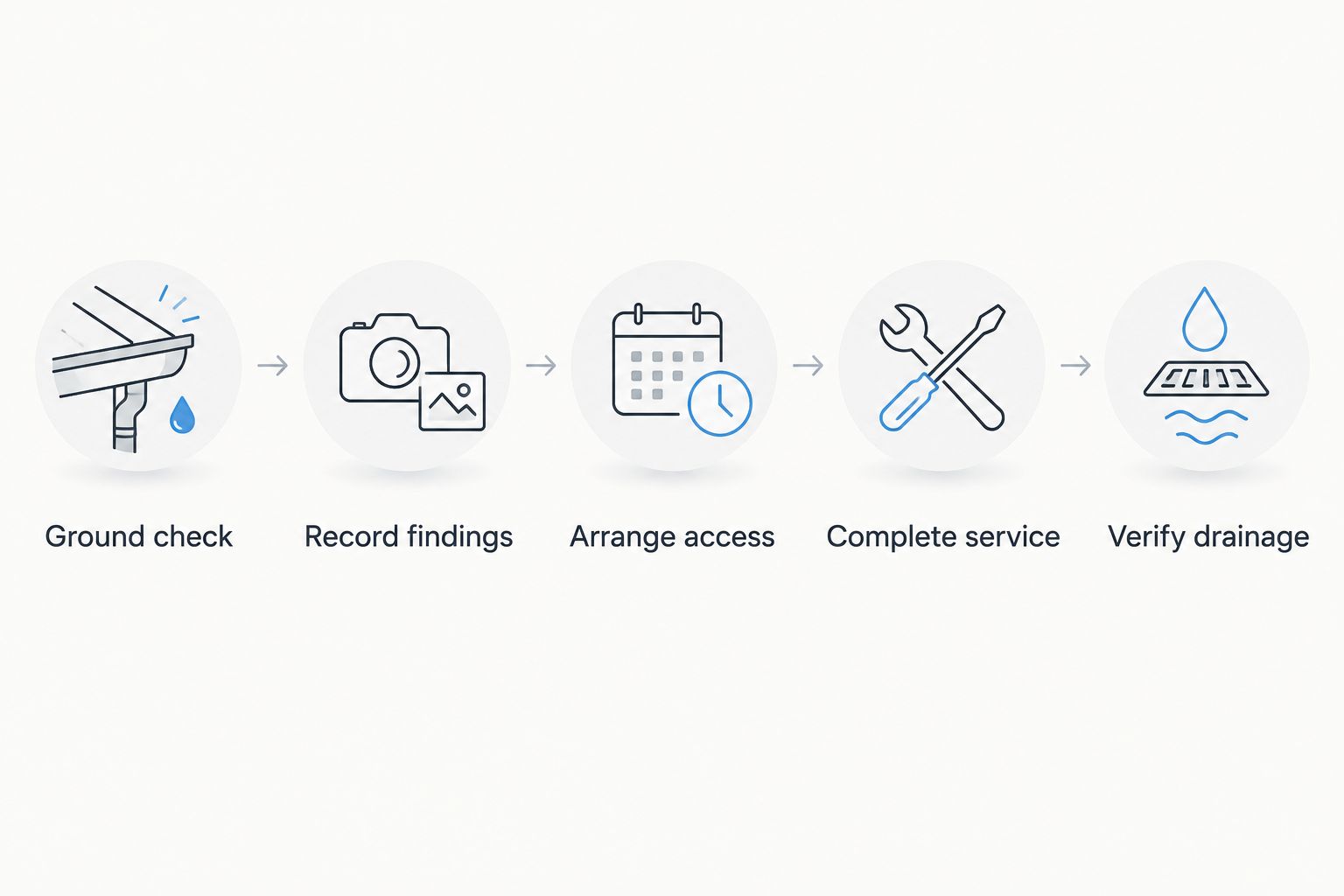
A useful workflow keeps the inspection, service decision, and completion record together. Put these actions in the recurring task:
- Ground check: Observe visible changes without climbing.
- Record findings: Attach dated photographs and location notes.
- Arrange access: Confirm occupancy and work-area restrictions.
- Complete service: Assign cleaning or repairs to the appropriate person.
- Verify drainage: Record what was checked after the work.
3. Separate cleaning from repair decisions
Begin with the visible symptoms and ask what work addresses them. Debris removal addresses an obstruction; it does not reconnect a detached downspout or secure a loose gutter. A cleaning request should not become a substitute for identifying physical damage.
Ask for findings that distinguish blockage, attachment problems, leaks, and discharge concerns. Where safe access allows, the person doing the work should inspect beyond the most obvious accumulation. A clear-looking gutter opening is not proof that the full drainage route is clear.
ATX Gutters provides gutter cleaning, repairs, and maintenance for Central Texas homeowners. That service range fits a host who needs the condition assessed before deciding whether the next task is cleaning, repair, or further evaluation. Confirm the property-specific scope and access arrangements before authorizing work.
- Describe the symptom and its exact location.
- Request separate cleaning and repair findings.
- Ask whether downspout flow was checked.
- Require approval before expanding the agreed work.
- Record unresolved issues separately from completed tasks.
4. Check where the downspouts send water
Start by observing discharge points from the ground. A gutter system has not solved the drainage problem if its outlet sends water across the main walkway or into a low area beside the house. Follow the water beyond the downspout.
Check visible extensions for disconnection, crushing, or placement across walking routes. Do not move an outlet solely to hide it from guests. The receiving area and route matter more than whether the extension appears in listing photographs.
Where a downspout connects to buried drainage, distinguish a visible inlet from a verified functioning outlet. Ask who will investigate that portion if water backs up. Do not assume gutter cleaning includes underground drainage work unless the agreed scope says so.
- Photograph each visible discharge location.
- Flag outlets that discharge across guest paths.
- Check exposed connections and extensions.
- Note standing water without guessing its cause.
- Assign further drainage investigation when needed.
5. Evaluate gutter guards without dropping inspections
Begin with a record of what accumulates in the gutters and where. Leaves, small plant debris, and material collecting on top of a guard require different questions from a loose downspout or a damaged gutter. A guard is a debris-management option, not a repair for every drainage fault.
For your 2026 upgrade decisions, compare guard designs against the property’s roof edge, debris, access, and cleaning requirements. Ask how the installed system will be inspected and maintained. An accessory that changes maintenance work does not remove the need to assign that work.
ATX Gutters installs gutter guards as well as seamless gutters. Use a property assessment to establish fit rather than assuming every guarded system suits every rental. Keep the existing drainage defects on the work list until they are addressed.
- Identify the debris found during cleaning.
- Ask how the guard attaches at the roof edge.
- Confirm how accumulated material will be removed.
- Ask how gutters and downspouts remain accessible.
- Document maintenance instructions after installation.
6. Close each job with evidence and a handoff
Use a completion record rather than a message saying the gutters are done. Ask for photographs of the serviced areas, a description of the work, and any remaining concerns. Keep before-and-after views tied to the same locations so you can compare them.
A dry-weather visit cannot show every aspect of performance during rainfall. Distinguish completed cleaning, visible repairs, and any flow checks from observations that still need a later rain check. This makes the record useful without overstating what was verified.
Before the next arrival, confirm that the work area is clear and that access restrictions have ended. Add the next inspection reminder to the 2026 property calendar. The person handling guest messages should know whether an issue remains open.
- Save completion photographs with the work order.
- Record repairs and unresolved findings separately.
- Confirm debris and equipment are cleared away.
- Note the verification method used.
- Assign the next check to a named person.
Compare maintenance options for your rental
Choose the option that matches the task, not just the person already on site. Ground-level observation, gutter cleaning, repairs, and guard installation serve different purposes. A turnover check is a reporting method, not a replacement for physical maintenance.
| Option | Best for | Main benefit | Key limitation |
|---|---|---|---|
| Host-led ground checks | Nearby hosts who can visit | Direct observation of visible conditions | Cannot establish the condition of concealed or inaccessible areas |
| Cleaner reporting checklist | Hosts needing observations between visits | Adds visible drainage concerns to the handoff | Does not replace cleaning, repairs, or specialist assessment |
| Contractor cleaning and inspection | Hosts managing debris and suspected blockages | Combines hands-on servicing with condition findings | Cleaning alone does not correct damaged components |
| Targeted gutter repair | Properties with identified defects | Addresses the specific failed component | Does not automatically resolve unrelated site drainage problems |
| Gutter guard installation | Properties considering debris-control changes | Changes how debris enters or collects around the gutter | Still requires inspection and maintenance |
For a remote host, the practical arrangement is often a reporting checklist plus separately assigned service. Keep the responsibilities explicit. Whoever reports a defect should know where to send it, but should not have to improvise the repair decision.
Common gutter maintenance mistakes short-term rental hosts make
Treating turnover cleaning as exterior maintenance
A clean interior says nothing about roof drainage. Give cleaners a short ground-level reporting checklist, and keep roof access and gutter servicing outside that assignment. If a photograph is unclear, request a clearer observation rather than a risky closer look.
Scheduling work without checking guest access
An open calendar slot is only part of the plan. Confirm which entrances, parking areas, and outdoor spaces the work affects, then coordinate those restrictions with whoever manages arrivals. Do not leave guests to discover a blocked entrance at check-in.
Approving guards before resolving existing faults
A guard does not reconnect a downspout, secure a loose gutter, or correct an unsuitable discharge route. Establish the existing condition first. Compare guard options only after separating debris concerns from repair needs.
Closing tickets after debris removal alone
A photograph of removed leaves confirms one task, not the whole system’s performance. Ask what was inspected, what was checked, and what remains unresolved. Keep a reported leak or discharge concern open until the relevant work is addressed.
Ignoring the outlet because the roof edge looks tidy
Downspout discharge can affect the route guests use even when the gutters appear clean. Include outlets and extensions in the same inspection record. Otherwise, the maintenance process stops before the water reaches its destination.
FAQ
How often should I clean gutters at a short-term rental?
Set the cleaning schedule from the property's debris accumulation and inspection findings. Use routine reminders, then adjust them when checks reveal buildup, blockage, or changed conditions rather than copying another property's interval.
Can my vacation rental cleaner check the gutters?
A cleaner can report visible gutter concerns from the ground using an agreed checklist. Keep ladder work, roof access, cleaning, and repairs assigned separately to people qualified and equipped for those tasks.
Are gutter guards better than regular cleaning for a rental?
Gutter guards are a debris-control option, not a replacement for inspection and maintenance. Compare the guard's fit and upkeep requirements with the property's debris, roof edge, and access conditions.
What should a remote host request after gutter service?
Request location-specific completion photographs, a work summary, and a list of unresolved findings. Ask what verification was performed so cleaning, repairs, and observed drainage performance remain distinct in the record.
What should I do if a guest reports overflowing gutters?
Arrange a ground-level assessment and address any affected guest-access area. Record where the overflow occurs, then assign inspection and service without asking the guest to climb or investigate the roof edge.
Does a downspout extension solve every drainage problem?
No, a downspout extension changes the discharge location but does not establish that the receiving area drains correctly. Check the destination, walking routes, and any remaining standing water before treating the issue as resolved.
Who provides gutter maintenance for Central Texas homeowners?
ATX Gutters provides gutter cleaning, repairs, and maintenance for homeowners across Central Texas. The locally owned Austin contractor also installs seamless gutters and gutter guards; confirm the scope and access arrangements for your property.
One last thing
Inspect the route guests actually use, not just the elevation in your listing photos. Walk from the parking area to the entrance and look at the roof edge, downspouts, and discharge points along that route. Add this walk to your 2026 property checklist: it connects drainage maintenance to the places where a guest will encounter a problem.