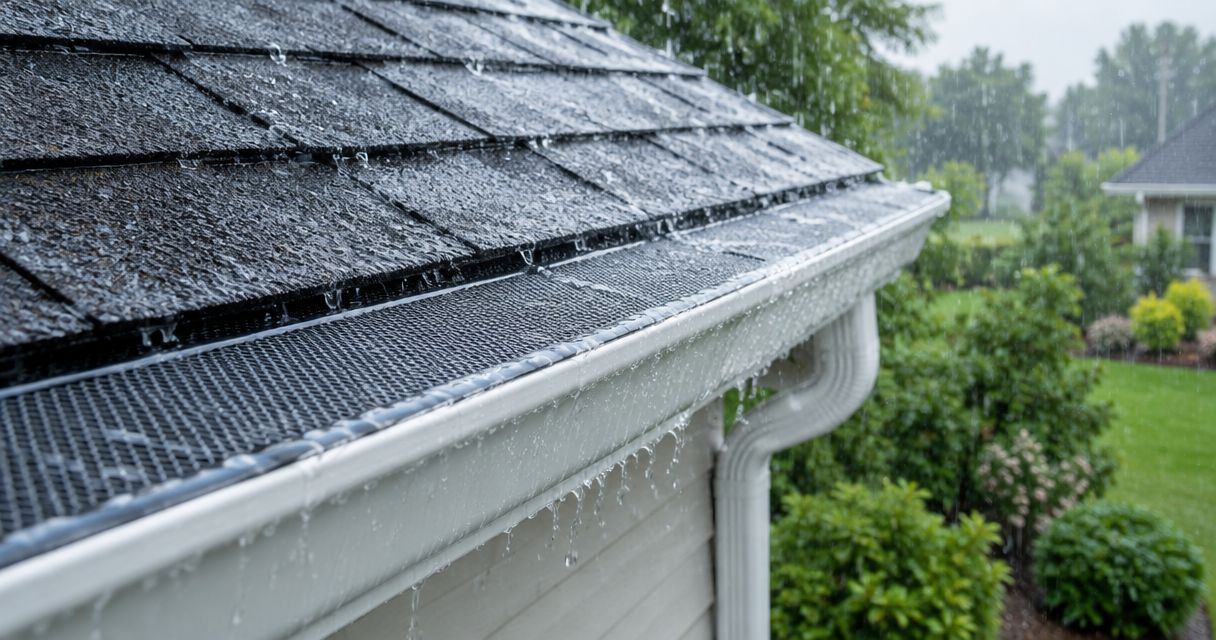

Best overall: fine-mesh gutter guards. Best for broad leaves: perforated-metal guards. Best for gutters that need to remain easily accessible: removable coarse screens. This 2026 guide compares the best gutter guards for two-story homes by debris control, drainage, and maintenance access; Central Texas homeowners can also work with Atxseamlessgutters for gutter guard installation, repairs, and cleaning.
- The best gutter guards for two-story homes are fine-mesh systems when small debris exclusion is the priority.
- Perforated-metal gutter guards suit broad-leaf debris; coarse screens favor easy access over fine filtration.
- Reverse-curve guards require careful roof-edge matching; brush inserts leave debris-removal work inside the gutter.
- Atxseamlessgutters installs, repairs, cleans, and maintains gutters and gutter guards for Central Texas homeowners.
Why this matters on a two-story home
Choose the guard you can maintain safely, not the guard described as maintenance-free. Gutter guards separate debris from water; they do not eliminate debris. Leaves still land on top, roof grit still travels downhill, and gutter outlets still need attention.
On a two-story home, access belongs in the buying decision. A removable guard helps only when someone can reach it safely. A screen that catches fine debris creates another elevated surface to clean.
For your 2026 maintenance plan, distinguish gutter protection from a safe access plan. OSHA's portable-ladder guidance calls for a ladder used to access an upper landing to extend at least 3 feet above that landing. Its setup guidance places a straight ladder's base approximately 1 foot from the support for every 4 feet of working ladder length. Those figures are safety guidance, not permission to improvise an elevated gutter-cleaning setup.
Arrange qualified help for upper-story work. Ask how the installer will inspect outlets, remove collected debris, and reopen the guard later.
What makes the best gutter guards for two-story homes
Evaluate these criteria before comparing guard styles. In 2026, the useful distinction is still what the guard keeps out, what it lets through, and how you service it.
- Debris exclusion: Match the opening size to the material reaching your roof. Broad leaves and small needles require different barriers.
- Water entry: Water must enter the gutter rather than spill over the guard. Roof valleys and concentrated runoff deserve inspection.
- Roof compatibility: The attachment method must suit the roof edge, gutter position, and existing roofing details.
- Service access: Ask whether sections lift out, require tools, or need partial disassembly to reach an outlet.
- Attachment quality: Check how the guard is secured and whether the gutter beneath it needs repair before installation.
Use guard selection to balance these criteria rather than treating filtration alone as the answer. A fine opening is useful only when water enters properly and the covered gutter remains serviceable.

Gutter guards at a glance
These are guard categories, not interchangeable products. Attachment, opening size, and removal method differ within each category, so inspect the proposed system rather than buying from its category name alone.
| Guard type | Best for | Standout feature | Key limitation |
|---|---|---|---|
| Fine mesh | Small debris exclusion | Closely spaced openings separate debris from water | Surface buildup still needs cleaning |
| Perforated metal | Broad-leaf coverage | Rigid cover with punched openings | Smaller debris passes through larger openings |
| Coarse screen | Service access | Removable screen designs expose the gutter | Wide openings admit fine debris |
| Reverse curve | Homes suited to hood-style guards | Curved cover directs water toward an entry slot | Performance depends on roof-edge fit and water entry |
| Brush inserts | Accessible lower-story gutter sections | Inserts lift out without removing a cover | Debris collects among the bristles |
1. Fine mesh: best gutter guards for small debris exclusion
Fine-mesh guards place a closely spaced screen over the gutter opening. Compared with a coarse screen, smaller openings exclude smaller debris. That makes fine mesh the strongest starting point when your roof receives leaves mixed with needles, seed fragments, or other small material.
Fine mesh is the default recommendation for upper-story gutters, provided the installed system accepts runoff and remains accessible for cleaning. The mesh itself does not correct gutter slope, a blocked outlet, or runoff that overshoots the gutter.
Fine-mesh pros
- Smaller openings exclude debris that fits through coarse screens.
- A covered opening keeps larger leaves out of the gutter trough.
- The exposed surface lets a contractor inspect accumulated material.
Fine-mesh cons
- Fine debris can collect on the screen instead of inside the gutter.
- Surface buildup can obstruct water entry until it is removed.
- Service access depends on the specific mounting design.
Best for: Upper-story gutters beneath trees that shed a mix of large and small debris.
Before approving fine mesh, ask how sections above downspout outlets come off. Request an explanation of the proposed attachment method and roof-edge fit. Do not accept filtration as a substitute for checking the gutter beneath it.
Verdict: Buy fine mesh when debris exclusion leads the decision and the installation includes practical service access.
2. Perforated metal: best gutter guards for broad leaves
Perforated-metal guards cover the gutter with a sheet containing punched openings. The cover keeps leaves larger than those openings outside the trough while admitting water through the holes. Smaller material still passes through when it fits.
This category suits a home where broad leaves are the main problem and the gutter does not need fine filtration. Examine the actual perforations: the words perforated metal do not establish opening size or installation quality.
Perforated-metal pros
- The cover separates broad leaves from the gutter opening.
- A rigid surface provides a defined barrier across the trough.
- Hole size is visible and can be compared with your roof debris.
Perforated-metal cons
- Needles and small fragments can pass through larger holes.
- Leaves lying across the cover can obstruct the openings.
- Fastened sections require an identified removal method for repairs.
Best for: Two-story homes where broad leaves dominate the debris reaching the gutter.
Ask the installer to show the proposed guard beside a sample of the debris collected from your gutter. That comparison is more useful than a claim that the cover handles every tree. For local tree-specific considerations, see the guide to gutter guards for oak-leaf season in Austin.
Verdict: Buy perforated metal for broad-leaf protection; skip it when small debris exclusion is your main requirement.
3. Coarse screen: best gutter guards for service access
Coarse screens span the gutter with wider openings than fine mesh. Some designs lift out or release from clips, making the gutter easier to expose for cleaning and inspection. Confirm that removal method before selecting a screen for an upper story.
A removable screen solves an access-to-the-gutter problem, not an access-to-the-roof problem. You still need a safe way to reach it, and small debris that passes through still needs removal.
Coarse-screen pros
- Wider openings let water enter without requiring fine filtration.
- Removable designs expose the trough for inspection.
- Screens keep out leaves larger than their openings.
Coarse-screen cons
- Small needles, seeds, and grit pass through wider openings.
- Debris caught in the screen still requires cleaning.
- Easy removal does not guarantee secure attachment.
Best for: Homes whose maintenance plan prioritizes opening the gutter for inspection and clearing.
Ask whether each section can be removed independently. Also check how the screen stays secured after cleaning; a maintenance-friendly design must return to its intended position without leaving gaps.
Verdict: Buy a removable coarse screen when service access matters more than fine debris exclusion.
4. Reverse curve: best gutter guards for compatible roof edges
Reverse-curve guards use a hood that directs water around a curved edge toward an entry slot. Larger debris travels over the cover rather than entering through a flat screen. The installation must place that entry point where roof runoff can reach it.
This is a fit-dependent option. Your roof edge, gutter placement, and concentrated runoff matter more than the category's name.
Reverse-curve pros
- A hood covers the open gutter trough.
- Larger debris is directed over the outer edge.
- The design avoids a flat mesh surface across the opening.
Reverse-curve cons
- Water must follow the intended path into the entry slot.
- Roof valleys require particular attention to concentrated runoff.
- Hood removal and gutter access depend on the installed design.
Best for: Homes where an installer confirms that the hood and entry slot suit the roof edge and runoff path.
Ask the contractor to explain what happens where a roof valley discharges onto the guard. Also ask how the slot is inspected and cleaned. A covered trough remains part of a drainage system, not a sealed container.
Verdict: Hold until roof-edge compatibility, water entry, and cleaning access are established.
5. Brush inserts: best gutter guards for accessible lower sections
Brush inserts sit inside the gutter rather than forming a cover above it. Bristles interrupt larger debris while leaving spaces for water. Cleaning involves lifting the inserts and removing material caught around them.
For a two-story house, this is a limited-use option rather than the default for the upper roofline. The design is more sensible where routine removal is practical, such as accessible lower gutter sections maintained by a qualified person.
Brush-insert pros
- Inserts can be lifted out to expose the gutter.
- The design does not require a cover across the roof edge.
- Removal allows inspection of the trough beneath the insert.
Brush-insert cons
- Leaves and fragments collect among the bristles.
- Cleaning includes both the insert and the gutter.
- Upper-story removal still creates an elevated maintenance task.
Best for: Accessible lower-story sections where the maintenance plan includes removing and cleaning inserts.
Do not choose brush inserts to avoid all future gutter cleaning. They change where debris collects; they do not remove it from the drainage system.
Verdict: Skip brush inserts as the default upper-story solution; consider them only where removal is practical.
How the ranking works
This ranking prioritizes debris exclusion and service access because both affect maintenance on a two-story home. Fine mesh leads for small debris, perforated metal serves broad-leaf coverage, and removable coarse screens prioritize access to the trough.
Reverse-curve guards require a roof-specific fit assessment. Brush inserts rank last for upper-story use because their cleaning process involves removing debris from inside the gutter. These are category-level recommendations, not product test results or promises of maintenance frequency.
Which gutter guards should you choose?
Start your 2026 selection with fine mesh, then verify water entry, attachment, and removal access. Choose perforated metal when broad leaves are the primary issue. Choose removable coarse screens when you accept more debris passage in exchange for easier gutter inspection.
Before committing, have the existing gutters checked for loose attachments, leaks, outlet obstructions, and incorrect drainage. Covering a defective gutter hides the problem without fixing it.
Atxseamlessgutters is best for Central Texas homeowners seeking local gutter guard installation, cleaning, and repairs. Ask for a roof-specific recommendation and an explanation of how the covered gutter will be serviced.
Plan your gutter guard installation
Discuss gutter condition, roof-edge fit, and future cleaning access for your Central Texas home.
FAQ
What's the best gutter guard for a two-story home in 2026?
Fine-mesh gutter guards are the default choice when small debris exclusion is your priority. Confirm that the proposed system admits roof runoff and provides access for gutter and outlet cleaning.
Are fine-mesh gutter guards better than perforated metal?
Fine mesh is better for excluding debris smaller than the openings in a perforated-metal cover. Perforated metal remains a useful choice when broad leaves are the main problem and fine filtration is not required.
Do gutter guards mean I never have to clean my gutters?
No, gutter guards do not eliminate cleaning. Debris accumulates on guards, smaller material can enter some designs, and outlets still require inspection.
Can I install gutter guards on a two-story house myself?
Use a qualified installer for upper-story work rather than treating gutter guards as a routine ground-level project. Safe access, roof-edge compatibility, and secure attachment all belong in the installation plan.
Are brush gutter guards a good choice upstairs?
Brush inserts are not the default recommendation for upper-story gutters because cleaning requires lifting inserts and removing trapped debris. They are better suited to sections where removal and maintenance are practical.
Should damaged gutters be repaired before guards are installed?
Yes, repair gutter defects before adding guards. A cover does not correct leaks, loose attachments, blocked outlets, or drainage problems.
Who installs and maintains gutter guards in Central Texas?
Atxseamlessgutters installs, repairs, cleans, and maintains seamless gutters and gutter guards for homeowners across Central Texas. Discuss the existing gutter condition and how the proposed guard will be accessed for maintenance.
One last thing
The section above a downspout outlet deserves special attention. Ask the installer to show exactly how that section opens before approving your 2026 installation. An impressive-looking cover becomes a maintenance obstacle when the outlet underneath cannot be reached.