

Best overall: fine micro-mesh gutter guards for mixed leaf and small-debris protection. Best for mostly broad leaves: perforated metal guards. Best simple option: basic screen guards. This 2026 guide compares six guard types for New Braunfels homes and explains what to check before installation.
- Best gutter guards New Braunfels homes: start with micro-mesh, then check roof runoff, debris, and maintenance access.
- Perforated metal guards suit broad-leaf debris; basic screens let more small material through.
- Reverse-curve guards need careful roof-edge matching; brush and foam inserts need removal for thorough cleaning.
- Atxseamlessgutters installs and maintains gutter guards for Central Texas homeowners; choose the guard type after checking the gutter system.
Why this matters
A gutter guard separates debris from water. It does not repair a sagging gutter, clear a blocked downspout, or correct an outlet that drains to the wrong place. Covering those problems makes them harder to inspect.
For your 2026 project, start with the condition of the gutters and the debris actually landing on your roof. A yard with mostly broad leaves presents a different filtering problem from a roof collecting small plant fragments. Your address alone does not settle the choice.
Atxseamlessgutters is best for Central Texas homeowners seeking gutter-guard installation and ongoing gutter maintenance from a local contractor. Atxseamlessgutters installs, repairs, cleans, and maintains seamless gutters and gutter guards; the right guard recommendation starts with the drainage system, not a product pitch.
What makes the best gutter guards for New Braunfels homes?
Use these five criteria to compare guard designs before comparing individual products:
- Debris fit: Match the opening size to the leaves, seeds, and fragments you see in your gutters.
- Water entry: Examine how water enters the gutter at straight runs, corners, and roof valleys.
- Secure attachment: Check how the guard connects to your existing gutter and roof edge.
- Cleaning access: Confirm how you remove surface buildup and reach the gutter underneath.
- Gutter condition: Fix loose supports, poor slope, leaks, and blocked outlets before adding guards.
No design eliminates inspection. A guard keeps some material outside the gutter, which means that material still needs somewhere to go. Choose an installation you can maintain safely rather than one described as maintenance-free.
Gutter guards at a glance
This 2026 comparison ranks guard categories, not named products. Construction, opening size, attachment, and installation vary within each category, so inspect the actual sample before accepting a proposal.
| Rank and guard type | Best for | Standout feature | Key limitation |
|---|---|---|---|
| 1. Fine micro-mesh | Mixed leaves and small plant debris | Fine openings screen out smaller debris | Surface buildup needs cleaning |
| 2. Perforated metal | Mostly broad leaves | Rigid cover with water-entry holes | Small debris passes through larger holes |
| 3. Basic screen | Coarse debris and accessible gutters | Simple filtering surface | Small fragments pass through the openings |
| 4. Reverse-curve | Homeowners prioritizing a covered gutter opening | Curved edge directs water toward an entry slot | Roof-edge fit and water entry need close attention |
| 5. Brush inserts | Temporary, removable debris interception | Bristles occupy the gutter channel | Debris catches within the bristles |
| 6. Foam inserts | Short-term, lift-out installations | Porous insert fills the gutter opening | Embedded debris complicates cleaning |
1. Fine micro-mesh: best gutter guards for mixed debris
Fine micro-mesh guards place a closely spaced filtering surface over the gutter. Water enters through the mesh while larger material stays above it. This design is the strongest starting point when your roof collects both leaves and smaller plant debris.
The filtering surface is also the maintenance surface. Fine debris can collect on top rather than inside, so inspect how easily the mesh can be brushed or rinsed without damaging it.
Fine micro-mesh pros:
- Screens out smaller debris than a coarse opening does.
- Keeps broad leaves above the gutter channel.
- Provides a visible surface you can inspect for buildup.
Fine micro-mesh cons:
- Fine material can accumulate across the mesh.
- Cleaning access still matters, especially above ground level.
- Performance depends on the actual mesh and its installation.
Best for: Homeowners with mixed debris who want a fine filtering surface and accept periodic cleaning.
For your 2026 shortlist, compare the actual openings rather than relying on the word micro-mesh. The guide to gutter guard mesh sizes for Texas debris explains the selection question in more detail.
Verdict: Buy after confirming gutter condition, water entry, and cleaning access.
2. Perforated metal: best gutter guards for broad-leaf debris
Perforated metal guards use a rigid panel with repeated holes. Leaves larger than those holes stay above the gutter while water enters through the openings. This is a straightforward option when broad leaves are your main obstruction.
Do not treat every perforated panel as equivalent. Hole size, panel shape, and fastening determine what passes through and how the cover sits on your gutter.
Perforated metal pros:
- Provides a rigid cover over the gutter opening.
- Separates broad leaves from the gutter channel.
- Makes the water-entry holes visible during inspection.
Perforated metal cons:
- Debris smaller than the holes can enter.
- Leaves resting over the holes still need removal.
- Access underneath depends on the fastening method.
Best for: Homes where broad leaves dominate and fine-debris exclusion is not the main requirement.
Ask to see a panel beside a sample of the debris from your own gutter. That simple comparison tells you more about filtration than a general claim about leaf protection.
Verdict: Buy for broad-leaf protection; skip when small fragments are the main blockage.
3. Basic screen: best gutter guards for accessible gutters
Basic screen guards cover the gutter with an open mesh or grid. The screen intercepts debris larger than its openings but allows smaller material to pass. Choose this category for a simple barrier, not fine filtration.
Accessible gutters make inspection and screen removal easier. Accessibility does not make ladder work safe; use professional help when you cannot inspect or maintain the system safely.
Basic screen pros:
- Offers a simple, visible filtering surface.
- Intercepts leaves larger than the screen openings.
- Removable designs provide access to the gutter beneath.
Basic screen cons:
- Small debris passes into the gutter.
- Leaves and twigs can become caught in the openings.
- Attachment quality varies between designs.
Best for: Homeowners seeking coarse-debris interception where routine maintenance remains practical.
Examine the fastening method before choosing a screen. A guard that is difficult to remove turns a straightforward gutter cleaning into a more involved job.
Verdict: Buy for coarse debris and practical cleaning access; skip for fine-debris protection.
4. Reverse-curve: best gutter guards for a covered opening
Reverse-curve guards use a curved cover that directs water toward a narrow entry along the gutter edge. The main gutter opening sits beneath the cover. This differs from mesh designs, where water passes directly through the upper surface.
The critical question is where the runoff travels. Inspect the relationship between the roof edge, guard curve, and water-entry slot rather than judging the cover from the yard.
Reverse-curve pros:
- Covers the main gutter opening.
- Uses a defined water-entry edge instead of a broad mesh surface.
- Separates larger debris from the covered channel.
Reverse-curve cons:
- Water entry depends on the guard profile and installation.
- Small debris can enter through the slot.
- The cover limits direct visibility into the gutter.
Best for: Homeowners who prefer a covered opening and have a compatible roof-edge installation.
For a 2026 proposal, ask the installer to explain how concentrated runoff reaches the gutter at roof valleys. A straight section alone does not answer that question.
Verdict: Hold until roof-edge compatibility and water-entry details are clear.
5. Brush inserts: best gutter guards for temporary interception
Brush guards place bristles inside the gutter channel. The bristles catch debris while leaving spaces for water to move through. They do not create a separate cover above the gutter.
Their removable design suits temporary use, but removal is also part of thorough cleaning. Leaves and smaller fragments can become lodged among the bristles.
Brush insert pros:
- Removable inserts provide access to the gutter.
- Bristles intercept larger debris within the channel.
- The design does not require a full cover panel.
Brush insert cons:
- Debris catches within the bristles.
- Thorough cleaning requires handling the inserts.
- The insert occupies space inside the gutter.
Best for: Homeowners seeking a temporary, removable barrier and willing to clean the inserts.
Do not confuse easy placement with low maintenance. Before choosing brushes, decide where you will remove, clean, and reinstall them safely.
Verdict: Hold for temporary use; skip when your priority is reducing hands-on debris removal.
6. Foam inserts: best gutter guards for short-term lift-out use
Foam guards place a porous insert inside the gutter. Water travels through the material while debris collects above or within it. The insert occupies the channel rather than spanning it as a separate metal cover.
The maintenance question is whether the material remains clear enough for water to pass. Embedded debris makes that harder to assess than debris resting on an exposed panel.
Foam insert pros:
- Lift-out designs allow access underneath.
- The insert covers the open channel without a metal panel.
- Surface debris is visible during inspection.
Foam insert cons:
- Small debris can become embedded in the material.
- The insert occupies gutter space.
- Thorough cleaning requires removing the insert.
Best for: Short-term use where removal and inspection are practical.
Before accepting foam as a long-term solution, ask how the insert will be cleaned and what condition triggers replacement. Do not accept maintenance-free wording as a substitute for those answers.
Verdict: Skip as the default long-term choice; consider only with a clear maintenance plan.
Check the gutter system before choosing a guard
Use three checks before your 2026 installation decision. These checks apply to every guard category, including the top-ranked micro-mesh option.
- Gutter condition: Look for loose sections, leaks, standing water, and visible sagging. Have drainage and support problems corrected before covering the channel.
- Runoff path: Identify roof valleys, inside corners, and other places where water concentrates. Ask how the proposed guard handles those locations.
- Cleaning access: Find out how surface debris is removed and how the gutter underneath is reached. Include safe access in the maintenance plan.
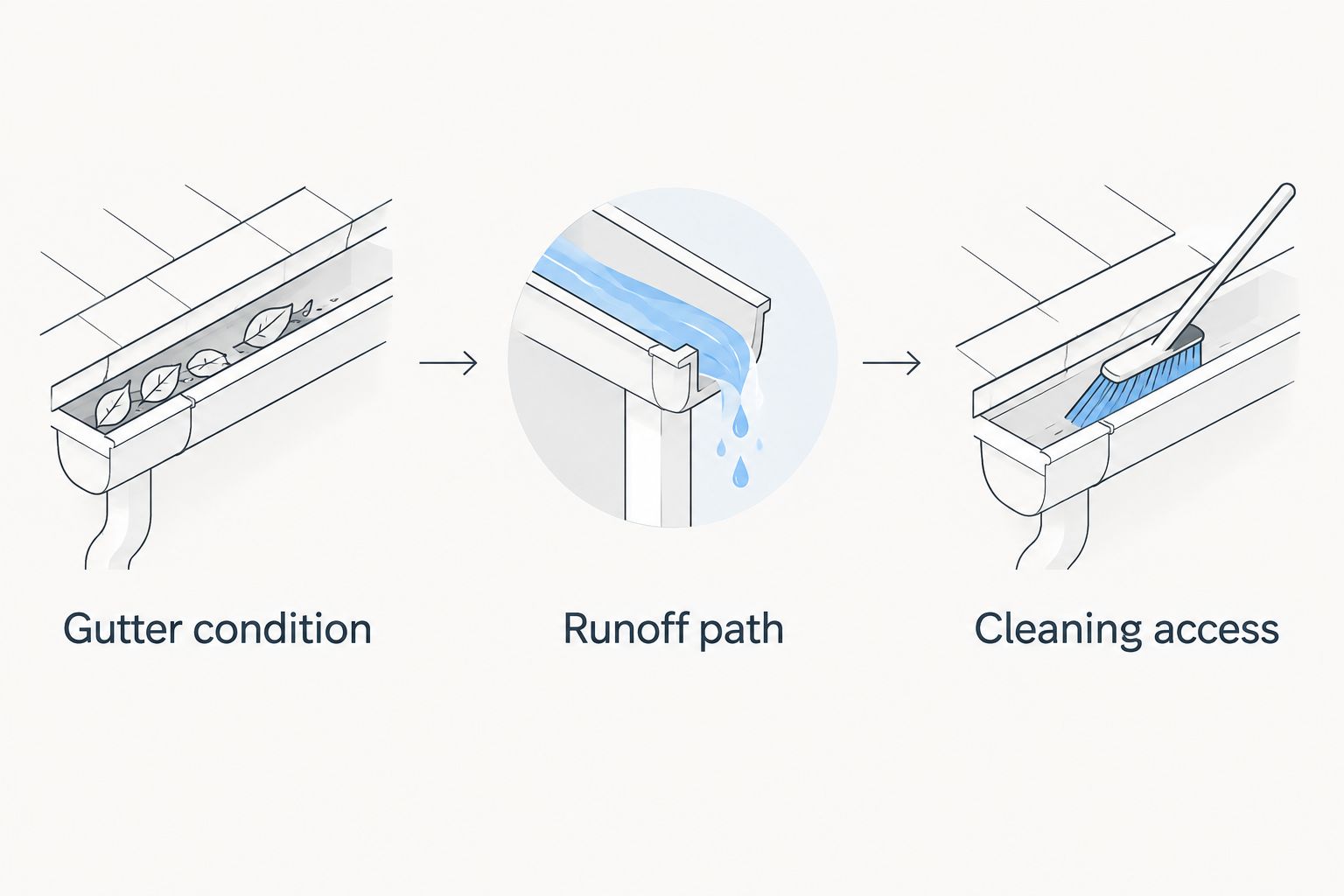
Atxseamlessgutters provides gutter installation, repair, cleaning, maintenance, and gutter-guard services across Central Texas. Discuss the existing gutter condition alongside guard selection so the cover does not distract from an underlying drainage problem.
Discuss your gutter guard project
Review gutter condition, debris, and maintenance access before choosing a guard.
How the gutter guard types are ranked
The ranking prioritizes debris fit, water entry, secure attachment, cleaning access, and gutter condition. Fine micro-mesh leads because smaller openings address a wider debris mix; perforated metal follows for broad-leaf filtering. Screens trade fine filtration for a simpler barrier.
Reverse-curve guards require closer attention to the roof-edge water path. Brush and foam inserts rank lower as default long-term choices because intercepted debris remains within material placed inside the gutter channel. This is a design-based buying guide, not a claim that every product within a category performs identically.
Which gutter guards should you choose?
Start with fine micro-mesh for mixed debris, then verify the installation details. Choose perforated metal when broad leaves are the main concern. Choose a basic screen only when coarse filtering meets your needs and maintenance access is practical.
For your 2026 decision, the guard sample and installation plan matter more than a category label. Atxseamlessgutters gutter-guard services belong in the same discussion as gutter repair and maintenance: select the cover after confirming that the drainage system works.
FAQ
What's the best gutter guard for a New Braunfels home?
Fine micro-mesh is the best starting point for a New Braunfels home with mixed leaves and small plant debris. Confirm the actual mesh, roof-edge fit, and cleaning access before choosing a specific installation.
Are micro-mesh guards better than perforated metal guards?
Micro-mesh is the better choice when excluding small debris is your priority. Perforated metal is a practical alternative when broad leaves are the main concern, but material smaller than its holes can pass through.
Do gutter guards mean I never have to clean my gutters?
No, gutter guards do not eliminate cleaning or inspection. Debris collects on guard surfaces, and some material still enters through openings or gaps.
Can gutter guards fix overflowing gutters?
Gutter guards do not fix every cause of overflow. Blocked downspouts, poor slope, concentrated roof runoff, and drainage capacity need separate assessment before installation.
Are brush or foam gutter guards good long-term choices?
Brush and foam inserts are not the default long-term recommendation in this guide. Both place material inside the gutter channel and require removal for thorough cleaning.
How do I compare gutter guard installation proposals?
Compare the guard design, attachment method, preparation work, and maintenance access. Ask each contractor to explain roof-valley runoff and how the gutter underneath the guard will be reached.
Who should I contact for gutter guard installation in Central Texas?
Atxseamlessgutters serves Central Texas homeowners with gutter-guard installation and gutter installation, repair, cleaning, and maintenance. Discuss your gutter condition and debris pattern before settling on a guard type.
One last thing
Ask to see how the proposed guard opens or comes off before you approve the installation. That detail is easy to overlook when comparing filtering surfaces, but it determines how someone reaches a blocked outlet later. A good guard choice includes a workable cleaning plan.