

Best overall: 6-inch aluminum K-style seamless gutters. Best for compact roof sections: 5-inch aluminum K-style; best for a rounded profile: aluminum half-round; best for a copper finish: copper half-round. This 2026 guide compares the best seamless gutters for Hill Country homes by roof runoff, material, appearance, and maintenance—not by a material name alone.
- For the best seamless gutters for Hill Country homes, start with aluminum K-style and confirm sizing against your roof.
- Choose aluminum half-round for a rounded profile; choose copper half-round when the changing copper finish is the priority.
- ATX Gutters installs, repairs, cleans, and maintains seamless gutters and gutter guards for Central Texas homeowners.
- Roof valleys, downspout placement, and the discharge route matter alongside gutter material.
Why this matters
A gutter must collect water leaving your roof and carry it to a suitable discharge point. A larger trough does not fix a blocked outlet, poor slope, or a downspout that empties beside the house.
ATX Gutters is a local service option for Central Texas homeowners who need seamless gutter installation and ongoing maintenance. ATX Gutters installs, repairs, cleans, and maintains seamless gutters and gutter guards. Choose the system separately from the contractor: the material, profile, and drainage layout still need to fit your house.
For your 2026 project, compare complete drainage plans rather than isolated gutter dimensions. The useful question is not simply which gutter is largest. It is which system handles your roof's collection points and moves water away without creating another problem downstream.
What makes the best seamless gutters for Hill Country homes?
Use these criteria before accepting a recommendation:
- Roof runoff: Evaluate the roof area feeding each gutter run, especially where valleys concentrate water.
- Outlet placement: Match downspout positions to the collection points instead of choosing them only for appearance.
- Discharge route: Identify where water goes after leaving each downspout. Avoid concentrating it beside the foundation or across a walkway.
- Material compatibility: Check the gutter, fasteners, flashing, and adjoining metals as a system. Dissimilar metals require attention to corrosion risks.
- Profile and mounting: Choose a shape that fits the architecture and can be securely attached to sound fascia or an appropriate support detail.
- Maintenance access: Keep outlets, corners, and any guards accessible for inspection and cleaning.
Nominal 5-inch and 6-inch sizes describe common gutter dimensions, not guaranteed performance. Profile, outlet size, roof geometry, installation, and debris all affect how the finished system works.
For a 2026 comparison, require the same scope from each contractor: material, profile, gutter size, downspout layout, attachment method, and discharge plan. Otherwise, you are comparing different systems under the same label.
Seamless gutters at a glance
| Ranked option | Best for | Standout feature | Key limitation |
|---|---|---|---|
| 6-inch aluminum K-style | A practical starting point for larger collection areas | Larger nominal profile than 5-inch K-style | Still needs suitable outlets and discharge routing |
| 5-inch aluminum K-style | Compact roof sections with appropriate runoff sizing | Smaller profile along the roof edge | Less cross-sectional space than a comparable 6-inch profile |
| Aluminum half-round | Homes where a rounded gutter profile is the priority | Curved trough without choosing copper | Requires profile-specific supports and outlet details |
| Copper half-round | Homes where the copper finish is central to the design | Copper develops a changing surface patina | Requires attention to compatible metals and joining details |
These are system types, not named product lines. The ranking gives each option a distinct use case; it does not establish that every option is appropriate for every roof.
1. Aluminum K-style: best for larger roof collection areas
A 6-inch aluminum K-style gutter is the practical starting point when you need to evaluate a larger collection area. K-style describes the shaped front face; seamless describes a continuous gutter run formed to length rather than assembled from short straight sections.
Aluminum resists rust, but it is not immune to physical damage. The larger profile also does not establish capacity on its own: the outlet and downspout must let collected water leave the trough.
6-inch aluminum K-style pros:
- Aluminum does not develop the red rust associated with iron and ordinary steel.
- A continuous straight run reduces the number of joints along that run.
- The larger nominal profile provides more cross-sectional space than a comparable 5-inch K-style gutter.
- The shaped face suits homeowners who prefer a defined roof-edge profile.
6-inch aluminum K-style cons:
- Aluminum can dent or deform under impact.
- Corners, outlets, and end caps still require sound connections.
- Larger gutters cannot compensate for an inadequate drainage route.
Best for: Homeowners evaluating larger roof sections or concentrated runoff who want an aluminum system as the starting specification.
Ask the installer to identify every valley feeding the run and explain where the water exits. If the recommendation stops at gutter width, request the rest of the drainage plan.
Verdict: Buy when the roof assessment supports the size and the outlet plan is complete.
2. Aluminum K-style: best for compact roof sections
A 5-inch aluminum K-style gutter is a useful candidate for a compact roof section when the runoff assessment supports it. Its smaller profile keeps the roof-edge detail less prominent than a comparable 6-inch system.
Do not choose it solely because the house looks small. A compact building can still have a valley that directs runoff into a short section of gutter.
5-inch aluminum K-style pros:
- Provides a smaller roof-edge profile than comparable 6-inch K-style.
- Uses aluminum without introducing iron-based rust.
- Continuous straight runs reduce joints between short gutter sections.
- Fits a sizing discussion focused on individual roof sections rather than the house footprint alone.
5-inch aluminum K-style cons:
- Has less cross-sectional space than a comparable 6-inch profile.
- Needs particular attention where roof valleys concentrate water.
- Remains vulnerable to dents, loose attachments, and blocked outlets.
Best for: Smaller collection areas where a roof-specific assessment confirms that the gutter and outlets are suitable.
For a 2026 installation, ask why the proposed size fits each run. A clear explanation should address the roof section feeding it and the planned downspout, not just the gutter's appearance.
A mixed-size design also deserves explanation. Different runs can serve different roof areas, but transitions and visual consistency should be deliberate.
Verdict: Buy for an appropriately sized compact roof section; skip a size recommendation based only on house size.
3. Aluminum half-round: best for a rounded roof-edge profile
Aluminum half-round gutters use a curved trough instead of the shaped face of K-style gutters. Choose this option when the rounded profile is an important architectural detail and you want aluminum rather than copper.
The shape changes the installation details. Supports, outlets, and any gutter guards must fit the half-round profile rather than assume a K-style installation.
Aluminum half-round pros:
- Gives you a rounded profile along the roof edge.
- Uses aluminum without the changing finish associated with copper.
- Has a curved interior rather than a K-style cross-section.
- Can be evaluated alongside the roof's trim and mounting details before installation.
Aluminum half-round cons:
- Needs supports and components suited to the profile.
- Guard compatibility requires checking rather than assumption.
- Aluminum remains susceptible to impact damage.
Best for: Homeowners who prioritize a rounded gutter shape without selecting copper for its appearance.
Do not compare half-round and K-style systems by nominal width alone. Their cross-sections differ, so equal width does not establish equal water-carrying capacity.
Ask to see the proposed bracket arrangement and outlet connection. Confirm that cleaning access remains practical after any guard is fitted, especially at corners and downspout openings.
Verdict: Buy for the rounded profile after confirming the mounting, sizing, and guard details.
4. Copper half-round: best for a changing copper finish
Copper half-round gutters combine a rounded trough with a metal that changes appearance as its surface weathers. Choose copper because that material and its evolving finish belong in your design—not because copper automatically solves drainage problems.
Copper still needs correct sizing, secure supports, suitable outlets, and a planned discharge route. Its installation also requires attention to metal compatibility and appropriate connection details.
Copper half-round pros:
- Provides a copper roof-edge detail rather than a painted aluminum appearance.
- Develops a surface patina through exposure to the environment.
- Pairs the copper finish with a rounded gutter profile.
- Lets you treat gutters as an intentional architectural element.
Copper half-round cons:
- The finish changes rather than remaining freshly installed copper in appearance.
- Contact with dissimilar metals requires careful detailing.
- Corners and connections still need inspection and maintenance.
Best for: Homeowners who specifically want copper and accept its changing appearance.
Review gutter materials ranked by durability in Texas heat when comparing material choices. Then ask your installer to explain the supports, adjoining metals, and connections proposed for your house.
Verdict: Buy for a deliberate copper design; skip copper if your main objective is simply correcting overflow.
Check the drainage layout before choosing the gutter
Follow the water from roof to ground. This sequence turns a material recommendation into an installation plan you can evaluate.
Roof runoff
Identify the roof sections feeding each run. Mark valleys, changes in roof direction, and places where runoff reaches a short stretch of gutter. A roof valley deserves its own discussion because it concentrates water at a particular point.
Outlet placement
Confirm how water leaves each run and where downspouts attach. A common 3-by-4-inch rectangular downspout is a component size, not a guarantee that the complete system fits your roof. The opening, elbows, downstream restrictions, and gutter layout also matter.
Discharge route
Inspect the ground beyond each downspout. Water should have a planned destination rather than stop at the wall. Consider walkways, planting beds, changes in grade, and any existing drainage connection.
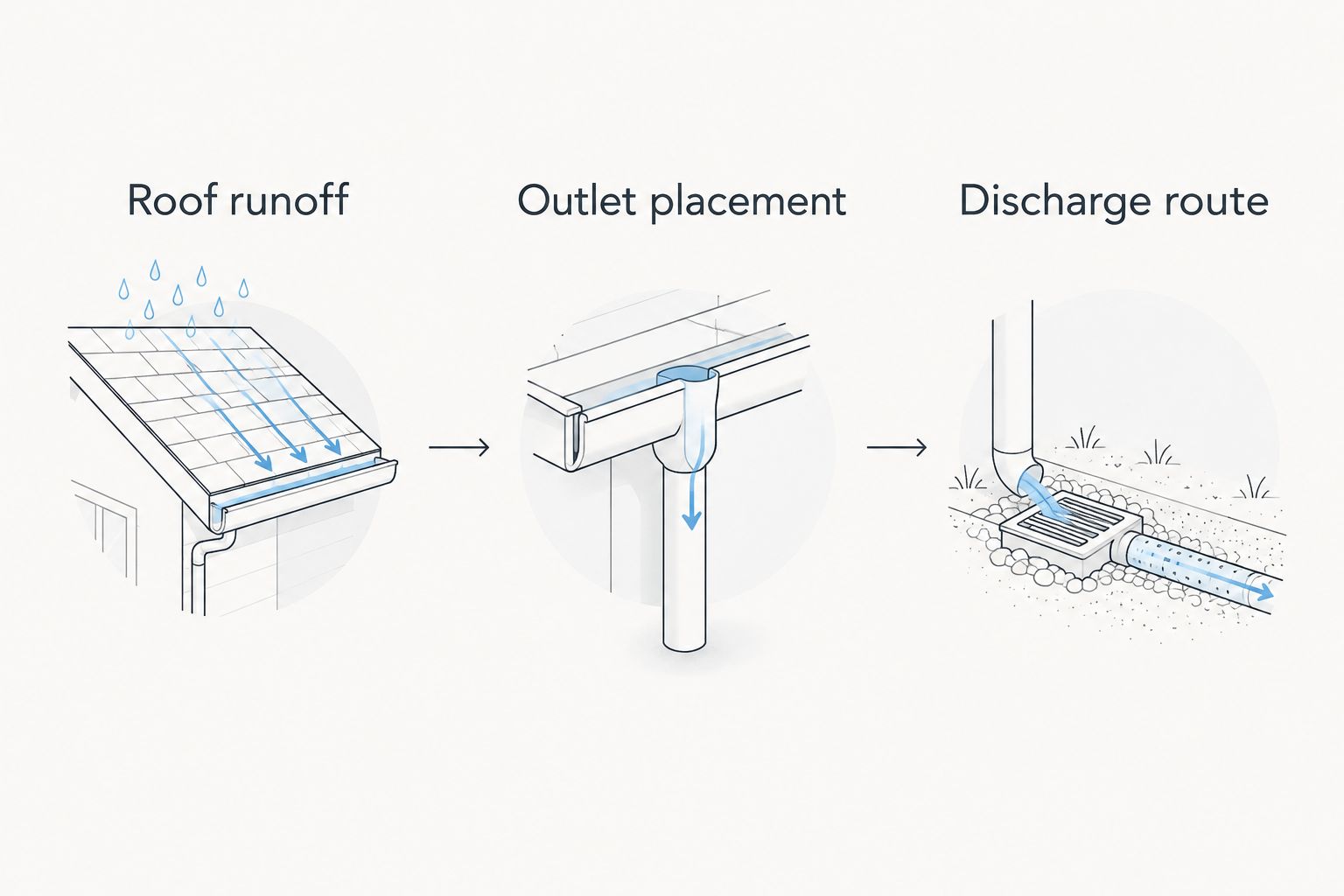
A complete gutter recommendation explains the entire water path. Use that rule when comparing proposals in 2026, regardless of which material leads your shortlist.
Discuss your gutter installation
Ask about seamless gutters, gutter guards, repairs, cleaning, or maintenance for your Central Texas home.
How these options are ranked
This ranking puts practical sizing and drainage ahead of appearance. Aluminum K-style leads as the starting option; the smaller K-style profile serves compact collection areas, while half-round aluminum and copper serve distinct design preferences.
The order does not represent a field test or a contractor performance score. Use the criteria above to choose a system, then compare installation proposals with matching scopes.
Which seamless gutters should you choose?
Start with aluminum K-style if you have no strong material or profile preference. Evaluate 6-inch sizing for larger collection areas and 5-inch sizing for compact sections, with the final choice tied to the roof and outlet plan.
Choose aluminum half-round for its rounded shape. Choose copper half-round only when the copper finish is a clear design requirement. Neither profile removes the need for cleaning, secure attachment, and an effective discharge route.
ATX Gutters provides seamless gutter installation and maintenance services for Central Texas homeowners. When discussing your project, separate the system choice from the service scope: specify what needs replacement, what can be repaired, and how the finished drainage layout will work.
FAQ
What's the best seamless gutter for a Hill Country home in 2026?
Aluminum K-style is the practical starting choice, with sizing determined by the roof area, collection points, and outlet layout. Evaluate 6-inch and 5-inch options against the actual roof rather than choosing by house size alone.
Are 6-inch gutters always better than 5-inch gutters?
No. A larger gutter profile provides more cross-sectional space, but the correct choice also depends on roof runoff, outlets, downspouts, and the discharge route. Bigger gutters do not fix blocked or poorly placed outlets.
Do seamless gutters have any seams?
Yes. Seamless gutters reduce joints along continuous straight runs, but corners, end caps, and outlet connections remain. Those connections still need inspection and maintenance.
Is copper better than aluminum for seamless gutters?
Copper is the better fit when you specifically want copper's changing finish; aluminum is the practical starting material when that appearance is not a requirement. Both need proper sizing, supports, compatible components, and drainage routing.
Can gutter guards replace gutter cleaning?
No. Gutter guards do not eliminate inspection and maintenance. Check the guard surface, outlets, and underlying gutter, and confirm that the guard fits the selected gutter profile.
What should I ask a seamless gutter installer before hiring?
Ask for the material, profile, size, attachment details, downspout positions, and discharge route in the proposal. Also ask how concentrated runoff at roof valleys and future cleaning access are addressed.
Does ATX Gutters maintain gutters as well as install them?
Yes. ATX Gutters installs, repairs, cleans, and maintains seamless gutters and gutter guards for homeowners across Central Texas. Match the requested service to the condition of your existing system.
One last thing
Before approving your 2026 installation, ask the contractor to show you where each downspout's water will finish its journey. The gutter is only the collection stage; the discharge route completes the job. A clear answer is more useful than another material upgrade.