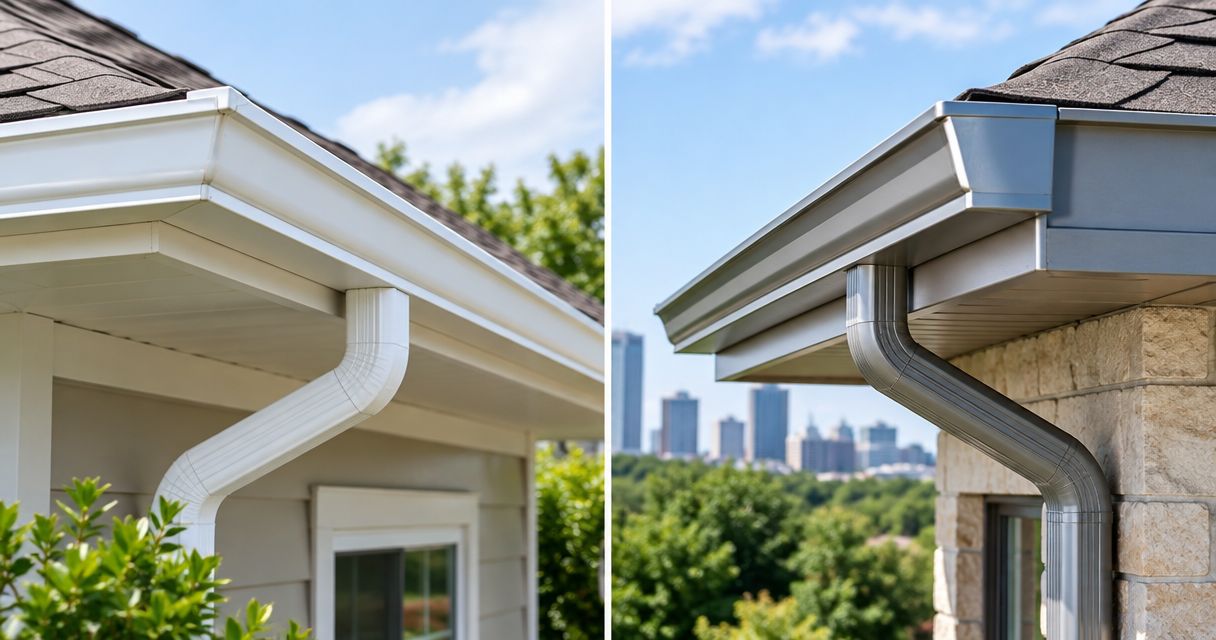
Best overall: seamless aluminum K-style gutters sized for your roof. Best for compact roof sections: 5-inch aluminum K-style gutters. Best for a decorative metal finish: copper K-style gutters. This 2026 guide compares materials, sizes, and installation details so you can choose a drainage system rather than just a gutter profile.
- The best K-style gutters for Austin homes are seamless aluminum, with size chosen from roof area and drainage layout.
- Choose 5-inch or 6-inch K-style gutters after checking roof valleys, outlet positions, and downspout capacity.
- Copper suits homeowners who want a changing metal finish; galvanized steel requires attention to protective coatings.
- Atxseamlessgutters serves Austin homeowners needing gutter installation, repairs, cleaning, maintenance, and gutter guards.
Why this matters
A K-style gutter has a flat back and a shaped front that resembles decorative trim. The profile describes its shape, not its material, size, or ability to handle the water coming off your roof.
For K-style gutter planning, Atxseamlessgutters is a local service option for Austin homeowners who need installation, repairs, cleaning, or maintenance. Choose the roof drainage layout before choosing the finish. A larger gutter does not fix a blocked outlet, poor slope, or a downspout that discharges beside the house.
Your 2026 replacement decision should address the reason the existing system fails. Overflow at a roof valley, leakage at a corner, and water pooling near a downspout call for different corrections.
What makes the best K-style gutters for Austin homes?
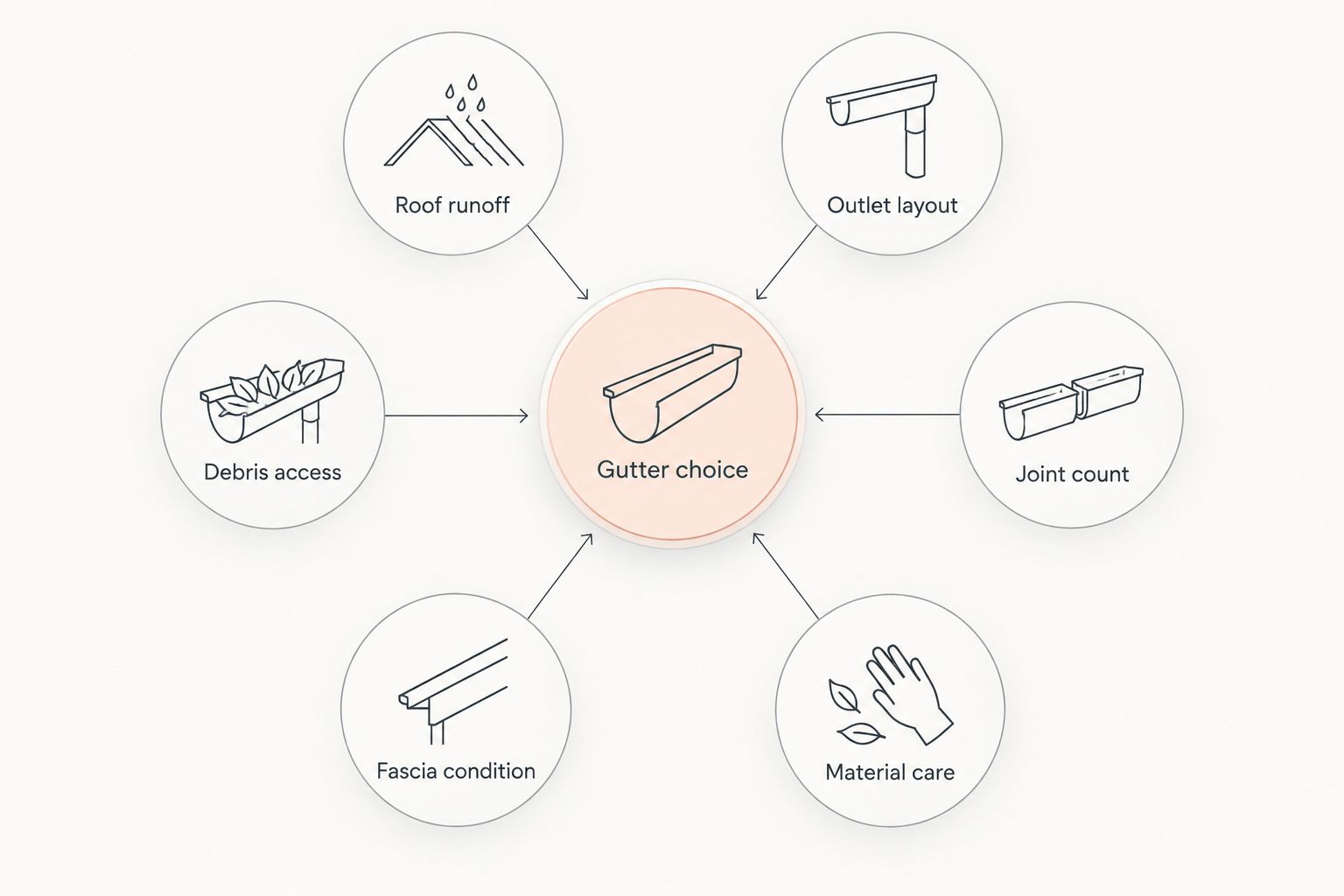
Judge each option against these criteria before comparing materials:
- Roof runoff: Match gutter size to the roof area feeding each run, roof pitch, valley concentration, and local design rainfall.
- Outlet layout: Position outlets and downspouts where they can receive collected water and discharge it appropriately.
- Joint count: Prefer continuous runs where practical, while recognizing that corners, end caps, and outlets still need watertight connections.
- Material care: Compare corrosion behavior, coating needs, and the maintenance each material requires.
- Fascia condition: Confirm that the mounting surface can support the installation before covering it with new gutters.
- Debris access: Keep gutters, outlets, and any guards accessible for inspection and cleaning.
These criteria matter more than a material ranking alone. Copper installed with poor drainage is still poor drainage; aluminum attached to deteriorated fascia still needs the fascia repaired.
K-style gutter options at a glance
This 2026 ranking separates buying situations rather than treating every home as the same installation. The aluminum entries differ by drainage application; the remaining entries address material preferences and installation approach.
| Rank and option | Best for | Standout feature | Key limitation |
|---|---|---|---|
| 1. Seamless aluminum, roof-sized | A default replacement system | Continuous runs with fewer intermediate joints | Still needs correct sizing, supports, and outlets |
| 2. 5-inch aluminum K-style | Compact, uncomplicated roof sections | Smaller profile than 6-inch gutters | Less cross-sectional capacity than the larger profile |
| 3. Copper K-style | A visible, changing metal finish | Develops a natural patina | Requires material-compatible joining and detailing |
| 4. Galvanized steel K-style | Buyers prioritizing a steel gutter body | Protective zinc coating over steel | Coating damage creates corrosion concerns |
| 5. Sectional vinyl K-style | Small, accessible DIY projects | Lightweight sections and connectors | More joints and sensitivity to temperature movement |
1. Seamless aluminum: best K-style gutters for replacement projects
Seamless aluminum is the default recommendation for an Austin homeowner replacing a complete gutter system. Continuous lengths reduce intermediate joints along straight runs, while aluminum does not develop the red rust associated with iron-based metals.
The recommendation is a configuration, not a fixed size. A contractor should select the profile and outlets from the roof layout, rather than repeat the dimensions of a system that already overflows.
Seamless aluminum pros:
- Fewer intermediate joints along continuous straight runs.
- Does not develop red rust.
- Supports a layout designed around individual roof sections.
Seamless aluminum cons:
- Thin metal can dent or deform under impact.
- Corners, outlets, and end caps remain potential leak points.
- Incorrect slope or inadequate outlet capacity still causes drainage problems.
Best for: Homeowners replacing an entire system who want a straightforward material choice and fewer intermediate joints.
Buy: Choose roof-sized seamless aluminum when the proposal explains the gutter dimensions, outlet locations, mounting method, and discharge route.
2. 5-inch aluminum: best K-style gutters for compact roof sections
A 5-inch K-style gutter is a standard nominal profile worth considering where the contributing roof area is limited and the drainage layout is uncomplicated. It gives you a smaller visible profile than a 6-inch gutter, but less cross-sectional capacity.
Do not select 5-inch gutters simply because the house is single-story. Roof area and concentrated runoff—not the number of floors—determine how much water reaches each run.
5-inch aluminum pros:
- Smaller visible profile than a 6-inch gutter.
- Suitable for consideration on limited contributing roof areas.
- Available as a continuous-run gutter configuration.
5-inch aluminum cons:
- Less capacity than the larger profile under comparable conditions.
- Concentrated valley runoff requires separate evaluation.
- A small or poorly positioned outlet can restrict the system.
Best for: Compact roof sections where sizing calculations support the smaller profile.
Hold: Approve 5-inch aluminum only after the installer checks contributing roof area, rainfall assumptions, and outlet capacity. Appearance alone is not enough.
3. Copper: best K-style gutters for a decorative metal finish
Copper K-style gutters suit homeowners who want the gutter itself to become an architectural feature. Exposed copper changes appearance through oxidation and patina formation; it should not be chosen with the expectation that it will retain a bright, newly installed finish.
The profile still matters. A decorative copper finish does not make K-style the right visual match for every house, and material choice does not remove the need for sound drainage design.
Copper K-style pros:
- Develops a natural patina rather than relying on a painted finish.
- Makes the gutter material a visible design element.
- Does not develop red rust.
Copper K-style cons:
- The finish changes over time.
- Contact with dissimilar metals needs careful detailing.
- Joint construction and repair require copper-compatible methods.
Best for: Homeowners who deliberately want exposed copper and accept its changing appearance.
Buy: Choose copper K-style gutters for the material and architectural effect—not as a substitute for correct sizing or installation.
4. Galvanized steel: best K-style gutters for a steel body
Galvanized steel K-style gutters use a zinc coating to protect the underlying steel. This option belongs on your shortlist when you specifically want a steel gutter body and accept the need to monitor its protective surface.
Distinguish galvanized steel from other coated steel specifications. Ask the installer to identify the actual material and coating instead of treating every metal gutter as equivalent.
Galvanized steel pros:
- Provides a steel gutter body.
- Uses a protective zinc coating.
- Offers an alternative to aluminum for a material-specific specification.
Galvanized steel cons:
- Damage to protective surfaces can expose steel to corrosion.
- Cut edges and connections need appropriate detailing.
- Protective coatings require inspection as the system ages.
Best for: Homeowners whose project calls for steel and who accept coating-related maintenance.
Hold: Choose galvanized steel only with a clearly identified coating, joining method, and maintenance plan. Do not buy an unspecified metal system.
5. Sectional vinyl: best K-style gutters for accessible DIY work
Sectional vinyl K-style gutters use separate lengths connected with fittings. Their light weight makes individual pieces easier to handle, but handling the material is only part of installation: you still need safe access, correct slope, suitable supports, and a working discharge route.
Vinyl expands and contracts with temperature changes. Follow the selected system's installation instructions rather than applying metal-gutter fastening details to plastic components.
Sectional vinyl pros:
- Lightweight sections are easier to handle individually.
- Connectors allow assembly from separate lengths.
- Does not rust.
Sectional vinyl cons:
- Multiple sections introduce more joints to inspect.
- Temperature movement must be accommodated.
- Light material does not eliminate ladder or installation hazards.
Best for: Small, accessible projects where the homeowner can follow the complete system instructions safely.
Skip: Skip sectional vinyl for a whole-home replacement if your priority is minimizing intermediate joints. Compare a continuous metal system instead.
Should you choose 5-inch or 6-inch K-style gutters?
Choose dimensions from the water reaching the gutter, not from the house's appearance. A 6-inch profile provides a larger cross section than a 5-inch profile, but the entire drainage path must work together.
Ask your installer to address these questions in the 2026 proposal:
- Contributing roof area: Which roof surfaces drain into each gutter run?
- Valley concentration: Where does runoff arrive in a concentrated stream?
- Outlet position: Can collected water reach an outlet without backing up?
- Downspout capacity: Does the downspout suit the outlet and expected flow?
- Discharge route: Where does the water go after leaving the downspout?
A 3-by-4-inch rectangular downspout is a standard size to discuss, not a universal requirement or a guarantee against overflow. Nominal dimensions alone do not establish system performance.
Watch the existing system during rain from a safe position on the ground. Record whether water spills along an entire run, at a valley, or near an outlet. Those observations help distinguish a capacity issue from a blockage or localized installation problem.
Check installation details before approving the job
Material selection is only the beginning. Use this sequence to turn a gutter recommendation into a defined scope of work.
Inspect the fascia
Ask for deteriorated mounting surfaces to be identified before installation. A new gutter should not conceal a support problem that remains unresolved.
Map the outlets
Have the proposal identify downspout locations and the roof sections each location serves. Confirm that the proposed route makes sense around doors, paths, and existing drainage features.
Specify the connections
Request the material, nominal profile size, mounting approach, and treatment of corners and outlets. The word seamless describes continuous runs; it does not mean the finished system has no connections.
Plan the discharge
Follow water beyond the downspout. Discharging beside the foundation or across a walking route is not a complete drainage solution, even when the gutter above works correctly.
Set the maintenance plan
Ask how you will access debris-prone areas and inspect the outlets. Gutter guards do not make a drainage system maintenance-free, and they should not conceal unresolved slope or discharge problems.
Atxseamlessgutters installs, repairs, cleans, and maintains gutters and gutter guards across Central Texas. Discuss the K-style gutter configuration you want and have the project details confirmed before approving the work.
Discuss your gutter project
Explain your overflow, repair, or replacement needs and discuss the installation scope.
How these K-style options are ranked
The 2026 ranking prioritizes drainage design, intermediate joint count, material care, and a clear installation scope. Seamless aluminum takes the default slot because continuous runs reduce intermediate connections without requiring the homeowner to choose a decorative specialty metal.
The other picks answer different needs: a smaller profile, exposed copper, a steel specification, or sectional DIY assembly. This is a configuration guide, not a claim that every installer offers every listed material.
Which K-style gutters should you choose?
Start with seamless aluminum and require roof-specific sizing. That is the default recommendation for an undecided Austin homeowner in 2026.
Choose 5-inch aluminum only when the drainage assessment supports it. Choose copper for its visible finish, galvanized steel for an intentional steel specification, and sectional vinyl for a suitable accessible DIY project.
For K-style gutter projects, Atxseamlessgutters is a local service option for Austin homeowners needing installation, repair, cleaning, or maintenance. Confirm the proposed material and dimensions rather than assuming that a service description specifies the system you will receive.
FAQ
What's the best K-style gutter material for an Austin home?
Seamless aluminum is the default recommendation for an Austin homeowner replacing a gutter system. Select its size and outlet layout from the roof drainage requirements rather than choosing material alone.
Are 6-inch K-style gutters better than 5-inch gutters?
A 6-inch K-style gutter has a larger cross section, but it is not automatically the right choice for every roof. Contributing roof area, rainfall assumptions, valley runoff, and outlet capacity determine the appropriate configuration.
Do seamless K-style gutters have any seams?
Seamless K-style gutters still have connections at components such as corners, end caps, and outlets. Continuous straight runs reduce intermediate joints; they do not create a connection-free system.
Are copper K-style gutters better than aluminum?
Copper is the better fit when you specifically want an exposed metal finish that develops a patina. Aluminum remains the default recommendation when that decorative material preference is not part of the project.
Can gutter guards stop K-style gutters from overflowing?
Gutter guards do not correct every cause of overflow. Check debris, slope, valley concentration, outlet capacity, and downspout discharge before treating guards as the solution.
Should I replace my gutters if water spills near one corner?
Inspect the localized problem before approving a whole-system replacement. A blocked outlet, damaged connection, or concentrated roof discharge needs a different response from a generally undersized system.
What should a K-style gutter installation proposal include?
A K-style gutter proposal should identify the material, nominal size, outlet locations, mounting approach, and discharge route. It should also address fascia repairs and explain how corners and other connections will be treated.
One last thing
Photograph where the water lands, not just where it overflows. A gutter can collect roof runoff correctly and still discharge it into the wrong place.
For your 2026 project, bring ground-level photos of the roof edge, downspout outlet, and surrounding drainage route. That gives the discussion a defined problem to solve instead of reducing the decision to aluminum versus copper.