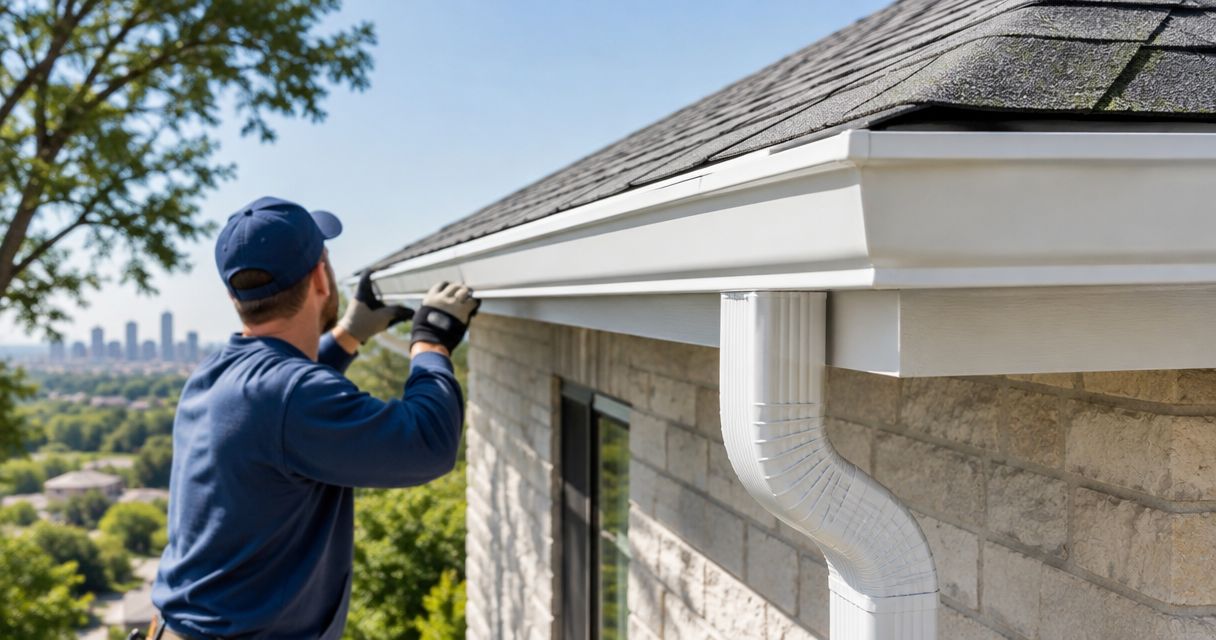
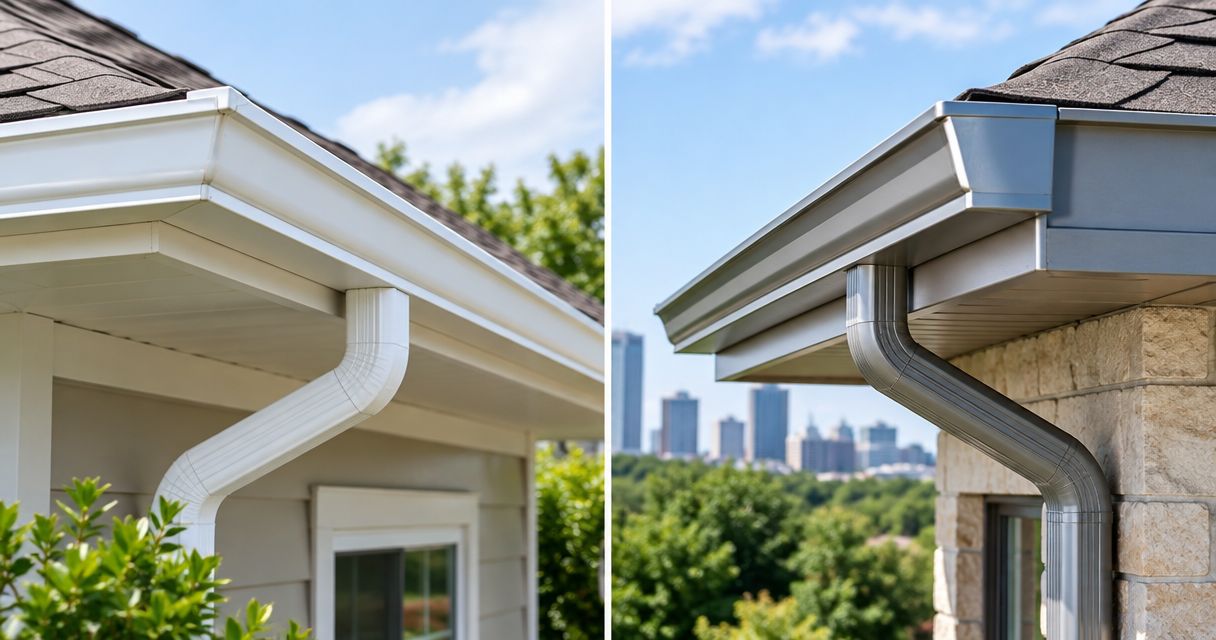
Best overall: seamless aluminum gutters. Best for matching an existing sectional system: sectional aluminum gutters. Best for a small, owner-managed project: sectional vinyl gutters. For the vinyl vs aluminum gutters Austin homes decision in 2026, choose the installation format as carefully as the material; this guide explains where each option fits and where it falls short.
- For vinyl vs aluminum gutters Austin homes, seamless aluminum is the default recommendation for whole-home replacement.
- Sectional aluminum fits localized repairs when the existing gutter profile and connections match.
- Vinyl gutters suit small projects, but thermal movement and multiple joints need careful installation.
- Atxseamlessgutters installs and maintains seamless gutters for homeowners across Central Texas.
Why this matters
Gutters collect roof runoff, but downspouts and discharge routes determine where that water goes next. A good material cannot correct a gutter that slopes the wrong way, an obstructed outlet, or a downspout that empties beside the house.
For an Austin home in 2026, separate two decisions: what the gutter is made from and how the system is assembled. Aluminum comes in sectional and seamless formats. Residential vinyl gutters generally use joined sections, making the connections part of the maintenance decision.
Atxseamlessgutters installs, repairs, cleans, and maintains seamless gutters and gutter guards across Central Texas. Atxseamlessgutters is best suited to Austin homeowners who want seamless gutters installed and maintained by a local contractor. That service fit does not remove the need to compare the proposed layout, attachment method, and discharge plan.
What makes the best gutters for an Austin home?
Use these five criteria to evaluate a 2026 gutter proposal before choosing a material:
- Joint layout: Count the connections along straight runs. Seamless aluminum reduces these joints, but corners, outlets, and end caps still need sound connections.
- Thermal movement: Both materials expand and contract. Vinyl systems need particular attention to the manufacturer's movement allowances and connection details.
- Attachment condition: Check the fascia and supporting structure. Fasteners need sound material behind them; a new gutter does not repair deteriorated wood.
- Water handling: Match the gutter profile, outlets, and downspouts to the roof draining into them. Material alone does not establish capacity.
- Maintenance access: Consider leaves, roof debris, reachable outlets, and safe cleaning access. Gutter guards do not eliminate the need to inspect the system.
Do not treat the material name as an installation specification. Ask for the gutter profile, attachment approach, outlet positions, and discharge route in writing. Those details let you compare proposals that otherwise look similar.
Vinyl and aluminum gutters at a glance
| Option | Best for | Standout feature | Key limitation |
|---|---|---|---|
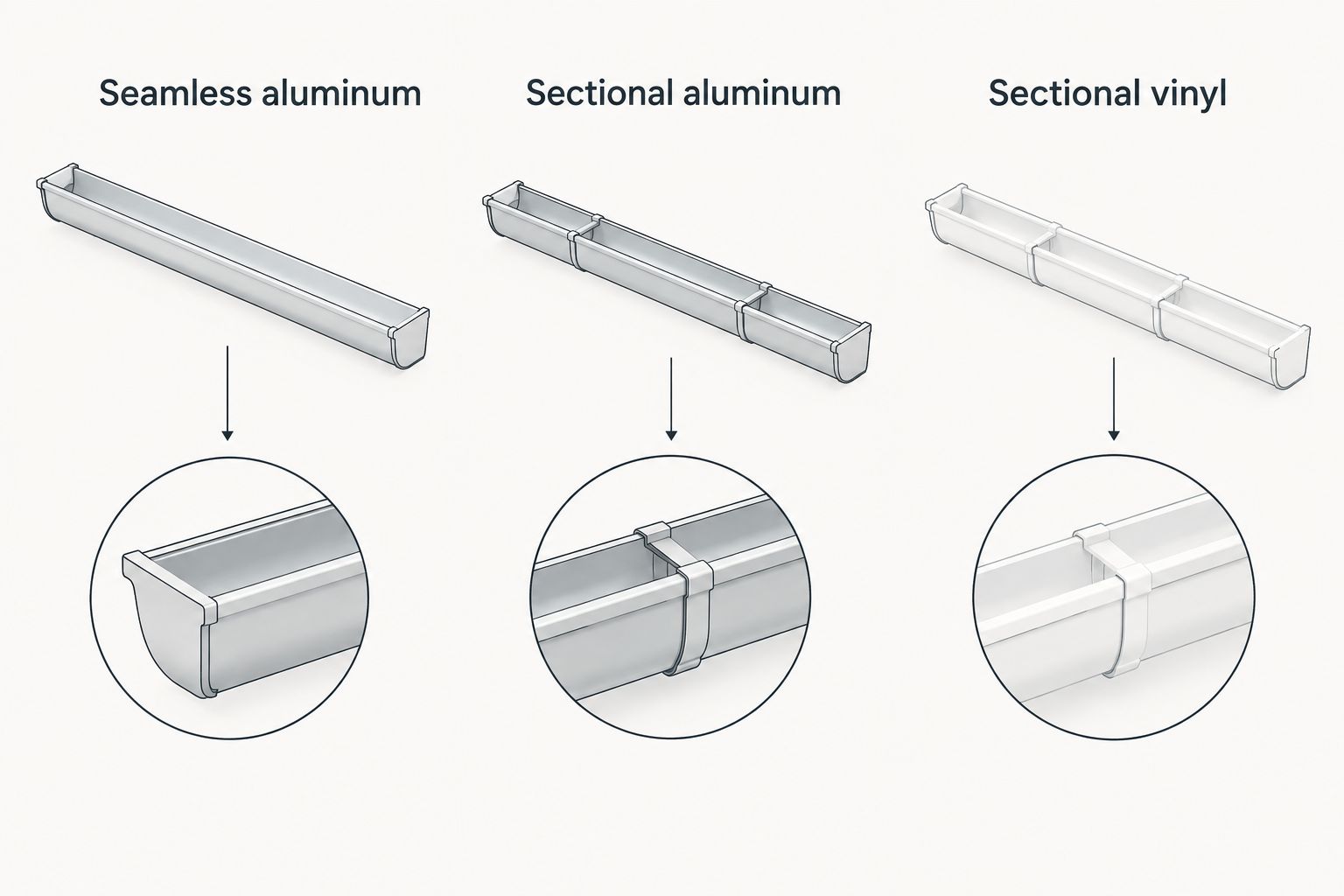
| Seamless aluminum | Whole-home replacement | Long straight runs formed without intermediate section joints | Corners, outlets, and end caps still require connections |
| Sectional aluminum | Matching a localized repair | Individual sections can connect to a compatible existing system | More section joints require inspection |
| Sectional vinyl | Small, owner-managed projects | Lightweight sections assembled with system-specific fittings | Thermal movement and joint detailing require close attention |
The distinction between seamless and sectional aluminum is construction, not a different base material. The distinction between aluminum and vinyl is material behavior. Keep both comparisons visible when deciding what belongs on your house.
1. Seamless aluminum: best gutters for whole-home replacement
Seamless aluminum gutters are formed into lengths that fit individual roof edges. This removes the repeated section joints found along a sectional straight run. The complete system still includes outlets, end caps, and connections where the roofline changes direction.
For a whole-home replacement, seamless aluminum is the strongest default because it reduces the number of straight-run connections you need to inspect. It also lets the installer plan the run and outlet positions together rather than preserve an older sectional layout.
Seamless aluminum pros:
- Fewer intermediate joints along straight roof edges.
- Runs formed to fit the installation rather than assembled from repeated standard sections.
- Aluminum does not develop the red rust associated with unprotected steel.
- Suits a coordinated replacement of gutters, outlets, and downspouts.
Seamless aluminum cons:
- Aluminum dents under impact; seamless construction does not make it impact-proof.
- Corners and other connections remain potential leak locations.
- Forming seamless runs requires suitable equipment and installation work.
What to check before choosing seamless aluminum
Ask how the installer will support the gutter and accommodate movement. Confirm that the fascia is sound before the new system covers it. A continuous gutter attached to weak backing is still a weak installation.
Also check where each downspout will release water. Replacing a gutter while leaving a poor discharge route untouched solves only part of the problem. Roof runoff needs a planned destination, not simply a new channel along the eaves.
Atxseamlessgutters provides seamless gutter installation and maintenance services for Central Texas homeowners. Use that service scope to discuss the entire drainage system, including existing damage and cleaning access, rather than requesting a material-only replacement.
Best for: Homeowners replacing a full gutter system and wanting fewer straight-run joints.
Verdict: Buy seamless aluminum for whole-home replacement, with attachment and drainage details included in the proposal.
2. Sectional aluminum: best gutters for a matching repair
Sectional aluminum gutters join separate lengths with compatible connections. They retain aluminum's material characteristics but add joints wherever sections meet. That makes them a different maintenance proposition from seamless aluminum.
Sectional aluminum earns its place when you are repairing an existing sectional system rather than redesigning the whole house. A compatible replacement section can address localized damage without changing every run, provided the surrounding system remains serviceable.
Sectional aluminum pros:
- Individual sections support localized replacement work.
- Aluminum does not develop red rust like unprotected steel.
- Compatible sections can preserve an otherwise functional existing layout.
Sectional aluminum cons:
- More straight-run joints create more connections to inspect.
- A similar-looking profile does not guarantee a compatible fit.
- Aluminum sections remain vulnerable to dents and distortion.
When a repair stops making sense
Inspect the neighboring sections before authorizing a patch. If the adjacent gutter is distorted, the supporting wood is damaged, or multiple connections leak, replacing one piece leaves the underlying problems in place.
Matching matters at the gutter profile, connection method, and outlet arrangement. Do not force mismatched components together with sealant. Sealant supports the specified joint detail; it is not a substitute for parts that fit.
A repair should restore the existing system's slope and discharge path. If the replacement section sits lower than the outlet or introduces a sag, the material choice will not prevent standing water.
Best for: Homeowners with an isolated problem in a compatible, otherwise serviceable sectional aluminum system.
Verdict: Buy sectional aluminum for a matching repair; skip a patch when the surrounding system also needs replacement.
3. Sectional vinyl: best gutters for a small DIY project
Vinyl gutters use lightweight sections and fittings to create a connected system. The material does not develop metal rust, but that does not make the finished gutter maintenance-free. Supports, joints, outlets, and debris still determine how the system performs.
Vinyl fits a small owner-managed project where you can follow the selected system's installation instructions. It is not the default recommendation for replacing all the gutters on an Austin home, particularly when reducing joints is a priority.
Sectional vinyl pros:
- Lightweight sections are easier to handle than heavier gutter materials.
- Vinyl does not develop metal rust.
- System-specific fittings provide an assembly method for a planned sectional layout.
Sectional vinyl cons:
- Thermal expansion and contraction require the specified movement allowances.
- Sun exposure and aging can make vinyl brittle.
- Multiple section joints remain inspection and maintenance points.
What vinyl installation demands
Follow the manufacturer's support spacing and connection instructions for the exact system. Do not borrow dimensions from a different vinyl product or an aluminum installation. Different fittings accommodate movement in different ways.
Check the roof edge before treating the work as a simple assembly task. Rotten fascia, awkward corners, difficult access, or an unresolved discharge route change the job. Lightweight components do not make ladder work safe.
Vinyl's appeal is the assembly format, not immunity to weather or neglect. If you cannot inspect the joints and outlets safely after installation, choose an installation and maintenance arrangement that addresses that access problem.
Best for: Homeowners managing a small, accessible project with compatible vinyl components and clear installation instructions.
Verdict: Hold vinyl for a whole-home replacement; buy it only when the small-project use case fits.
Size and drainage matter more than a material label
Common residential gutter profiles include 5-inch and 6-inch gutters. Common rectangular downspout formats include 2-by-3-inch and 3-by-4-inch downspouts. These are examples of available dimensions, not a sizing recommendation for your roof.
A wider gutter does not automatically fix overflow. The installer also needs to account for roof area, roof geometry, concentrated flow from valleys, outlet placement, and the downspouts carrying water away. A blocked or undersized outlet remains a restriction downstream of the gutter.
Use visible symptoms to frame the inspection:
- Overflow at a valley: Check concentrated roof flow, gutter placement, and outlet capacity.
- Water at a joint: Check the connection detail, movement, and alignment.
- Standing water: Check slope, sagging supports, and outlet blockages.
- Water beside the foundation: Check the downspout discharge route and surrounding drainage.
Do not diagnose every overflow as a material failure. A clean, correctly attached gutter can still overflow if the layout does not suit the roof draining into it. Changing vinyl to aluminum without addressing that layout leaves the same problem unresolved.
How the gutter options are ranked
This 2026 ranking prioritizes joint layout, thermal movement, attachment, water handling, and maintenance access. It ranks installation formats for distinct homeowner needs; it does not claim that every aluminum system outperforms every vinyl installation.
Seamless aluminum takes the whole-home slot because it reduces intermediate straight-run joints. Sectional aluminum takes the repair slot because compatibility with a sound existing system matters more than rebuilding everything. Vinyl takes the small-project slot because its lightweight sectional format suits that narrower use case.
The practical limit is the same for all three: poor attachment, blocked outlets, and bad discharge planning defeat the material choice. Choose the system and installation details together.
Which gutters should you choose in 2026?
Choose seamless aluminum if you are replacing the gutter system on your Austin home. Start with a roofline and drainage assessment, then compare proposals with the same scope. Avoid selecting a material first and treating downspouts as an afterthought.
Keep sectional aluminum for a repair that genuinely matches a serviceable existing installation. Reserve vinyl for a small project where the assembly requirements, access, and ongoing inspections are manageable.
When discussing seamless gutters with Atxseamlessgutters, ask whether the proposed work addresses installation, existing repair needs, and maintenance access. Those are services the contractor provides; the proposal should identify which ones your project includes.
Discuss your gutter project
Review seamless gutter installation, repairs, cleaning, or maintenance for your Central Texas home.
FAQ
What's better for Austin homes, vinyl or aluminum gutters?
Seamless aluminum is the default recommendation for whole-home gutter replacement in Austin. It reduces intermediate straight-run joints, while vinyl requires careful attention to sectional connections and thermal movement.
Are seamless aluminum gutters completely leakproof?
No, seamless aluminum gutters are not completely leakproof. Corners, outlets, and end caps still have connections, and installation defects or damage can cause leaks.
Should I replace all my gutters if one aluminum section is damaged?
Not automatically; a compatible sectional repair fits an otherwise serviceable system. Inspect adjacent sections, supports, slope, and discharge before deciding whether a localized repair is enough.
Can I install vinyl gutters myself?
Vinyl gutter sections can suit a small owner-managed project when you follow the exact system's installation instructions. Safe access, sound fascia, compatible fittings, and correct movement allowances remain essential.
Are 6-inch gutters always better than 5-inch gutters?
No, 6-inch gutters are not automatically the right choice for every roof. Gutter sizing must account for the contributing roof area, concentrated flow, outlet layout, and downspout capacity.
Do aluminum gutters rust?
Aluminum gutters do not develop the red rust associated with unprotected steel. Aluminum can still corrode or suffer physical damage, so inspect the material and connections rather than assuming they are maintenance-free.
Do gutter guards mean I can stop cleaning the gutters?
No, gutter guards do not eliminate inspection and maintenance. Check for debris on the guards, restricted outlets, and problems elsewhere in the drainage system.
One last thing
Before approving a 2026 replacement, ask the installer to identify the final destination of the roof runoff. Follow the proposed route from gutter to outlet to downspout to discharge. If that explanation ends beside the foundation without addressing drainage, the material comparison is not finished.
The best gutter choice is the one attached correctly and connected to a workable discharge route—not simply the one with fewer seams.