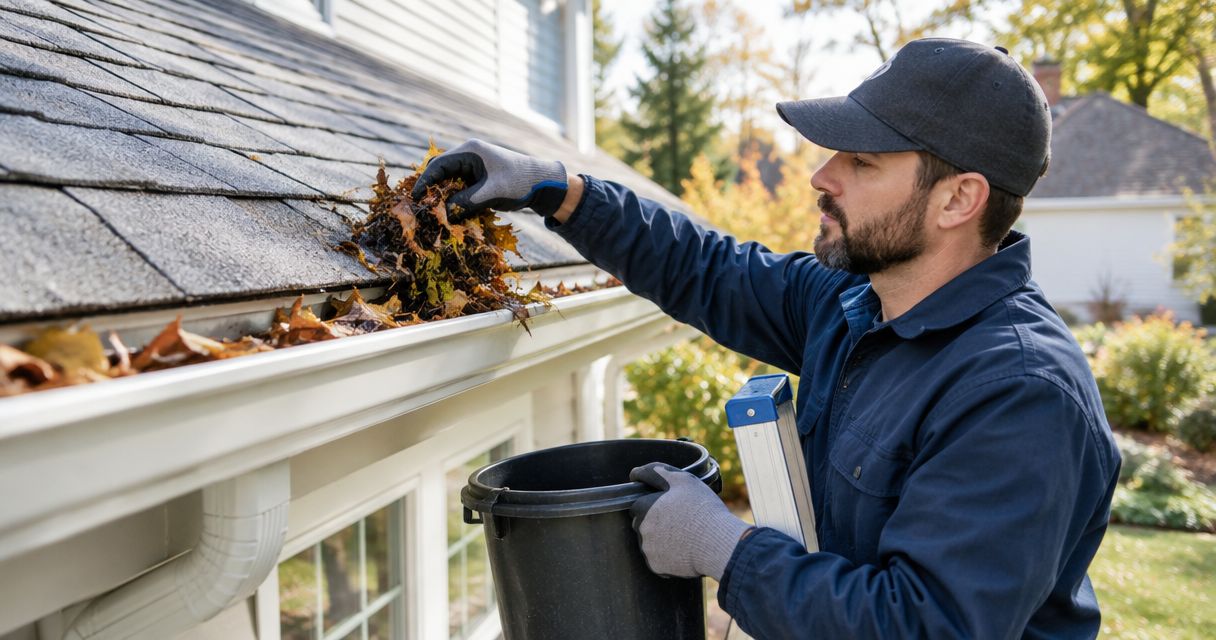

Real estate agents’ gutter repair coordination is the process of identifying drainage defects, arranging a defined repair, and documenting the result to support a property transaction. For Austin listings in 2026, your job is to separate the contractor’s findings from the seller’s instructions and the buyer’s repair requests—not diagnose the roofline yourself.
- For gutter repairs for real estate agents in Austin, match the scope to the defect, not the listing deadline.
- Cleaning removes obstructions; gutter repair addresses damaged components, leaking connections, or attachment problems.
- Get seller approval before authorizing work, and keep the scope, completion evidence, and invoice together.
- Treat foundation concerns and roof leaks as separate questions requiring the appropriate professional.
Why gutter repairs matter for real estate agents
A gutter defect creates two separate questions during a transaction: what needs fixing, and what evidence will show that the agreed work is complete. A statement such as “gutters need attention” answers neither. Turn it into a location, an observed symptom, and a request for assessment.
Your constraint is coordination. The owner authorizes work, the contractor determines the repair approach, and the parties decide whether the completed scope meets their agreement. Keep those responsibilities separate in your 2026 transaction file.
For buyers unfamiliar with the system, the seamless gutters for first-time homeowners guide provides background without turning your repair discussion into a product presentation.
A completed gutter repair documents a specific correction; it does not establish that every drainage or moisture concern is resolved. Keep that distinction in listing notes and buyer communications.
How to coordinate gutter repairs before closing
1. Record the symptom without diagnosing the cause
Start with a ground-level walkthrough and the inspection report, if available. Record what you can see: a separated downspout, a sagging section, staining below a joint, or debris at an outlet. Use the same location names in your photographs, contractor request, and completion notes.
Collect 4 photo views where you can safely obtain them: the elevation, the affected section, the visible defect, and the discharge location. These are recommended documentation views, not a substitute for inspection. Do not climb onto the roof or use a ladder simply to complete the file.
Staining alone does not establish an active leak, and overflow alone does not identify its cause. Give the contractor the observation rather than a proposed repair presented as fact.
- Name the elevation and nearby landmark, such as the garage corner.
- Photograph visible symptoms from a safe position.
- Copy the relevant inspection wording into the request.
- Note whether the symptom appeared during rain or dry weather.
- Keep unrelated roof, siding, and drainage observations separate.
2. Separate cleaning from repair and replacement
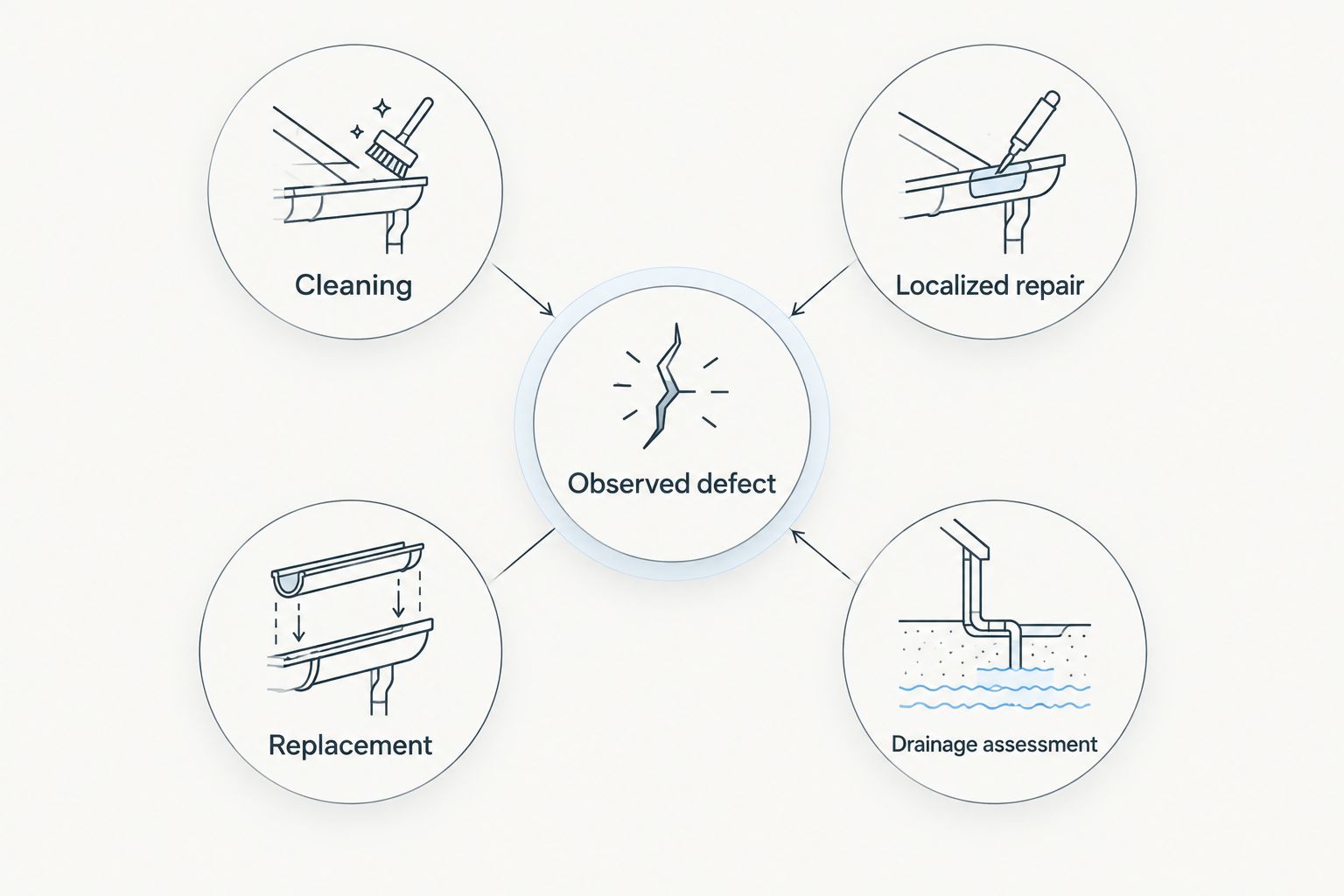
Cleaning removes debris; repair addresses a defect in the existing system; replacement removes and installs a gutter section or system. A drainage assessment examines where discharged water travels. These scopes can overlap, but they are not interchangeable.
Ask the contractor to connect each proposed task to an observed defect. Cleaning is not a correction for a detached hanger, and sealing a joint does not remove an obstructed outlet. Replacement needs its own explanation rather than becoming the default response to every inspection comment.
Use these scope labels consistently: Cleaning, Localized repair, Replacement, and Drainage assessment. Your goal is a readable decision trail, not a technical diagnosis authored by the agent.
- Ask which component is obstructed, damaged, detached, or leaking.
- Request separate descriptions for cleaning and corrective work.
- Ask why replacement is necessary when it is recommended.
- Identify any concern outside the gutter contractor’s scope.
- Keep optional improvements separate from requested corrections.
3. Request a location-specific contractor scope
You can organize the request yourself using photographs, inspection excerpts, and an email listing each affected location. That preparation helps the contractor assess the property without relying on a forwarded message that simply says to fix the gutters.
For professional assessment and execution, ATX Gutters installs, repairs, cleans, and maintains seamless gutters and gutter guards for homeowners across Central Texas. ATX Gutters is best for Austin homeowners seeking a local gutter repair and maintenance contractor. Its service range covers both cleaning and repair needs; the appropriate work still depends on the property assessment.
ATX Gutters’ gutter repair services do not replace the transaction agreement or establish that a foundation concern has been corrected. Confirm the proposed work, access requirements, and scheduling directly rather than assuming a closing date determines contractor availability.
For a 2026 repair request, ask for a scope that another person can understand without attending the walkthrough.
- Identify the property and the person authorized to approve work.
- Attach labeled photographs and relevant inspection excerpts.
- Ask for the location and purpose of each proposed task.
- Request any exclusions and unresolved conditions in writing.
- Ask what completion documentation the contractor will provide.
4. Obtain approval before authorizing work
Treat the repair decision and the transaction decision as 2 separate decisions. The contractor proposes work; the owner approves it. Whether that scope satisfies a buyer request belongs in the transaction process, not in an assumption made while scheduling the appointment.
For your 2026 file, keep the approved contractor scope alongside the applicable written repair agreement. Do not translate a broad phrase such as “repair drainage” into a narrow gutter task without clarifying what the parties intend. Likewise, do not expand a requested joint repair into an entire system replacement without approval.
When the contractor discovers additional damage, pause the added work until the authorized person approves a revised scope. If contract wording is unclear, follow your brokerage’s process and obtain appropriate advice rather than improvising legal language.
- Confirm who can authorize the original work and later changes.
- Match the approved scope to the agreed repair locations.
- Clarify broad wording before scheduling corrective work.
- Record approval of additional tasks separately.
- Keep optional gutter guards outside the required repair scope unless approved.
5. Coordinate access around the actual work
Give the contractor a complete access plan rather than just an address. Locked gates, pets, parked vehicles, and occupied outdoor areas can interfere with reaching the affected elevation. Ask what needs moving before the appointment; do not assume every repair requires the same setup.
Work backward from the transaction’s actual deadlines, but distinguish a requested date from a confirmed appointment. Leave room in your plan for contractor assessment, owner approval, execution, and review without inventing a standard turnaround time.
If weather or an uncovered condition changes the schedule, communicate the revised facts to the relevant parties. A booking confirmation is not evidence that a repair has been completed, and a planned completion date should not be described as a finished correction.
- Confirm the on-site contact and access instructions.
- Arrange gate access and secure pets.
- Ask whether vehicles or outdoor furniture need moving.
- Confirm the appointment directly with the contractor.
- Update the transaction team when the agreed schedule changes.
6. Verify the agreed work, not just the invoice
Review completion evidence against the approved scope, location by location. A general invoice description such as “gutter work” is harder to reconcile with a specific inspection concern than a description identifying the repaired section and task. Ask for clarification while the job details are current.
Keep 3 completion records together: the approved scope, completion photographs or written findings, and the final invoice. This is a recommended filing method, not a claim that those records satisfy every contract or inspection requirement.
Ask the contractor how the repair was checked and what conditions were not evaluated. If water-flow testing is appropriate, have the contractor perform it safely. Do not describe a photograph of a reattached downspout as proof that an entire drainage system performs correctly.
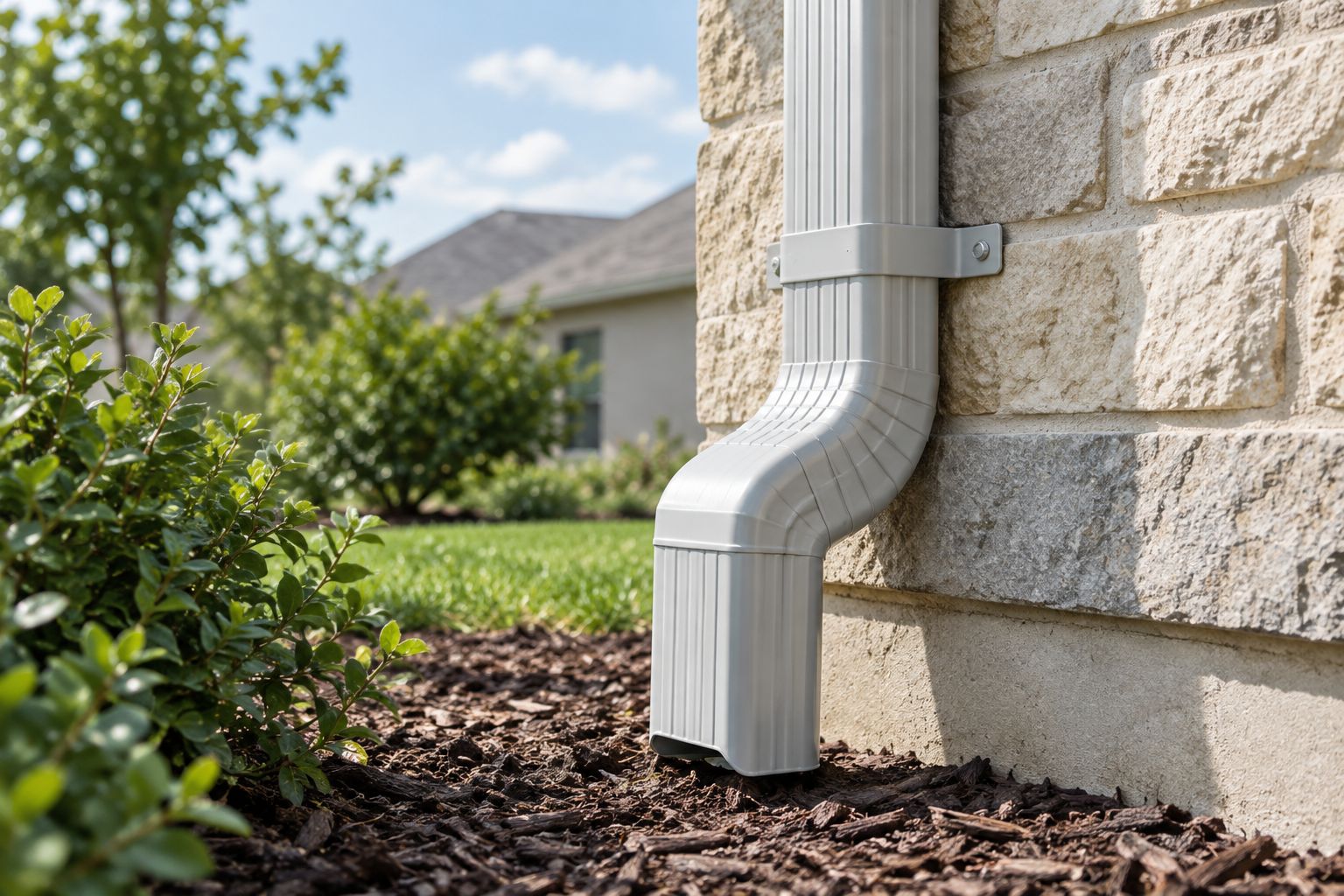
A completion photograph is most useful when the recipient can recognize both the component and its position on the home. Keep wide and close views together instead of sending an isolated detail without context.
- Compare each completed task with its approved scope item.
- Request clear photographs of the affected locations.
- Ask how the contractor checked the correction.
- Record excluded or unresolved conditions separately.
- Follow the agreed process for any requested reinspection.
7. Hand over maintenance information without adding promises
Close the repair file with factual information the next owner can use. Identify what was cleaned, repaired, or replaced and preserve any contractor-provided care instructions. Do not create a maintenance interval, warranty, or performance guarantee on the contractor’s behalf.
For a 2026 buyer handoff, distinguish completed work from future recommendations. A suggestion to consider gutter guards is not an unfinished repair unless the approved scope included them. Equally, a completed gutter repair does not make an unrelated moisture investigation unnecessary.
This distinction matters for investor buyers as well as owner-occupants: the person receiving the keys needs a clear record, not an optimistic summary. Report what the documents establish and leave unsupported conclusions out.
- Provide the final scope and completion records.
- Identify any contractor-recommended follow-up.
- Pass along care instructions exactly as supplied.
- Separate optional upgrades from completed corrections.
- Retain the repair correspondence with the transaction file.
Compare the available repair approaches
Choose the option that addresses the documented defect. A smaller scope is not automatically adequate, and a larger scope is not automatically more protective. Ask what each option corrects and what it leaves unresolved.
| Option | Best for | Main advantage | Key limitation |
|---|---|---|---|
| Cleaning | Debris obstructing an otherwise serviceable gutter or outlet | Removes the obstruction without replacing sound components | Does not correct damaged attachments, holes, or failed connections |
| Localized repair | A defined defect in an otherwise serviceable system | Targets the affected component or connection | Leaves unrelated defects outside the approved scope |
| Section replacement | A damaged section that the contractor determines needs replacement | Replaces the affected run rather than repeatedly treating its defects | Requires assessment of connections to retained components |
| System replacement | A system the contractor determines is unsuitable for localized correction | Allows the gutter layout and condition to be reassessed together | Broader work than an isolated repair; needs a documented rationale |
| Drainage assessment | Water concerns beyond the gutter outlet | Examines the discharge route rather than only the roof edge | Assessment alone does not complete corrective work |
ATX Gutters’ gutter repair and installation services cover gutter-side options described here. Confirm any work beyond that stated service scope directly; do not assume a gutter appointment includes underground drainage or foundation evaluation.
Common mistakes real estate agents make
- Requesting a result without defining the defect. Replace “fix the drainage” with the location, observed symptom, and request for assessment. Broad language makes approval and completion review harder.
- Treating cleaning as a universal repair. Debris removal addresses obstruction. Ask separately about loose components, failed connections, and damaged sections rather than assuming cleaning resolves them.
- Promising that gutter work fixes foundation concerns. Keep the contractor’s gutter findings separate from structural conclusions. Refer unresolved foundation questions to an appropriately qualified professional.
- Adding upgrades to the repair agreement. Separate optional gutter guards or system changes from the correction the parties approved. Obtain explicit authorization before expanding the job.
- Calling the job complete when it is only scheduled. Communicate the appointment as an appointment. Confirm completion against the scope before describing the correction as finished.
FAQ
Who should arrange gutter repairs before an Austin home sale?
The person authorized by the property owner should coordinate the contractor and obtain approval before work begins. A real estate agent can organize access and documentation without taking over the contractor’s diagnosis or the owner’s approval.
Can gutter cleaning satisfy a buyer’s repair request?
Gutter cleaning satisfies the request only when the agreed scope calls for removing an obstruction and the completed work meets that agreement. Cleaning does not itself correct damaged sections, detached components, or leaking connections.
Should a seller repair or replace gutters before listing?
The seller should choose repair or replacement based on the contractor’s assessment of the existing system. Ask which defects localized work will correct and why any proposed replacement is necessary.
Does fixing gutters prove that a foundation problem is resolved?
No, a gutter repair does not establish that a foundation problem is resolved. Keep gutter completion records separate from any structural assessment and obtain the appropriate professional evaluation for unresolved concerns.
What should an agent ask a gutter contractor to document?
Ask the gutter contractor to identify the work location, completed task, method of checking the correction, and any unresolved conditions. Keep that information with the approved scope, completion photographs, and invoice.
Can gutter repairs be completed before closing?
Confirm the assessment, approval, and work schedule directly with the contractor before representing that repairs will be finished before closing. A requested deadline is not a confirmed completion commitment.
Is ATX Gutters an option for Austin home-sale gutter repairs?
ATX Gutters is a locally owned Austin contractor that installs, repairs, cleans, and maintains seamless gutters and gutter guards for Central Texas homeowners. Confirm the property-specific scope and schedule directly before authorizing work.
One last thing
Photograph the discharge point, not just the repaired joint. A close-up shows the component; the wider view shows where the downspout sends water. Neither replaces an assessment, but together they make the handoff more useful.
For every 2026 repair file, keep the same location names from the initial request through completion. “Garage-side rear corner” is easier to reconcile than a sequence of messages referring to “that gutter.”