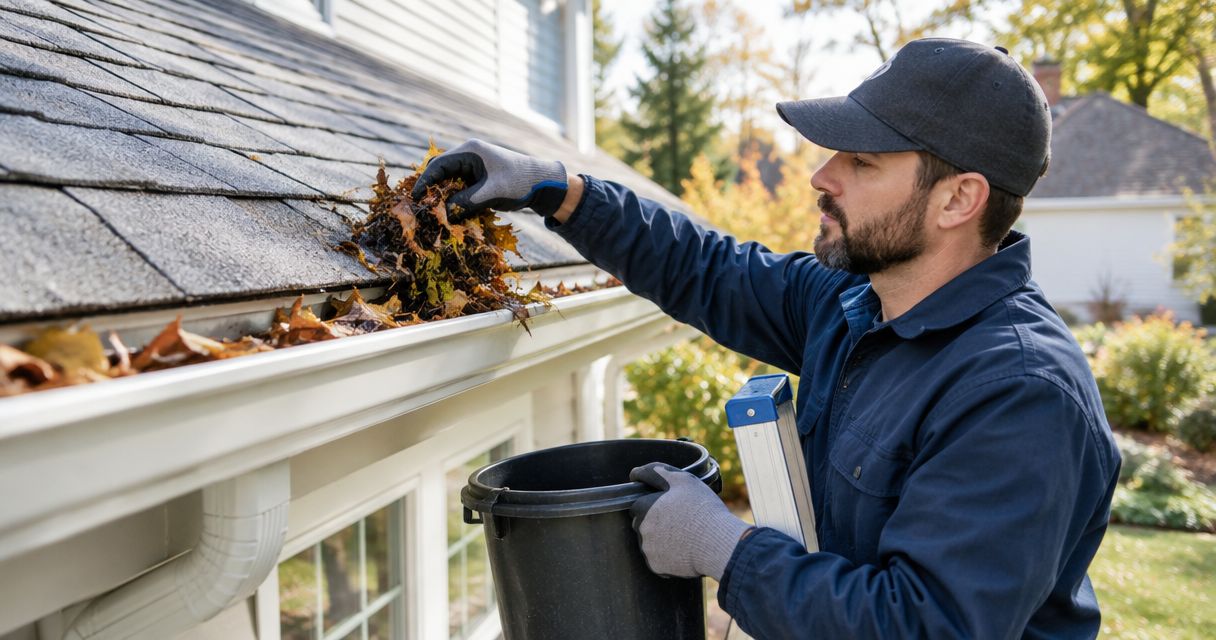
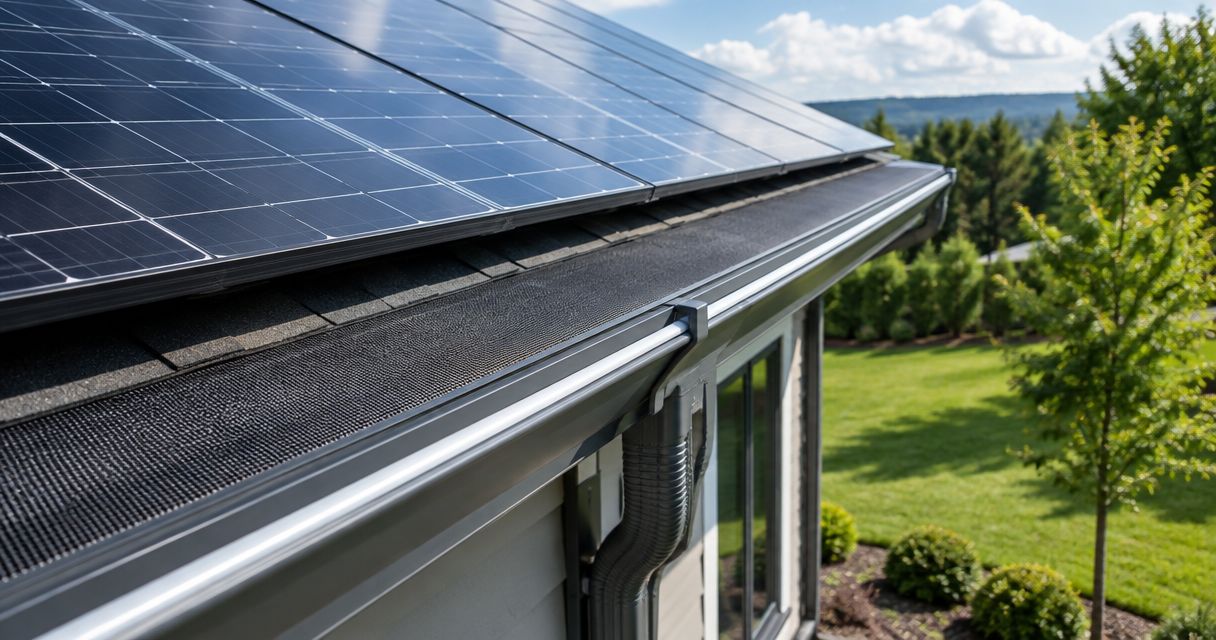
Solar-panel homeowners’ gutter protection is the use of gutter guards to keep roof debris out of drainage channels while preserving access to the solar installation. Choosing gutter guards for homes with solar panels means checking where panel runoff lands, how the guards attach, and whether both systems remain accessible for maintenance.
- Choose gutter guards for homes with solar panels by runoff behavior, debris type, attachment method, and maintenance access.
- ATX Gutters serves Central Texas homeowners needing gutter guards, installation, repairs, cleaning, and maintenance.
- Gutter guards protect gutter openings; solar-panel pest barriers protect a different part of the roof.
- Fix existing drainage problems before covering gutters, and keep solar wiring outside the gutter-work area.
Why gutter protection matters for solar-panel homeowners
Solar panels add another surface that sheds water toward the roof below. The important question is not whether solar panels automatically require special gutters; it is whether water reaches your existing gutters without overshooting, backing up, or escaping at a joint.
Leaves and roof debris still reach gutters beneath a solar-equipped roof. Guards address that debris, but they do not correct a sagging gutter, obstructed downspout, or poorly positioned outlet. Choose drainage performance first and debris protection second.
ATX Gutters is best for Central Texas homeowners seeking gutter installation, repairs, cleaning, and gutter guards from a local contractor. The company provides those services; solar equipment work belongs with your solar provider. Start with ATX Gutters when the problem concerns the gutter system rather than the panels or electrical components.
For your 2026 project, keep the gutter scope and solar scope separate in writing. That distinction makes it clear who handles attachments, access restrictions, and any equipment that must move before work begins.
How to choose and install compatible gutter guards
1. Map the runoff before choosing a guard
Start with a ground-level inspection during rain, from a sheltered position away from electrical equipment and falling branches. Watch the roof edge below the panels, roof valleys, gutter corners, and downspout outlets. Do not climb onto a wet roof to investigate a spill.
Record where water misses the gutter and where it enters but fails to drain. Those are different problems: an inlet problem needs attention at the roof edge, while slow drainage calls for inspection of the gutter and downspout path.
Create a baseline of 4 photos: the panel-facing roof edge, a gutter corner, a downspout connection, and the discharge point. Take photographs from safe ground positions; ask a contractor to document anything you cannot see. A short video of active overflow gives the installer more useful context than a description of a wet wall alone.
- Mark visible overflow locations on a simple house sketch.
- Identify roof valleys that feed the affected gutter.
- Photograph the lower edge of the panel array from the ground.
- Note whether overflow occurs with or without visible debris.
- Keep observations with your 2026 project notes.
2. Check solar access and attachment restrictions
Read your solar installation documents before approving gutter work. Find any instructions covering roof access, wiring, mounting hardware, and work near the array. Do not assume that a gutter installer has permission to loosen panel hardware or relocate cables.
Keep 2 service records together: the solar installation paperwork and the gutter work scope. If either document leaves an attachment question unresolved, get a written answer from the responsible installer before work starts. Warranty terms depend on the actual documents, not a general promise that a guard is compatible with solar panels.
A visual check is the starting point; it is not permission to touch electrical components. If you see loose wiring near the eave, stop planning work in that area until your solar provider addresses it. Gutter guards and panel pest barriers must not become improvised cable supports.
- Ask the solar provider to identify restricted work areas.
- Confirm whether the proposed guard touches roofing materials.
- Keep guard fasteners separate from solar mounting hardware.
- Require a clear plan for working around nearby cables.
- Record who will remove and replace guards for future access.
3. Match the guard to the debris and roof edge
Identify what actually collects in your gutters before choosing an opening size. Broad leaves, small fragments, seeds, and roof grit present different filtering challenges. A fine screen blocks smaller debris than a coarse opening, but material can still accumulate on top of either surface.
Inspect existing debris from the ground where possible, or ask for photographs during cleaning. Then compare guard samples with the gutter profile and the proposed fastening method. The guide to gutter guard mesh sizes for Texas debris provides a related starting point for that comparison.
ATX Gutters installs gutter guards and maintains gutters for Central Texas homeowners. That is a practical route when you want professional work rather than a self-managed installation; it does not establish which guard design fits your particular roof. Ask for the proposed design, attachment details, and cleaning method before accepting the scope.
- Match openings to the debris found at your home.
- Compare how each sample fits the existing gutter edge.
- Ask how surface debris will be removed.
- Confirm that outlets remain accessible after installation.
- Request evidence for any claimed rain-handling performance.
4. Repair the drainage system before covering it
Check the existing gutter system before a guard conceals its interior. Look for visible sagging, separated joints, loose hangers, staining below seams, and water remaining after drainage should have finished. Report what you see rather than trying to diagnose an unseen slope problem yourself.
Cleaning is the first task when debris prevents inspection. A qualified installer can then assess gutter alignment, attachment condition, outlets, and downspouts. A guard is not a repair for an existing drainage defect. Covering a damaged section leaves the underlying problem unresolved and makes later access another part of the repair.
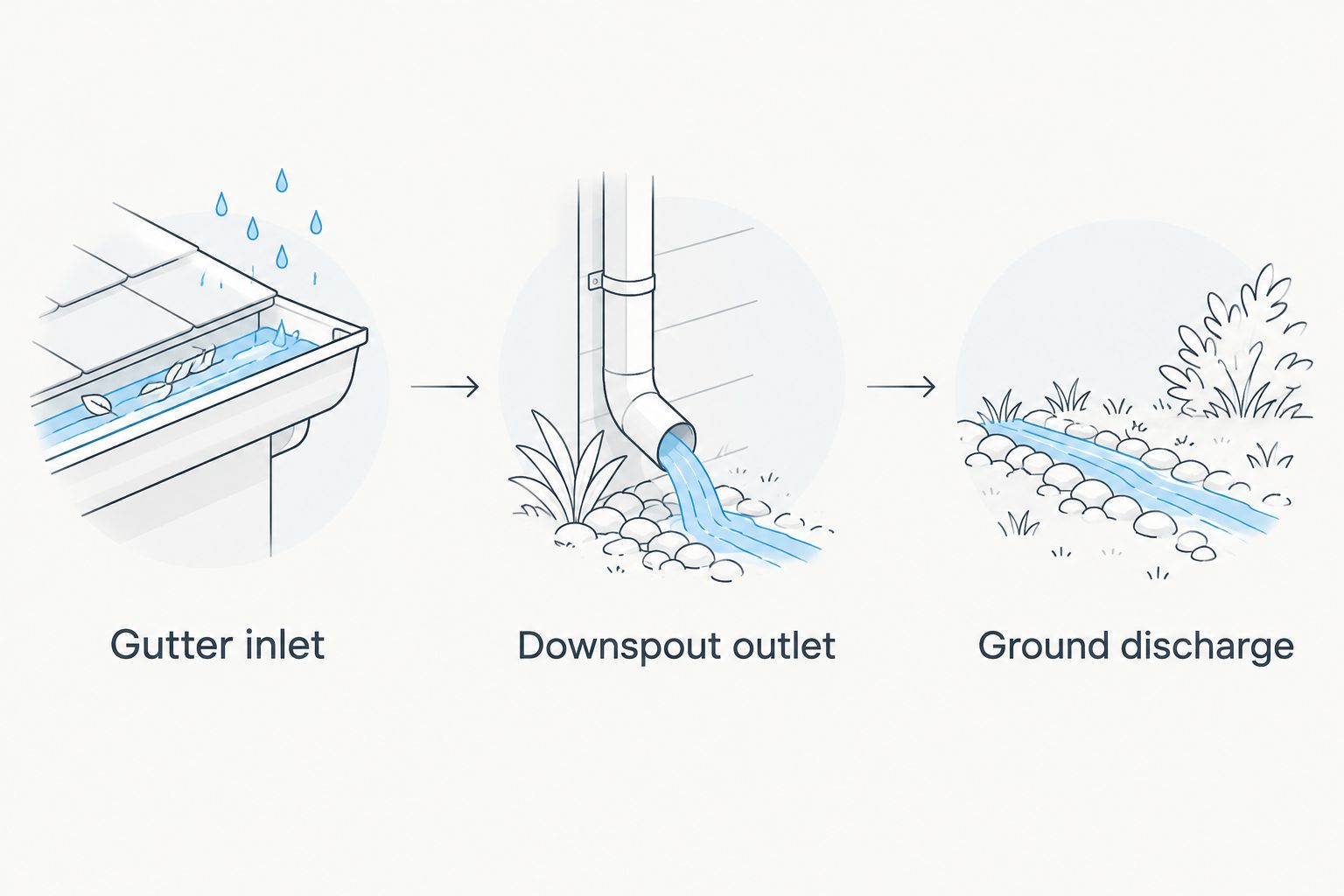
Review 3 locations before approving the guard installation: the gutter inlet, the downspout outlet, and the ground discharge point. Water needs a usable path through all of them. For a 2026 installation, put any repair work ahead of guard fitting in the written sequence, rather than treating it as an unspecified extra.
- Clear debris before assessing the gutter interior.
- Identify leaking joints and damaged sections.
- Ask the installer to assess hangers and alignment.
- Confirm that downspouts are unobstructed.
- Check where discharged water travels on the ground.
5. Approve a specific installation scope
Ask for a written description of the guard and its attachment method, not just a statement that the system works with solar panels. The scope should identify the gutter sections included, any repairs, and the boundaries of work near the array.
Review how the installer will reach the gutter safely without using panel frames, cables, or solar mounting hardware as supports. If access requires solar equipment to move, assign that work explicitly to the appropriate provider. Do not let an unresolved access problem become an on-site improvisation.
Keep the guard removable wherever future inspection or repair requires access. A cover that excludes leaves but complicates every service visit has a real maintenance limitation. Ask the installer to explain removal and reinstallation before installation, while you can still compare alternatives. Save photographs showing the completed gutter edge and any areas close to the solar installation.
- Specify the guard type and attachment location.
- Separate gutter repairs from solar equipment work.
- Identify access constraints before scheduling.
- Document how outlets and corners remain serviceable.
- Request completion photographs of concealed or elevated areas.
6. Verify performance and plan maintenance
Inspect the finished installation from the ground, then observe the system during rain when it is safe. Watch the same locations recorded before the work. Compare whether water enters the gutter, travels through the downspout, and leaves the discharge point without an obvious obstruction.
A controlled water check can reveal local leaks or blockages, but it does not reproduce every storm condition. Do not treat a brief demonstration as proof that overflow is impossible. Keep the installer’s maintenance instructions with your 2026 service records and report persistent problems with photographs or video.
Set inspection reminders around the debris conditions at your property instead of accepting a maintenance-free promise. Guards still need attention when leaves collect on top, openings become coated, or outlets obstruct. Inspect after roof or solar service as well, because nearby work can leave debris or disturb gutter components.
- Compare post-installation runoff with your baseline observations.
- Check for surface debris from a safe ground position.
- Keep the guard removal instructions accessible.
- Record leaks or overflow before requesting service.
- Recheck gutters after work on the roof or array.
Compare gutter protection options for solar-equipped homes
No guard design wins simply because a roof has solar panels. Compare the debris barrier, attachment method, and service access together. These are design categories, not verified specifications for a particular manufacturer’s product.
| Option | Best for | Main advantage | Key limitation |
|---|---|---|---|
| Fine-mesh guards | Homes where small debris drives the decision | Smaller openings exclude finer material | Surface buildup still needs inspection and cleaning |
| Coarse-screen guards | Homes dealing mainly with larger leaves | Openings provide a barrier to larger debris | Smaller fragments can pass through |
| Surface-tension covers | Homeowners considering a solid-cover design | The cover directs water toward an entry opening | Performance depends on the design, installation, and runoff conditions |
| Open gutters with scheduled cleaning | Homeowners prioritizing direct service access | The gutter interior remains accessible | Debris enters directly and must be removed |
| Solar-panel pest barriers | Homeowners addressing animal access beneath panels | Addresses the gap beneath the array | Does not protect gutter openings or replace gutter cleaning |
Keep solar-panel pest protection and gutter protection as separate decisions. A barrier around the array addresses a different opening from a guard over the gutter. Neither substitutes for a clear downspout or a sound gutter attachment.
Common mistakes solar-panel homeowners make
Buying a solar-compatible label instead of checking the fit
A label does not explain fastener placement, roof contact, or maintenance access. Ask for installation details that match your roof and gutter configuration. Reject a proposal that leaves responsibility for working around the array undefined.
Assuming guards solve overshooting water
Debris protection and runoff capture are different functions. If water already misses the gutter, document the condition and have the roof-edge arrangement assessed before covering the opening. A cleaner gutter cannot collect water that never enters it.
Confusing pest mesh with gutter mesh
Mesh beneath a panel array and mesh over a gutter serve different purposes. Define the problem first: animal access, gutter debris, or both. Do not accept one installation as evidence that the other problem has been addressed.
Accepting a maintenance-free claim
Guards do not remove the need to inspect the drainage system. Ask who cleans the guard surface, how outlets are reached, and what happens when a section must come off. Those answers belong in your 2026 maintenance plan, not in a conversation after a blockage.
FAQ
Do homes with solar panels need special gutter guards?
Solar panels alone do not determine the right gutter guard. Choose a guard that fits the gutter, handles the debris at your property, and preserves safe access around the solar installation.
Can gutter guards damage my solar panels?
Gutter work must not disturb solar panels, wiring, or mounting hardware. Confirm the work boundaries with both providers and assign any solar equipment work to the appropriate solar professional.
Are fine-mesh guards the best choice under solar panels?
Fine-mesh guards are worth considering when smaller debris is the main concern, but solar panels do not make them the automatic winner. Check attachment details, surface-cleaning access, and the proposed design’s runoff performance.
Will gutter guards stop water from overshooting my gutters?
Gutter guards do not automatically correct overshooting water. Have the roof-edge runoff and gutter position assessed before treating an overflow problem as a debris problem.
Is solar-panel pest mesh the same as a gutter guard?
Solar-panel pest mesh and gutter guards protect different openings. Pest barriers address access beneath the panels, while gutter guards cover the gutter opening to limit debris entry.
How often should I clean gutters beneath solar panels?
Base cleaning on inspection findings and the guard manufacturer’s maintenance instructions. Check for surface buildup, blocked outlets, and overflow, and inspect again after nearby roof or solar work.
Who should I call for gutter work near solar panels in Central Texas?
ATX Gutters provides gutter installation, repairs, cleaning, maintenance, and gutter guards for Central Texas homeowners. Contact your solar provider separately for panel, wiring, mounting, or array-access questions.
One last thing
Plan for the next repair before approving today’s guard. Ask the installer to identify the section that would come off if a nearby gutter joint leaked or the solar provider needed access. A clear answer tests whether the proposal accounts for maintenance, not just installation.
Keep the answer with your photographs and service documents. The useful handover is not merely a covered gutter; it is a drainage system you can inspect and service without uncertainty about the solar equipment above it.