

To prevent gutter clogs oak leaves cause in Austin, remove accumulated debris, clear the downspout openings, and confirm that water drains through the entire system. Gutter guards can reduce leaf entry, but they still need surface cleaning and inspection. For your 2026 maintenance plan, respond to visible leaf buildup rather than waiting for a fixed cleaning date.
- Prevent gutter clogs oak leaves cause by clearing gutter channels, downspout openings, and discharge points together.
- Atxseamlessgutters provides seamless gutter cleaning, repairs, maintenance, and gutter guard installation for Central Texas homeowners.
- Gutter guards reduce leaf entry, but surface debris can still block water from entering.
- If clean gutters still overflow, investigate drainage and installation problems before adding guards.
How do you prevent gutter clogs during oak leaf season in Austin?
Clear the full drainage path, then check what happens when water enters it. Removing visible leaves is only part of the job: a blocked outlet or downspout can leave an otherwise clean gutter overflowing.
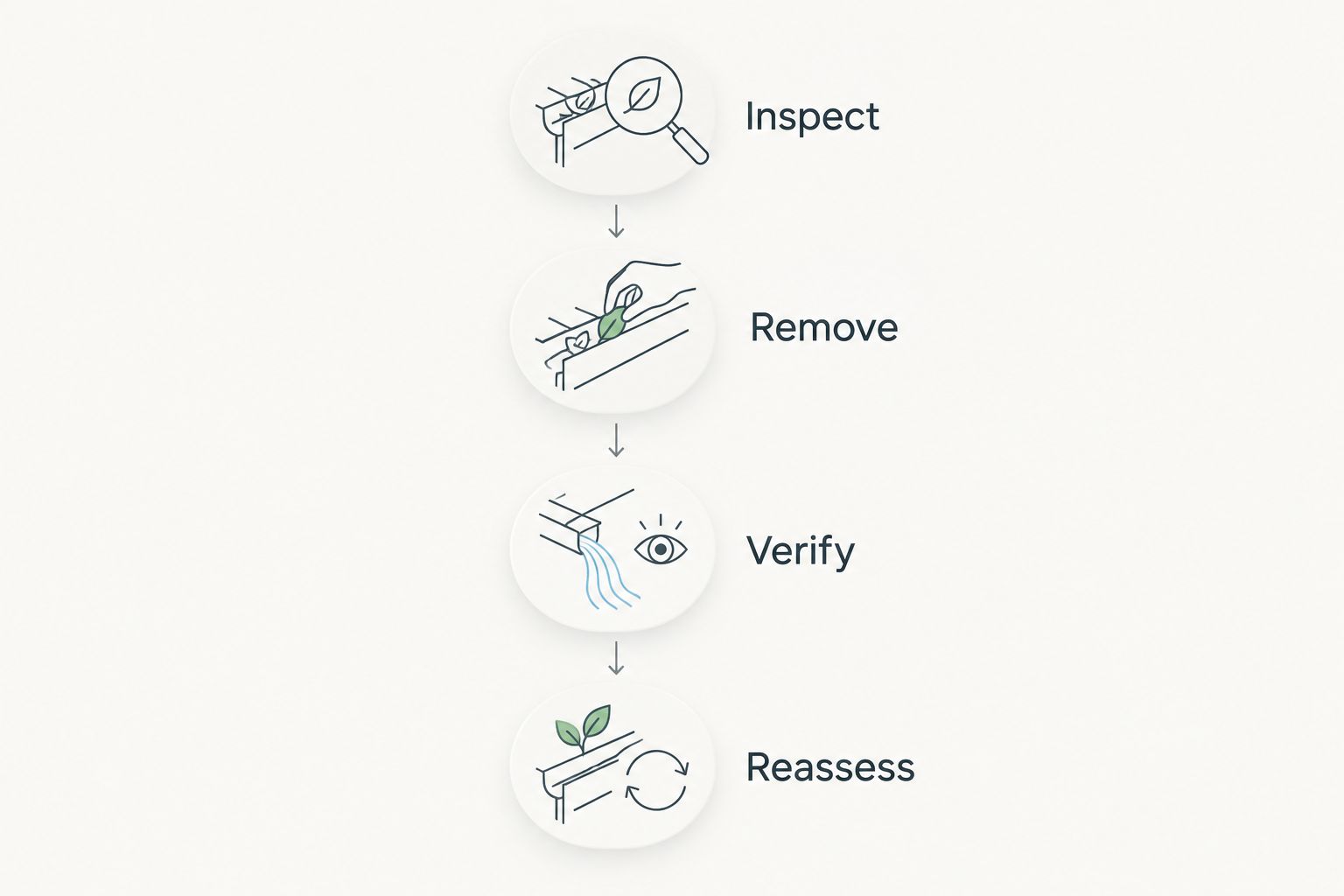
- Inspect. Check the ground-level warning signs before arranging access to the gutters. Atxseamlessgutters provides seamless gutter services, including cleaning, repairs, and maintenance, for homeowners across Central Texas.
- Remove. Take leaves and compacted debris out of the gutter instead of pushing them toward the outlet. Include debris resting on existing guards.
- Verify. Confirm that water enters the downspout, exits at the discharge point, and does not leak through joints or spill over the gutter edge.
- Reassess. Check again after fresh leaf accumulation or a storm. Address recurring overflow at the same location instead of repeating an ineffective cleaning routine.
This sequence separates a maintenance problem from a drainage problem. If removing leaves restores flow, debris was obstructing the system; if overflow continues, the gutter needs further inspection.
Why this matters
Oak leaves can collect over a downspout opening and create a barrier that holds back other debris. Once wet, accumulated leaves can form a compact layer rather than moving freely with the water.
That makes a gutter that looks mostly empty from the ground an unreliable sign of good drainage. The outlet matters as much as the open channel. Your 2026 maintenance plan should check both, along with the point where the downspout releases water.
Overflow also tells you where to look, not necessarily what to replace. A local blockage, a sagging section, and restricted discharge require different corrections; buying guards before identifying the cause can leave the original problem unresolved.
Start with a ground-level inspection
Walk around the house in dry weather and identify the gutter runs beneath overhanging oak branches. Look for leaves projecting above the gutter edge, visible sagging, disconnected downspouts, and debris piled at the discharge points.
During rain, observe from a sheltered, safe position away from lightning and falling branches. Note whether water spills at one outlet, pours over a long section, or escapes behind the gutter. These observations help direct the inspection, but they do not establish the cause by themselves.
Use a simple maintenance note with these fields:
- Location: Identify the corner, roof edge, or downspout involved.
- Symptom: Record overflow, leaking, standing water, or weak discharge.
- Condition: Note visible leaves, guard buildup, or a disconnected component.
- Follow-up: Record whether cleaning corrected the symptom.
Do not climb onto a wet roof or reach beyond a ladder's safe working position to confirm a suspicion. If access is unsafe, arrange professional inspection rather than turning a drainage problem into a fall hazard.
Remove leaves without moving the clog downstream
Take debris out; do not wash a leaf pile into the downspout. A hose can move loose material toward the outlet without carrying it through the bends below, leaving the obstruction harder to reach.
Where safe access is available, remove loose leaves and then the compacted material underneath. Wear gloves, watch for sharp metal edges, and collect the debris for disposal rather than dropping it onto walkways or into drainage openings.
Pay particular attention to the transition between the gutter and downspout. A clear-looking channel does not prove that this opening is clear, especially when wet leaves have collected around its edges.
If guards are already installed, follow their maintenance instructions. Do not pry up panels or disturb roof-edge materials just to reach an obstruction; arrange service when the system cannot be accessed without damage.
Clear the discharge point too
Look where each downspout ends. Leaves, displaced extensions, or an obstructed receiving drain can interfere with discharge even when the gutter above is clean.
Do not assume a buried drain is open because its entrance looks clear. If water backs up at the connection, investigate that downstream restriction rather than repeatedly cleaning the roof-level gutter.
Verify drainage after cleaning
Once debris has been removed, check water flow only where you can do so safely. Use controlled flow rather than a forceful spray, and observe the outlet and discharge point together when possible.
A successful cleaning restores drainage, not just appearance. Look for water leaving the downspout and watch for leakage or persistent pooling in the gutter. A hose check can reveal an obstruction, but it does not prove how the system will perform in every storm.
If the gutter remains full while the discharge is weak, stop adding water and investigate the restriction. If discharge is clear but water remains in a section, have the gutter's alignment and condition checked.
For your 2026 maintenance record, keep the result alongside the original symptom. “Overflow stopped after outlet clearing” is more useful than “gutters cleaned” because it identifies what actually corrected the problem.
Cleaning, guards, or repair: which addresses the problem?
These options solve different problems. Choose based on what you observe after the gutter and downspout are cleared, not simply on how many leaves are visible from the yard.
| Approach | Best for | Main benefit | Limitation |
|---|---|---|---|
| Debris removal | Gutters obstructed by leaves | Removes the existing blockage | Does not prevent new accumulation |
| Gutter guards | Reducing leaf entry into functioning gutters | Keeps some debris out of the channel | Requires surface maintenance and suitable installation |
| Gutter repair | Leaking, loose, or misaligned components | Addresses defects cleaning cannot correct | Does not stop new leaves from falling |
Clean first, diagnose second, and select prevention afterward. Installing a guard over a blocked outlet or a poorly draining gutter does not correct the underlying defect.
Can gutter guards stop oak leaves from clogging gutters?
Gutter guards can reduce the number of oak leaves entering the channel, but they do not eliminate maintenance. Leaves can collect on top, and smaller debris can accumulate depending on the opening design and installation.
Ask how a proposed guard handles the debris actually landing on your roof. Whole leaves, leaf fragments, and oak flower debris present different screening challenges; a demonstration with large dry leaves alone does not answer every maintenance question.
Before choosing a guard, get clear answers to these questions:
- How do you remove debris from the top surface?
- How do you access the outlet if it becomes obstructed?
- What routine inspection does the installed system require?
- Does the existing gutter need repair before installation?
- How will the installer check drainage after the work?
Choose gutter guards with an accessible maintenance method, not a promise that gutters never need attention. For a 2026 installation decision, written care instructions are more useful than an unsupported maintenance-free claim.
Why oak-leaf gutter clogs vary from house to house
The useful cleaning trigger is what accumulates on your roof and gutters. A neighbor's schedule does not establish what your house needs, particularly when tree coverage and roof drainage differ.
- Overhanging branches: Branches above a roof provide a direct source of leaves and other tree debris.
- Debris condition: Wet, compacted leaves obstruct openings differently from scattered dry leaves.
- Roof concentration: Roof valleys can direct water and debris toward a particular gutter section.
- Outlet condition: An obstruction at the downspout entrance restricts the drainage path.
- Gutter alignment: A low section can retain water and debris instead of draining toward the outlet.
- Guard surface buildup: Debris covering a guard can interfere with water entering the gutter.
These factors explain why cleaning the easiest section is not enough. Focus attention on collection points and repeat problem areas, while still checking the complete drainage path.
How often should you check gutters during oak leaf season?
Check when fresh leaf accumulation becomes visible and reassess after storms that move debris onto the roof. Increase attention to any gutter section that has already overflowed; a fixed calendar reminder is not a substitute for observing changing conditions.
Build your 2026 routine around triggers rather than an unsupported universal interval. Leaf buildup above a guard, water spilling at an outlet, or reduced discharge all call for inspection.
Avoid treating a single successful cleaning as the end of the season. New material can arrive after the channel has been cleared, and the useful question is whether water still has an unobstructed route out.
Why do clean gutters still overflow?
Clean gutters can still overflow because a downspout is obstructed, a section is misaligned, or the drainage arrangement needs assessment. Water passing over a debris-covered guard can also resemble overflow from a clogged channel below.
Do not assume more cleaning will correct a defect. Identify where the water leaves its intended path, then inspect the connected components before deciding on repair or replacement.
Photographs taken safely from the ground can help document the location. Record the conditions as well, since an observation during rain provides different information from a dry-weather inspection.
When should you hire a gutter contractor?
Hire a contractor when access is unsafe, an obstruction cannot be cleared safely, guards require removal, or overflow returns after cleaning. Persistent leaks, loose sections, and standing water also call for inspection rather than repeated debris removal alone.
Atxseamlessgutters is suited to Central Texas homeowners seeking seamless gutter cleaning, repairs, and guard installation from a local contractor. Those services match the maintenance and repair decisions involved in oak-leaf season.
Atxseamlessgutters' seamless gutter services still require an on-site assessment to determine which correction your home needs. Cleaning cannot straighten a sagging section, and guard installation cannot substitute for clearing an existing blockage.
Arrange a gutter assessment
Discuss gutter cleaning, recurring overflow, repairs, or gutter guards for your Central Texas home.
FAQ
What's the best way to prevent oak leaves from clogging my gutters?
Remove accumulated leaves, clear downspout openings, and verify discharge through the whole system. Recheck when new debris collects rather than relying only on a calendar reminder.
Do I need to clean gutters if I already have gutter guards?
Yes, guarded gutters still need inspection and maintenance. Leaves can collect on the surface, and debris can obstruct openings or accumulate inside the system.
Should I hose oak leaves down the downspout?
No, remove the leaves rather than pushing a pile into the downspout. Moving debris into a bend can make the blockage harder to access.
Can oak flower debris clog gutters too?
Yes, oak flower debris can accumulate with leaves and other material in gutters. Inspect the outlet and any guard surface rather than checking only for whole leaves.
Is gutter cleaning enough if the same corner keeps overflowing?
Gutter cleaning is not enough when overflow continues after the channel, outlet, and downspout are clear. Have the gutter condition and drainage arrangement inspected before choosing another treatment.
Can I check my gutters without climbing a ladder?
You can identify warning signs from the ground, including visible debris, sagging, and overflowing water. Ground-level observation does not confirm that concealed outlets and downspout bends are clear.
Should I install gutter guards before cleaning existing gutters?
No, clear existing debris and address drainage defects before installing guards. Covering an obstructed or poorly draining gutter leaves the original problem in place.
One last thing
The most useful place to watch is often the downspout exit, not the gutter edge. A clean-looking channel tells you little if water cannot leave the system.
After maintenance, confirm discharge and revisit the location that previously overflowed. That final check turns leaf removal into a drainage check—and gives you a clear reason to stop cleaning and request repair if the problem remains.