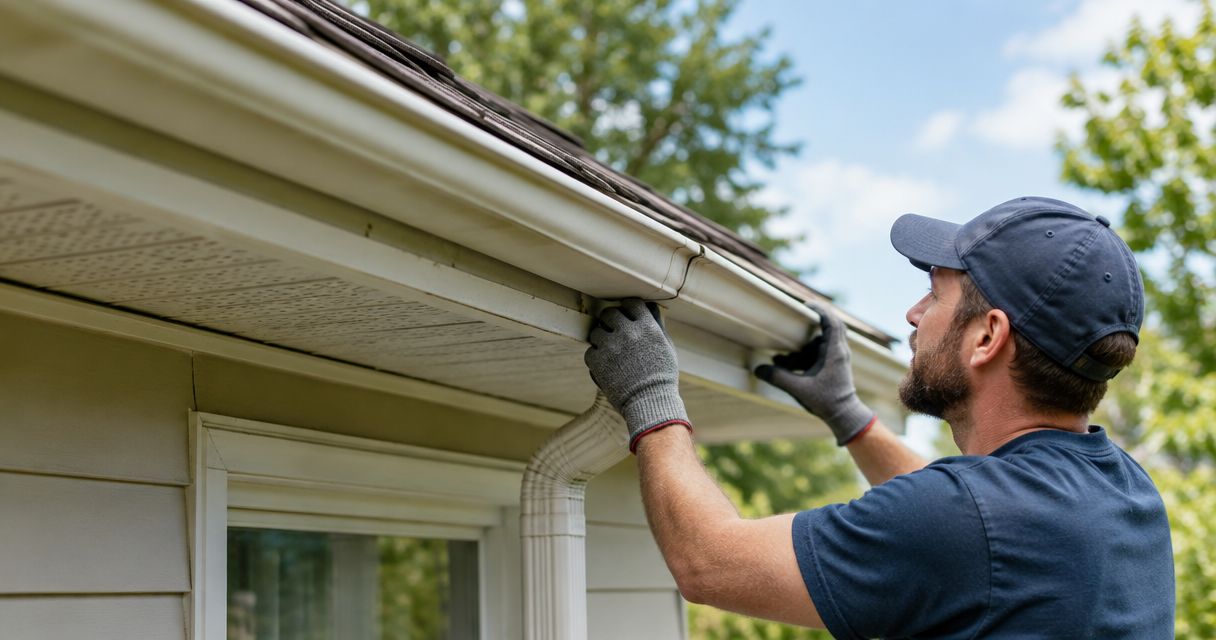
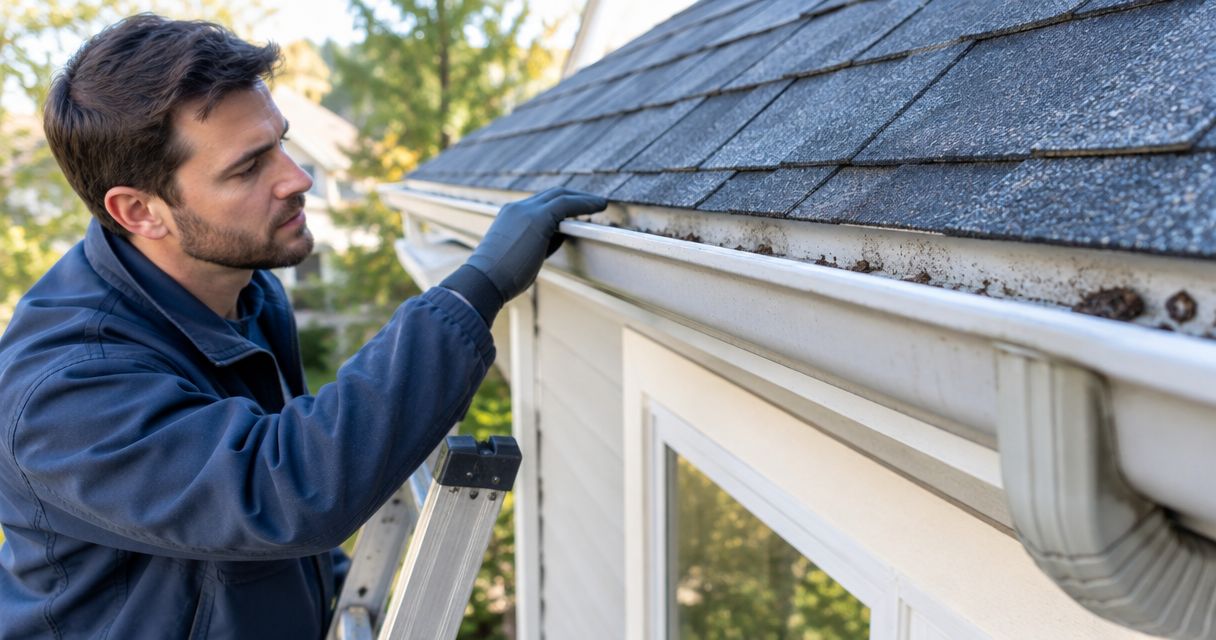
The clearest signs gutters need replacing are widespread holes or splits, badly distorted sections, and repeated leaks that persist after appropriate repairs. Overflow, loose hangers, or a leaking joint alone do not prove you need new gutters; check for blockages, attachment problems, and poor drainage before choosing replacement.
- Signs gutters need replacing include widespread splits, perforation, and distorted channels that no longer drain properly.
- Overflow alone is not a replacement verdict; blocked gutters and downspouts need attention first.
- Repair isolated defects when the surrounding gutter and attachment surface remain sound.
- ATX Gutters provides gutter installation, repair, cleaning, and maintenance for Central Texas homeowners.
How can you tell if your gutters need replacing?
Replace gutters when the channel itself has failed beyond a practical localized repair—not simply because water spills over an edge. Your 2026 inspection should distinguish damaged material from a maintenance or installation problem.
Use this comparison to organize the next step. ATX Gutters handles gutter installation, repairs, cleaning, and maintenance for homeowners across Central Texas.
| Next step | Best for | What supports this choice | Benefit | Limitation |
|---|---|---|---|---|
| Clean | Debris restricting an otherwise sound system | Leaves, sediment, or a blocked outlet interrupt water flow | Addresses the obstruction without replacing sound material | Does not fix holes, distortion, or failed attachments |
| Repair | Isolated defects in a sound gutter run | A leaking joint, loose hanger, or localized alignment problem | Preserves usable sections | Does not correct widespread material failure |
| Replace | Failed gutter channels or extensively damaged runs | Numerous holes, major splits, or distortion that prevents drainage | Removes the failed sections | Will not fix rotten fascia or an unsuitable discharge route by itself |
A home can need more than one approach. Replace a failed run while retaining a sound one, or repair an attachment problem and clear a blocked downspout during the same visit.
Why this matters
The wrong diagnosis leaves the original problem in place. New gutters attached to deteriorated fascia still have an attachment problem; repaired gutters connected to an obstructed downspout still have a drainage problem.
For your 2026 maintenance plan, focus on where water enters, where it escapes, and where it finally discharges. A stain below the roofline identifies a place to investigate, not the repair to authorize.
Ask for the cause of the failure before agreeing to the scope of the work. That keeps a cleaning issue from becoming an unnecessary replacement and prevents repeated patching of failed material.
Check the gutter channel for actual material failure
Holes and splits across multiple sections
Look for openings through the gutter bottom and sides, not just a drip at a connection. Widespread perforation or splitting supports replacement because sealing one opening leaves the other failed areas in service.
An isolated opening needs a different assessment. Its location, the condition of the surrounding material, and whether previous repairs have held determine whether a localized repair makes sense.
Surface discoloration is not the same as a hole. Ask the contractor to show where water passes through the channel rather than treating every visible mark as evidence of failure.
Distortion that prevents drainage
A crushed, twisted, or deeply deformed gutter can interrupt the path to the outlet. Replacement of the affected run becomes relevant when the channel cannot be restored to a serviceable shape.
Sagging requires a closer diagnosis. Loose hangers, a poorly supported section, or damaged fascia can cause sagging even when the gutter material remains usable.
Repeated leakage after appropriate repairs
Recurring leaks deserve investigation, especially when previous work addressed the same location. The useful question is whether the repair failed or whether the surrounding gutter has deteriorated.
Repeated sealant application is not proof that the entire system needs replacing. Ask whether the joint moves, whether water stands there, and whether the adjacent material can still support a lasting repair.
Check drainage before condemning the gutters
Overflow looks dramatic, but it does not identify the cause. A blocked outlet, accumulated debris, incorrect alignment, or an unsuitable gutter layout can each interrupt drainage.
Watch from a sheltered ground-level location during rain when conditions are safe. Note whether water spills at a corner, along an entire edge, behind the gutter, or directly above a downspout.
- Overflow near an outlet: Have the outlet and connected downspout checked for obstruction.
- Overflow along a run: Check debris, alignment, and whether the layout handles the roof runoff reaching it.
- Water behind the gutter: Have the roof-edge detail and gutter placement inspected together.
- Water collecting at the discharge: Check the downstream drainage route rather than assuming the gutter channel has failed.
For a 2026 inspection, record these locations with ground-level photos. A description such as overflow above the rear downspout gives a contractor more useful information than gutters leaking everywhere.
How to inspect your gutters without climbing onto the roof
Use this sequence to gather observations, not to perform a ladder inspection. Stay away from loose sections, electrical lines, and areas where falling debris presents a hazard.
- Walk the perimeter. From the ground, look for hanging sections, obvious gaps, disconnected downspouts, and visible channel distortion.
- Record the symptoms. Photograph stains, washed-out soil, and the locations of visible leaks. Separate what you see from what you think caused it.
- Check the discharge. Identify where each visible downspout releases water and whether the outlet appears obstructed or disconnected.
- Observe safe rainfall. From shelter, note where water escapes. Do not climb a ladder during rain or a storm.
- Request a diagnosis. Ask which defects need cleaning, which need repair, and which require replacement, with the reason for each recommendation.
Do not pull on a sagging gutter to test its strength. The attachment or fascia can fail, and a ground-level view cannot establish whether either is sound.
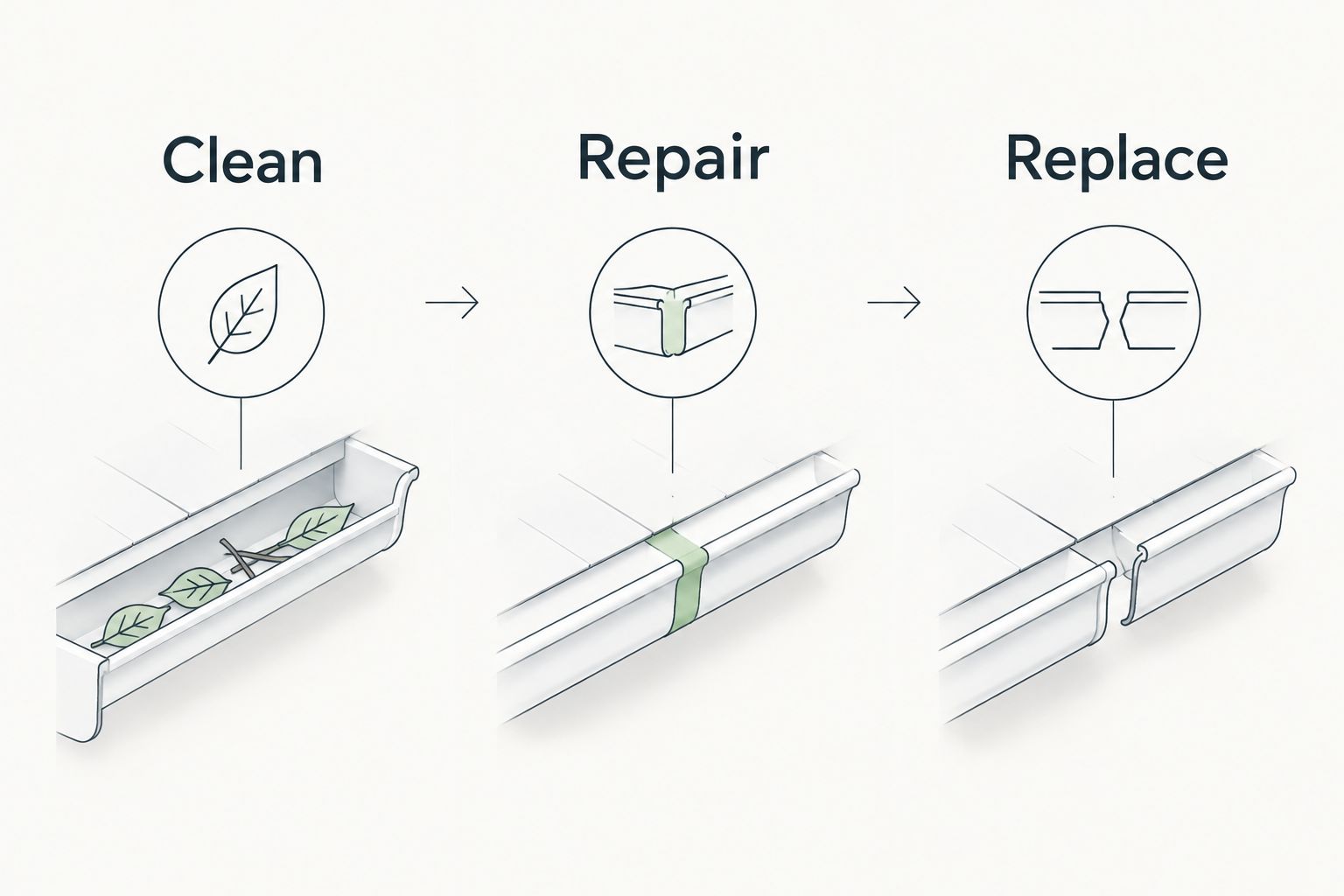
Choose cleaning, repair, or replacement by the defect
The decision is not a contest between newer and older gutters. It is a check of whether the existing channel, supports, and drainage route can do their jobs after the proposed work.
Clean
Best for: Restricted flow caused by debris in an otherwise serviceable system. Cleaning removes the obstruction and allows the remaining condition to be assessed.
Its limit is structural: clearing leaves does not restore split metal, straighten a crushed channel, or repair an unsound attachment surface. Recheck drainage after cleaning rather than assuming the visible overflow was the only issue.
Repair
Best for: A defined, localized defect with sound material around it. Repair can address a connection, hanger, or alignment problem without discarding a usable run.
Its limit is scope: isolated repairs do not renew deteriorated material elsewhere. The guide to whether old gutters can be repaired instead of replaced covers that decision in more detail.
Replace
Best for: Gutter runs with widespread material failure or deformation that cannot be corrected into a serviceable channel. Replacement removes that failed material rather than adding another patch.
Its limit is that gutters are only part of the drainage system. Include necessary fascia, roof-edge, attachment, and discharge corrections in the discussion rather than assuming new channels resolve everything.
Why gutter replacement recommendations vary
A sound 2026 recommendation accounts for the whole affected run. These factors explain why similar-looking symptoms lead to different scopes:
- Extent of damage: An isolated defect and deterioration throughout a run are different repair problems.
- Material condition: Sound material around a leak supports a different decision from cracked or perforated surroundings.
- Attachment condition: Loose supports and deteriorated fascia require separate attention from the gutter channel.
- Drainage layout: Outlet locations, downspout condition, and channel alignment affect where water collects or escapes.
- Repair history: A recurring symptom calls for checking why earlier work did not resolve it.
- Roof-edge water entry: Water passing behind a gutter requires inspection of how runoff reaches the channel.
Ask the contractor to identify these conditions on your home. A replacement recommendation should connect a visible defect to a specific correction, not rely on age or appearance alone.
Can old gutters be repaired instead of replaced?
Old gutters can be repaired when the defect is localized and the surrounding material remains sound. Age provides context, but it does not show whether a channel is perforated, distorted, or still serviceable.
For your 2026 decision, ask what makes the proposed repair suitable. The answer should address the channel, its supports, and the cause of the leak—not just the presence of sealant.
Does overflowing mean gutters need replacing?
Overflowing gutters do not automatically need replacing. Clear obstructions and inspect alignment, outlets, and downspouts before deciding that the gutter channel has failed.
If overflow continues after those issues are addressed, ask for an assessment of the gutter layout and the roof runoff reaching it. Another cleaning will not correct a layout problem.
Do gutter guards fix gutters that need replacing?
Gutter guards do not repair holes, restore distorted channels, or secure failed attachments. Inspect and correct the underlying gutter system before considering guards.
Guards address debris entry, not every cause of water escape. They also do not eliminate the need to inspect the gutter and outlet beneath them.
What should a replacement recommendation explain?
Request a scope that separates necessary corrections from optional additions. You should understand what remains, what comes off, and which underlying problems need attention before installation.
A useful scope answers these questions:
- Which gutter runs have failed, and what shows that failure?
- Which existing sections remain serviceable?
- Does the fascia or roof edge need separate work?
- Will the outlet locations or downspout routes change?
- How will drainage be checked after the work?
ATX Gutters serves Central Texas homeowners who need gutter installation, repair, cleaning, or maintenance. Describe the symptoms when requesting an assessment, and ask for the reason behind each recommended action.
Request a gutter assessment
Discuss the leaks, sagging, or overflow you see and the gutter work your home needs.
FAQ
What are the strongest signs gutters need replacing?
The strongest signs gutters need replacing are widespread holes or splits and badly distorted channels that cannot be restored to serviceable condition. A localized leak or overflow requires a diagnosis before replacement is justified.
Do sagging gutters always need replacing?
Sagging gutters do not always need replacing. Loose hangers or damaged fascia can cause sagging even when the channel remains usable, so inspect the attachments and supporting surface.
Can I replace just one damaged gutter section?
Replacement can be limited to an affected section or run when the remaining system is serviceable and the connection details allow it. Ask how the new work will connect and drain with what remains.
Does peeling paint below my gutters prove they have failed?
Peeling paint below gutters does not prove the gutter channel has failed. Inspect for overflow, leaking connections, and water passing behind the gutter before choosing a repair.
Should I replace gutters based only on their age?
Do not replace gutters based only on age. Material condition, drainage performance, attachment condition, and repair history provide the evidence needed for the decision.
Will new gutters fix water collecting beside my house?
New gutters alone will not fix every cause of water collecting beside a house. Check downspout discharge and the downstream drainage route as well as the gutter channels.
What should I ask a gutter contractor before approving replacement?
Ask the contractor to identify the failed material, explain why repair is unsuitable, and describe any attachment or drainage corrections. The scope should distinguish replacement work from cleaning and localized repairs.
One last thing
A sound-looking gutter can still send water to the wrong place. Before closing out a repair or replacement, ask how water travels from the roof edge through the downspout to its discharge point.
Keep your 2026 inspection photos alongside the work scope. They give you a record of the original symptoms and a reference when checking whether those same problems return.