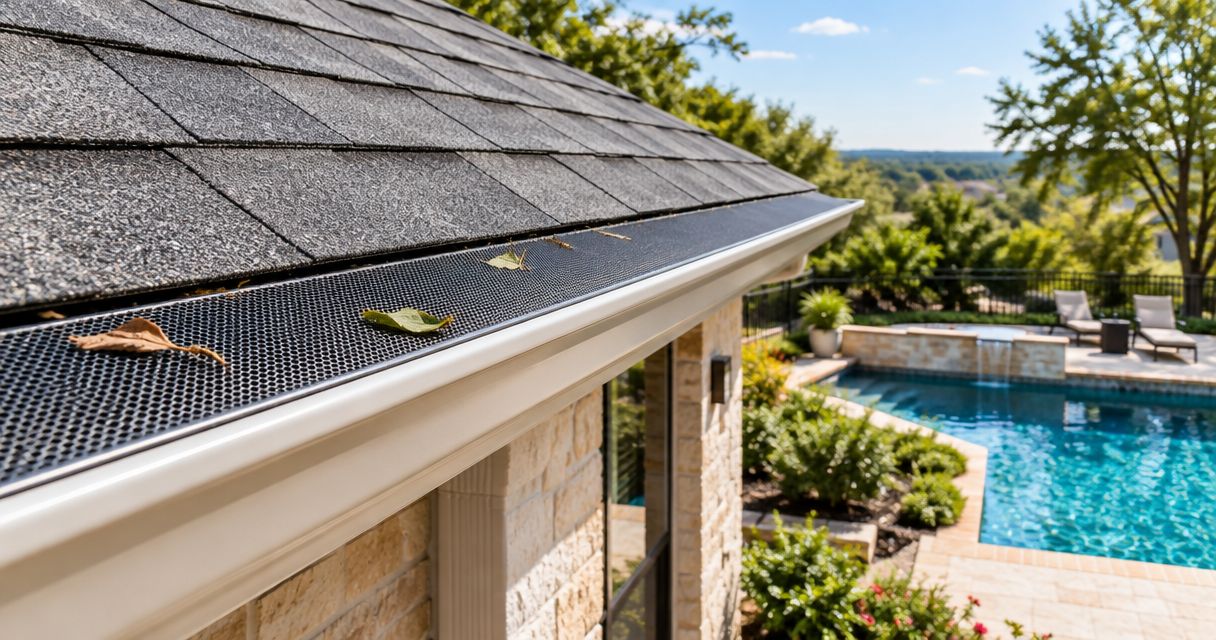

Seamless gutter installation is worth the extra cost when you need replacement gutters and want fewer joints along the roofline—not when a sound system needs a minor repair. The installation premium does not eliminate cleaning, corner connections, downspout maintenance, or repairs to damaged fascia. For a 2026 decision, compare complete drainage plans rather than treating the word seamless as proof of better performance.
- Is seamless gutter worth it? Yes for replacement projects where fewer gutter joints address an actual maintenance concern.
- ATX Gutters installs seamless gutters for Central Texas homeowners; compare the proposed drainage layout before committing.
- Seamless gutters still need cleaning, sound attachments, sealed corners, and clear downspouts.
- Repair sound existing gutters when an isolated defect—not widespread deterioration—is the problem.
Why this matters
Your gutters must collect roof runoff and send it to a suitable discharge point. Removing joints helps with one part of that job; it does not correct poor placement, inadequate drainage capacity, or an outlet that dumps water beside the house.
ATX Gutters installs, repairs, cleans, and maintains seamless gutters and gutter guards for homeowners across Central Texas. Those are different jobs, and choosing the right job matters more than automatically replacing everything.
Before signing a 2026 installation proposal, identify what your existing system does wrong. A leaking connection, a blocked outlet, and a sagging gutter require different responses. A useful recommendation connects the proposed work to the observed problem.
Is seamless gutter installation worth the extra cost in 2026?
Yes, when replacement is justified and fewer joints are a meaningful benefit for your roofline. Seamless gutters use continuous lengths along individual runs, reducing the connections found between sectional gutter pieces. Corners, outlets, and end caps still create connection points.
The distinction is fewer joints, not no joints. That reduces the number of locations where connecting separate gutter sections requires sealing, but it does not establish a guaranteed service life or a maintenance-free system.
| Approach | Best for | Main advantage | Main limitation |
|---|---|---|---|
| Seamless installation | Homeowners replacing deteriorated gutters | Fewer joints along straight gutter runs | Requires proper fitting, support, outlets, and ongoing maintenance |
| Sectional installation | Projects where assembling separate gutter lengths suits the work | Individual sections can be assembled or replaced | More connections along the gutter run require attention |
| Targeted repair | Homeowners with otherwise sound existing gutters | Addresses a localized defect without full replacement | Does not correct deterioration elsewhere or an unsuitable overall layout |
For your 2026 comparison, hold the installation scope constant. Compare the same roof edges, material, gutter profile, downspout arrangement, removal work, and discharge plan. Otherwise, you are comparing different projects—not just seamless versus sectional construction.
Seamless installation: best for a justified replacement
Seamless installation makes the strongest case when the existing system already needs replacement. You can address the gutter runs, attachments, outlets, and discharge layout together rather than reproducing an arrangement that never worked properly.
The practical advantage is straightforward: a continuous run removes intermediate section joints. The cleaner appearance is another reason to choose it, but appearance alone does not establish drainage performance.
The limitation is that a long, continuous gutter still depends on its installation. Poor alignment, insufficient support, or an obstructed outlet can cause trouble regardless of how few seams it has. Damage to a continuous run can also require work beyond replacing a short sectional piece.
Choose seamless replacement when the existing gutters need replacement and the proposal fixes the drainage problem. Do not accept fewer seams as a substitute for an explanation of how water will leave the roof and move away from the house.
Targeted repair: best for sound gutters with a local defect
A leaking joint does not automatically justify replacing every gutter. If the surrounding material and attachments remain sound, resealing a connection or correcting a localized attachment problem can address the defect without changing the entire system.
Repair has limits. Repeated patching does not restore extensively deteriorated material, and sealing a joint does not solve overflow caused by a blocked downspout. The diagnosis must come before the repair recommendation.
Ask the contractor to identify both the visible symptom and its cause. Water dripping from a joint is evidence of a leak, but it does not tell you whether the problem is failed sealant, movement, standing water, or damaged material.
Choose targeted repair when the defect is isolated and the rest of the drainage system remains suitable. If the recommendation is full replacement, ask which additional conditions make repair inadequate.
Why the value of seamless gutters varies
The same installation choice does not deliver the same benefit on every house. For a 2026 project, these conditions determine whether the change addresses your actual needs:
- Existing condition: Sound gutters with an isolated defect present a different decision from gutters with widespread damage.
- Roof layout: Valleys and intersecting roof planes concentrate runoff at particular locations. The collection layout must account for those locations.
- Gutter material: Material affects corrosion behavior, expansion, appearance, and repair methods. Seamless construction does not erase those differences.
- Support condition: Fascia and gutter attachments must provide a sound base. New gutters cannot make deteriorated backing sound.
- Outlet placement: Water needs a clear route through the gutter, downspout, and discharge point. Fewer seams do not compensate for a poor route.
- Debris exposure: Leaves and other debris can obstruct gutters and outlets. Seamless construction does not prevent buildup.
These factors explain why a recommendation should be specific to your house. A proposal that discusses only gutter length leaves out the conditions that determine whether the system will work as intended.
Check the whole drainage path before choosing
Inspect from the ground and ask the installer to document elevated areas. Do not climb onto the roof or place yourself beneath damaged guttering to investigate a leak.
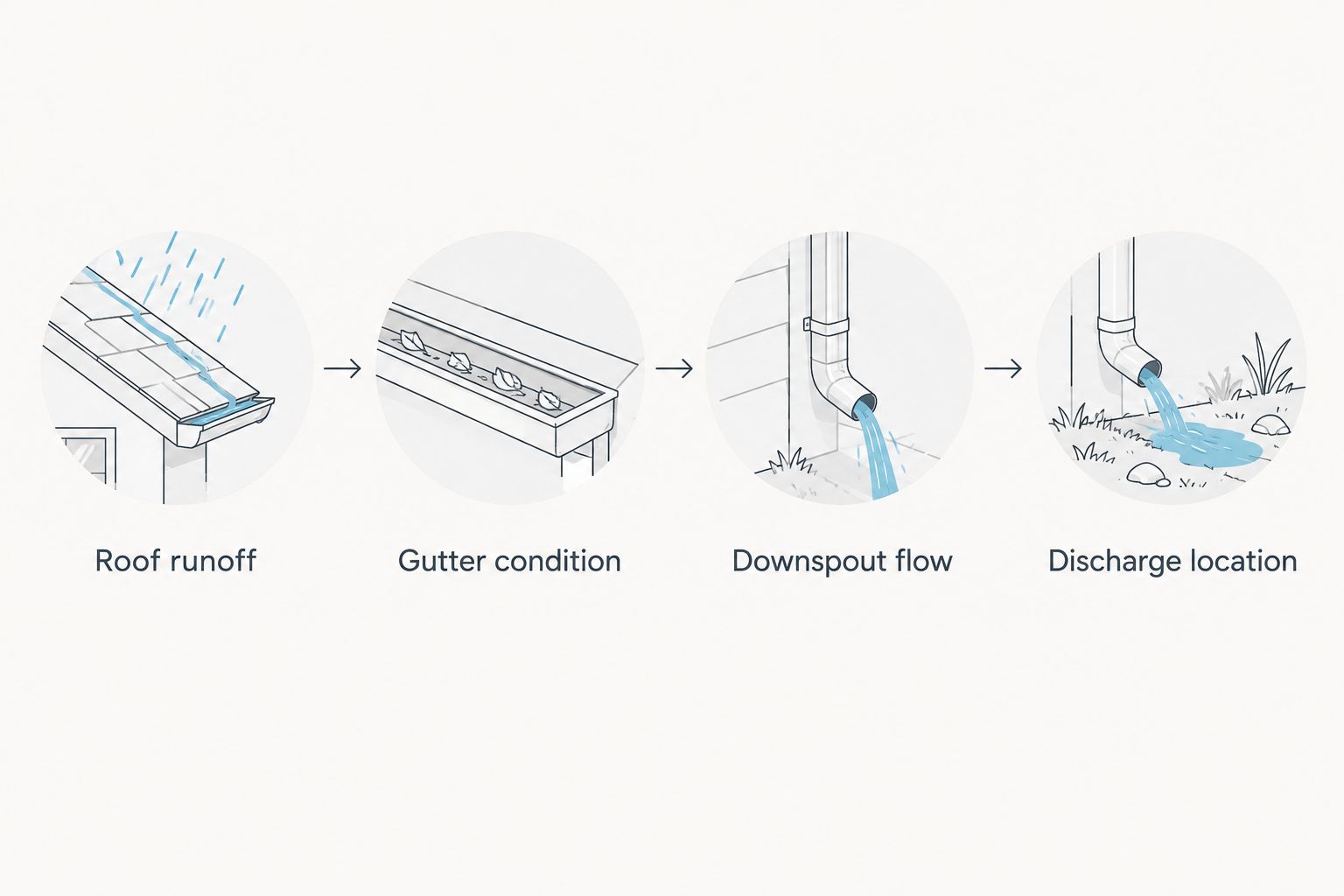
Use this sequence to separate a construction upgrade from a drainage correction:
- Roof runoff: Identify where roof planes deliver water, especially at valleys and concentrated discharge areas.
- Gutter condition: Look for visible sagging, separated connections, damaged material, and signs of overflow.
- Downspout flow: Have the contractor check outlets, downspout connections, and obstructions rather than inspecting the gutter trough alone.
- Discharge location: Confirm where water goes after leaving each downspout and whether the proposed work changes that destination.
A gutter is only part of this path. If the proposal replaces the trough but leaves an unsuitable discharge arrangement unchanged, the work does not address the complete drainage problem.
What should a seamless gutter proposal explain?
A useful 2026 proposal tells you what will change and why. It should distinguish new gutter installation from any related repair, removal, cleaning, or guard work so you can compare equivalent scopes.
Ask for clear answers to these questions:
- Which roof edges receive gutters, and which remain unchanged?
- What material and profile does the proposal specify?
- Where will the outlets and downspouts sit?
- How will the gutters attach, and what happens if damaged fascia is found?
- Where will each downspout discharge?
- What existing components will remain?
- How will you access the system for future cleaning and repairs?
Do not assume a gutter installation includes underground drainage, fascia replacement, or gutter guards. Confirm each item in writing. If separate work is necessary, understand its role before approving the gutter installation.
Compare the proposed result, not just the label on the proposal. A sectional and a seamless option are only comparable when both address the same collection and discharge needs.
What seamless gutters do not fix
Seamless gutters are not maintenance-free. Debris can accumulate in the trough, outlets can clog, and connections at corners or downspouts can leak. The system still needs inspection and cleaning appropriate to its condition and surroundings.
Seamless construction also does not make a gutter immune to deformation or attachment failure. If the gutter pulls away from its support, reducing intermediate joints will not solve the underlying problem.
Gutter guards are a separate decision. Their purpose is to limit debris entry, not to replace correct gutter installation or eliminate inspection. Ask how any proposed guard affects cleaning access and how debris will be removed from the surrounding roof edge.
Finally, gutters do not replace grading or other drainage work when those conditions need attention. A downspout that directs water toward the house remains a problem even when the gutter above it has no intermediate seams.
Do seamless gutters save money over time?
Seamless gutters do not carry a guaranteed payback. Fewer joints mean fewer intermediate connections to maintain, but your eventual repair needs depend on material, installation, debris, damage, and upkeep.
Do not treat an unsupported lifespan or repair-savings claim as a financial calculation. Ask what maintenance the proposed system still requires and which existing problems the installation will actually eliminate.
Are seamless gutters better for every Austin home?
Seamless gutters are not automatically the right project for every Austin home. Replacement can make sense when the existing system has widespread problems; a sound system with an isolated defect deserves a repair assessment first.
ATX Gutters is a fit for Central Texas homeowners seeking seamless gutter installation, repair, cleaning, or maintenance. The service choice still depends on the condition of your gutters and the drainage corrections your house needs.
Discuss your gutter project
Ask about installation, repair, cleaning, or maintenance for your Central Texas home.
FAQ
Is seamless gutter worth it if my current gutters only leak at one joint?
A single leaking joint does not automatically justify seamless replacement. Have the connection, surrounding material, attachments, and drainage checked before choosing between a localized repair and replacement.
Do seamless gutters have any seams at all?
Seamless gutters still have connections at features such as corners, end caps, and outlets. The benefit is eliminating intermediate joints along individual continuous gutter runs, not eliminating every potential leak point.
Will seamless gutters stop my gutters from overflowing?
Seamless construction alone does not stop overflow. The contractor must identify whether the cause is debris, outlet restrictions, gutter alignment, capacity, or the way roof runoff enters the system.
Can I keep my existing downspouts with new seamless gutters?
Existing downspouts need an assessment before reuse. Their condition, connections, placement, and suitability for the proposed gutter layout determine whether keeping them makes sense.
Do I still need to clean seamless gutters?
Seamless gutters still need cleaning and inspection. Leaves and other debris can obstruct the trough or outlets regardless of whether the gutter run contains intermediate joints.
Should I install gutter guards at the same time as seamless gutters?
Gutter guards should be a separate decision based on debris conditions and maintenance access. Ask how the proposed guard works with the gutter and how you will clean or inspect the system afterward.
Does ATX Gutters handle repairs as well as seamless installation?
ATX Gutters installs, repairs, cleans, and maintains seamless gutters and gutter guards for homeowners across Central Texas. Match the requested service to the condition of your existing system rather than assuming replacement is necessary.
One last thing
Before approving your 2026 installation, ask the contractor to show you where water will leave every downspout. That question shifts the discussion from how the gutters look to what the system actually does.
Fewer seams are a useful construction benefit; a complete water path is the requirement. If your proposal clearly addresses both, seamless installation has a defensible purpose. If it addresses neither the existing defect nor the discharge destination, ask for a revised plan before committing.